




























Views
Downloads


Printable 3-Digit Addition and Subtraction | Grade 2 Math

Paste this activity's link or code into your existing LMS (Google Classroom, Canvas, Teams, Schoology, Moodle, etc.).
Students can open and work on the activity right away, with no student login required.
You'll still be able to track student progress and results from your teacher account.
Mastering Multi-Digit Operations
This Grade 2 math worksheet empowers students to master three-digit addition and subtraction with regrouping. By bridging the gap between expanded form and standard algorithms, learners develop a deep conceptual understanding of place value. Students gain the confidence needed to solve complex multi-digit problems accurately in any classroom or home learning environment.
At a Glance
At a Glance
- Grade: 2 · Subject: Math
- Standard:
2.NBT.B.7— Add and subtract within 1000 using strategies based on place value- Skill Focus: 3-digit addition and subtraction with regrouping
- Format: 4 pages · 13 problems · Answer key included · PDF
- Best For: Independent place value and regrouping practice
- Time: 25–35 minutes
Comprehensive Practice Components
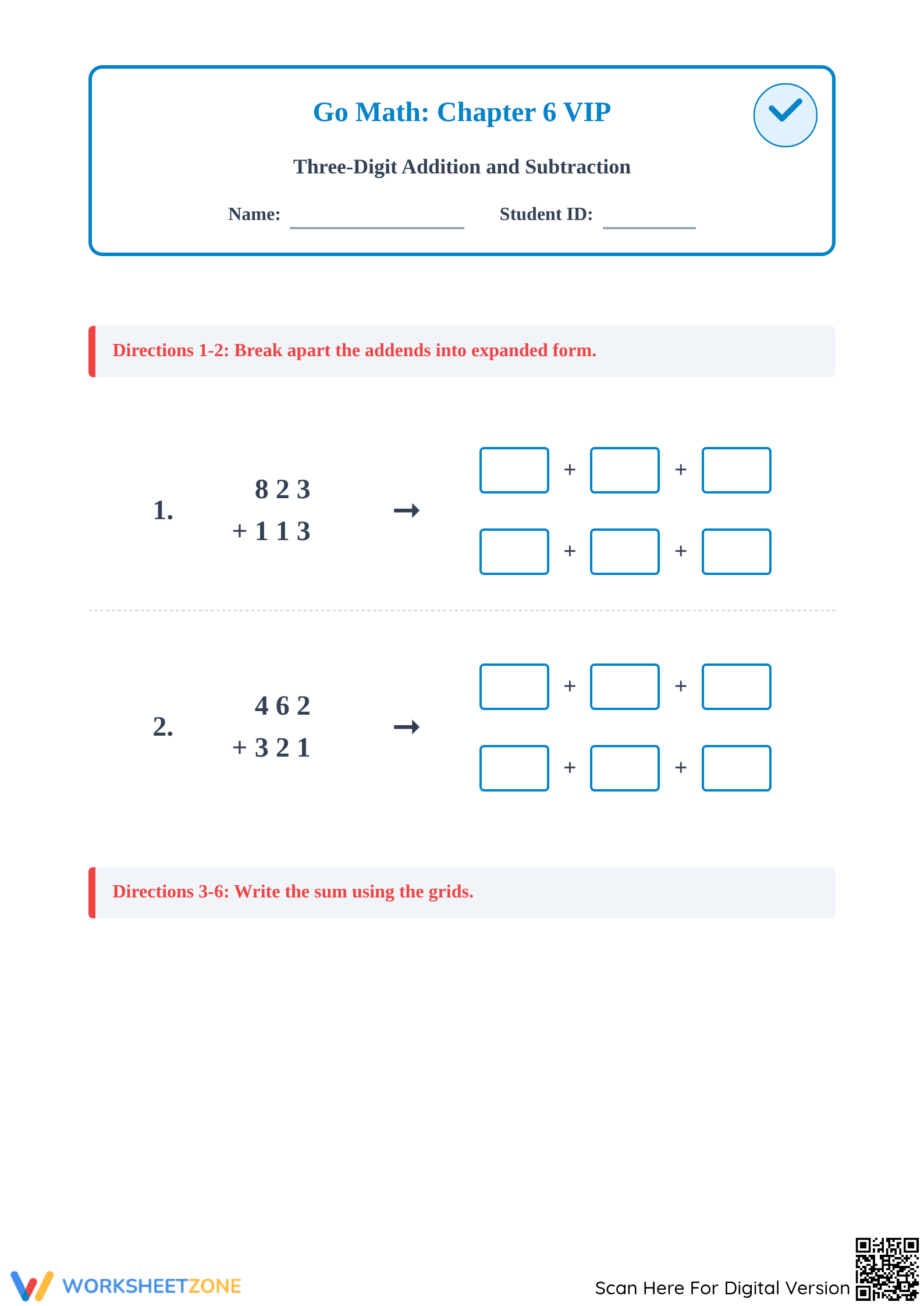
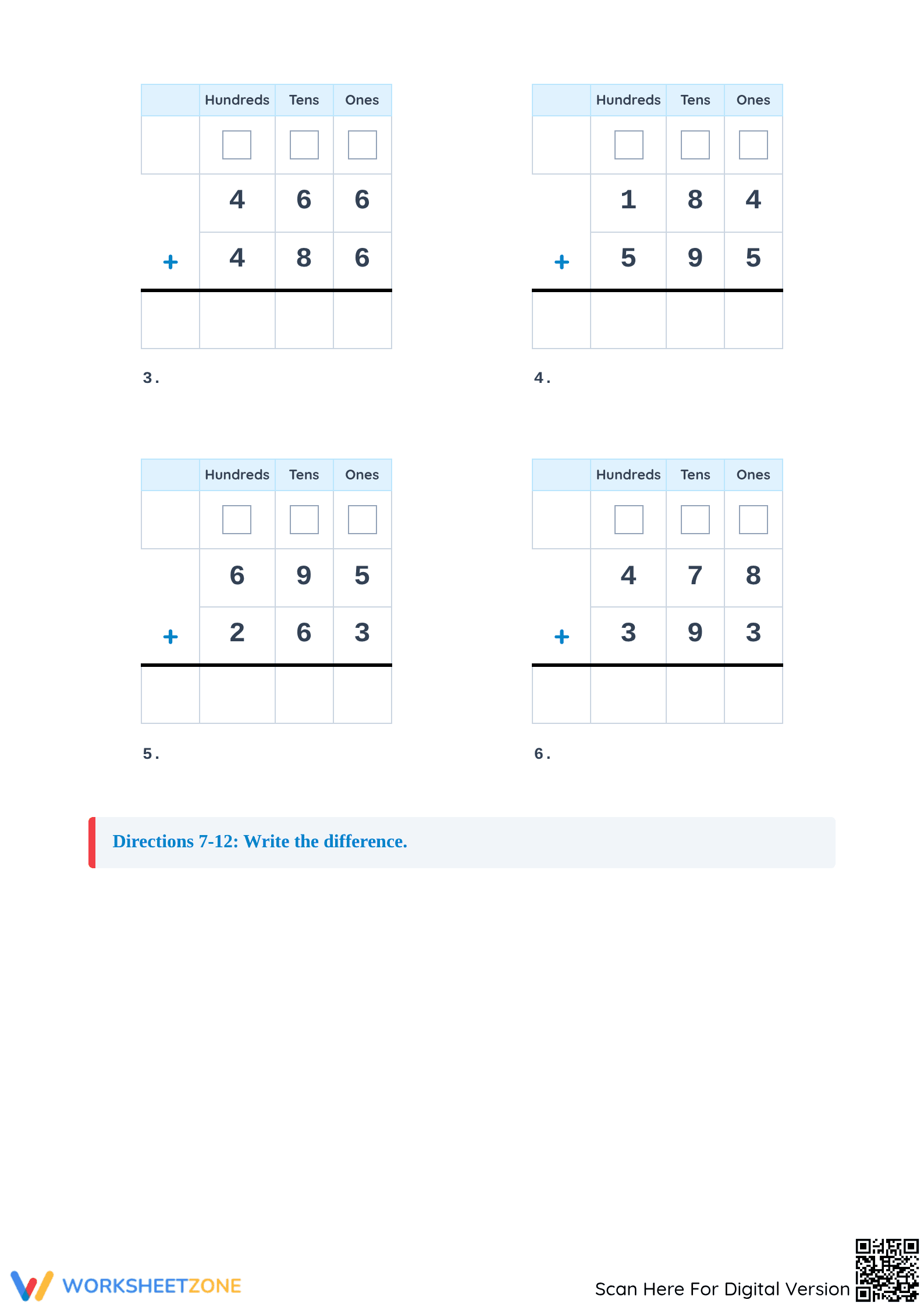
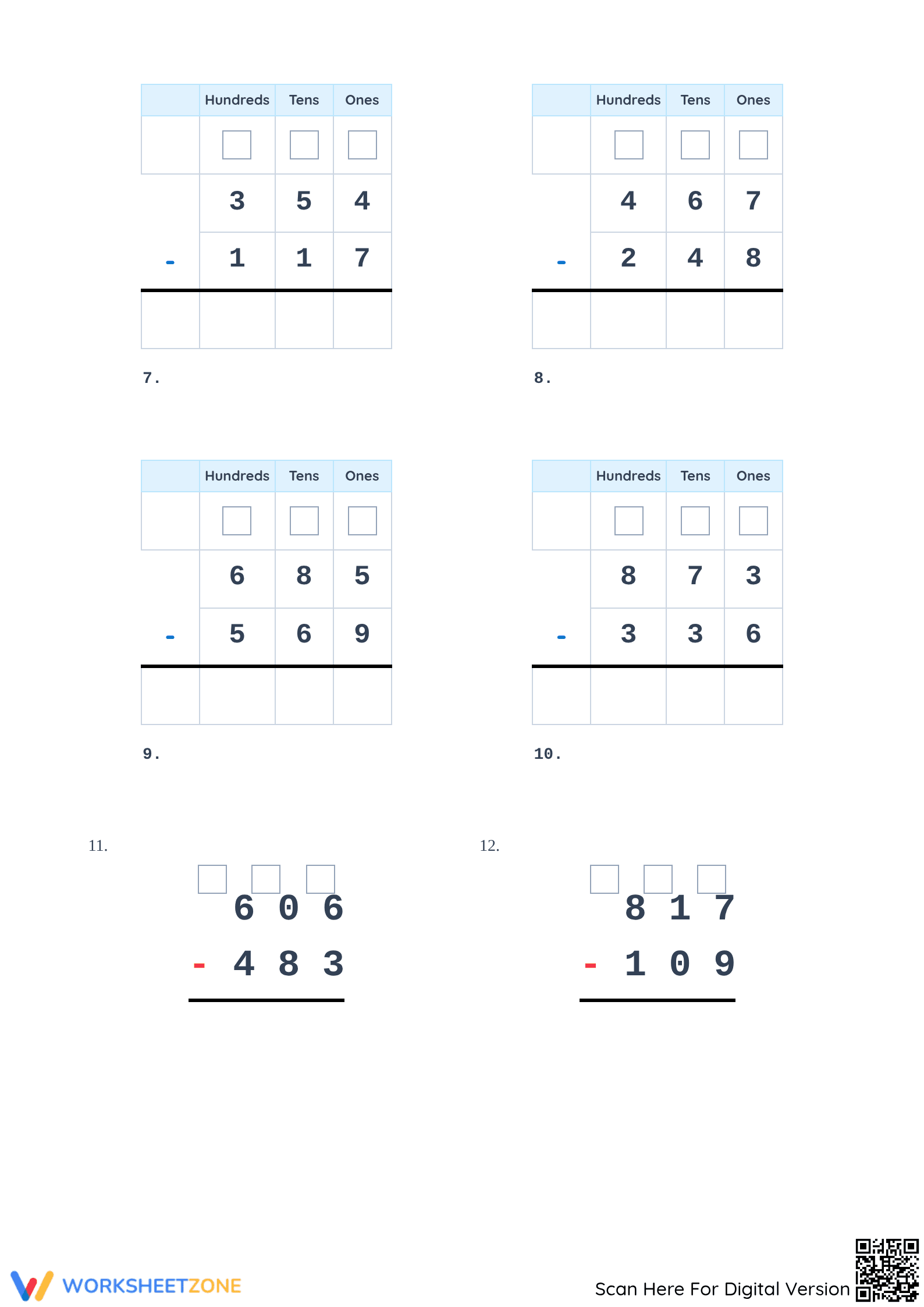
Inside this 4-page PDF, you will find a structured progression of 13 tasks designed for student success. The worksheet begins with expanded form decomposition, moves into vertical grid-supported problems for both addition and subtraction, and concludes with a bonus word problem. A full answer key is provided to facilitate quick grading and self-correction.
Skill Progression and Scaffolding
- Guided Practice: Tasks 1-2 utilize expanded form to break apart addends, providing a visual scaffold for place value and decomposing hundreds, tens, and ones.
- Supported Practice: Tasks 3-10 use place value grids (Hundreds, Tens, Ones) to organize regrouping steps for both operations, ensuring alignment and accuracy.
- Independent Practice: Tasks 11-12 and the Bonus Challenge remove structural grids, requiring students to apply mastery to standard algorithms and contextual word problems.
This sequence follows the gradual-release model, moving from high scaffolding to independent mastery of complex multi-digit arithmetic.
Standards Alignment
Aligned to 2.NBT.B.7, students add and subtract within 1000 using strategies based on place value and the relationship between operations. This resource also supports 2.NBT.B.9 as students explain why these strategies work. Both standard codes can be copied directly into lesson plans, IEP goals, or district curriculum mapping tools.
Instructional Implementation
Use this during the "independent practice" phase of a lesson. It is also an excellent tool for small-group intervention for students transitioning to 3-digit regrouping. Observation tip: Watch students during the expanded form section; if they struggle to decompose numbers, they likely need additional work with place value disks. Expected completion time is 30 minutes.
Targeted Student Population
This resource is designed for Grade 2 students but serves as a review for Grade 3 and 4 learners. It is particularly effective for students who benefit from visual organization and scaffolds. Pair this worksheet with a 3-digit addition anchor chart or base-ten blocks for a multisensory learning experience that reinforces conceptual place value.
According to the NAEP, proficiency in multi-digit addition and subtraction with regrouping is one of the strongest predictors of future success in rational number operations and algebraic thinking. This worksheet aligns with the principles outlined in Fisher & Frey (2014) regarding the gradual release of responsibility, ensuring students move from conceptual decomposition in expanded form to the procedural efficiency of the standard algorithm. Research from EdReports (2024) emphasizes that high-quality materials must explicitly connect place value understanding to algorithmic steps rather than relying on rote memorization of rules. By utilizing place value grids and word problem application, this resource provides the necessary breadth for Grade 2 mastery of 2.NBT.B.7. Educators can rely on this structured approach to ensure that a majority of students achieve baseline competency when paired with direct modeling and manipulative-based instruction.


