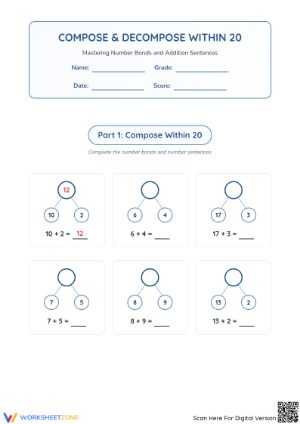
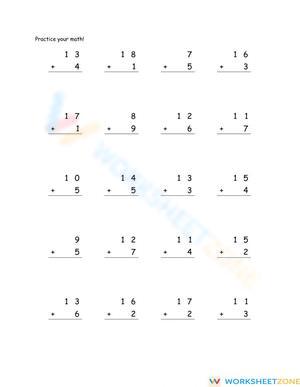
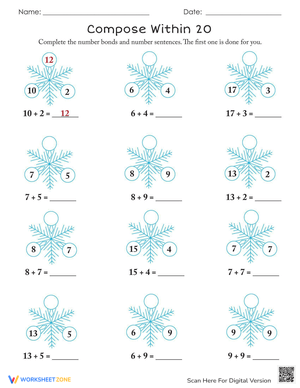
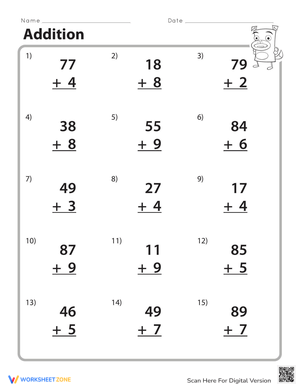
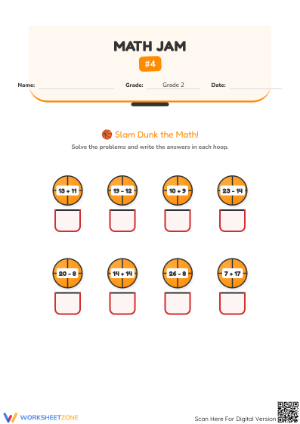
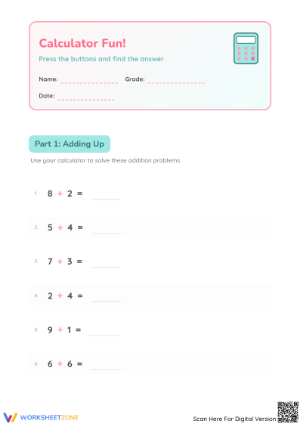
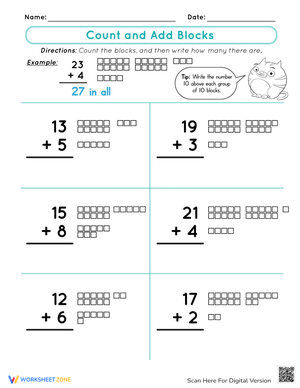
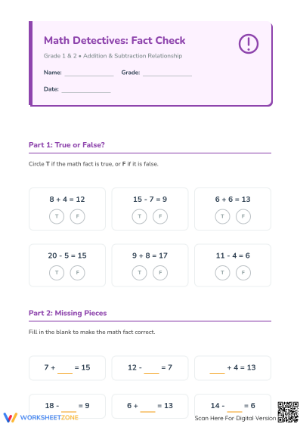
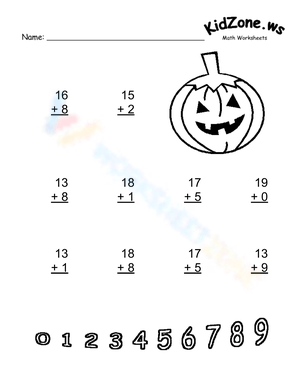
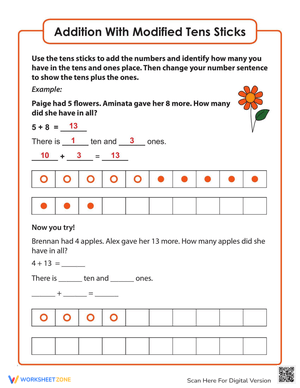
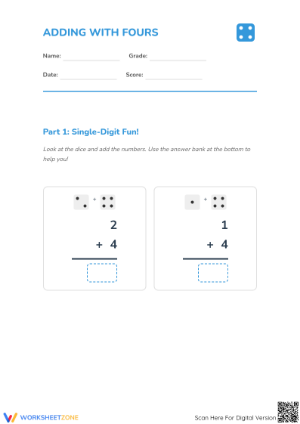
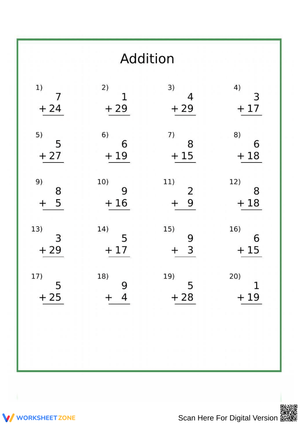
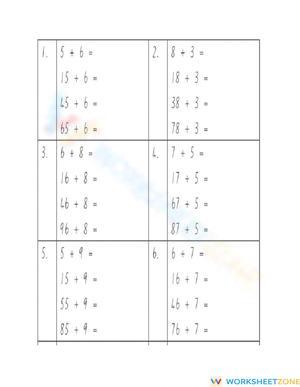
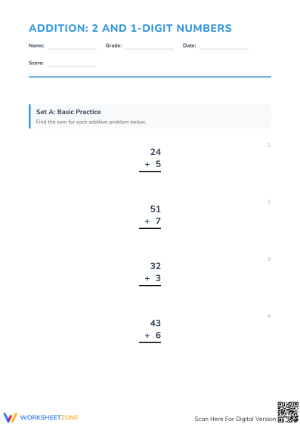
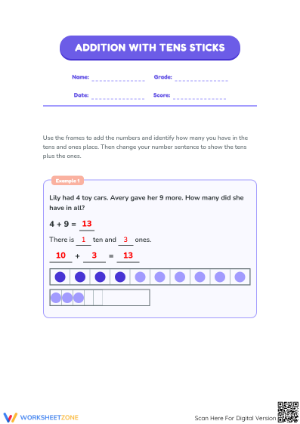
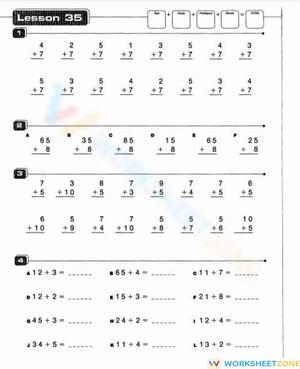
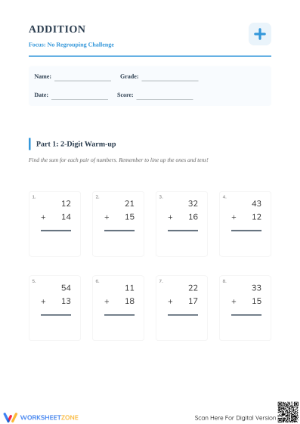
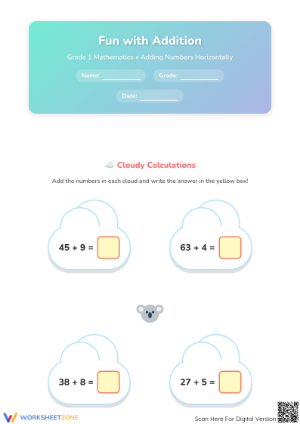
These 2nd grade two digit by one digit addition printable worksheets give teachers a focused set of practice materials that follow the exact progression second graders need — from problems that stay comfortably within a ten all the way to problems that require carrying a new ten into the tens column. Each worksheet stands alone and targets a specific skill, so teachers can pull individual worksheets for warm-ups, small-group work, or end-of-lesson checks without committing to a full packet. Answer keys accompany every worksheet in the set.
Skills These Worksheets Build
The set moves through four distinct skill areas. Early worksheets give students problems where the ones digits sum to 9 or less — work that builds the foundational habit of right-aligning digits and solving the ones column first, before regrouping ever enters the picture. This matters more than it might seem: many second graders who can mentally solve 34 + 5 will write the 5 below the 3 instead of the 4 when working on paper, then add left to right as if the columns don't exist. Establishing correct alignment on simpler problems prevents those habits from hardening.
Later worksheets introduce problems like 47 + 6, 58 + 8, and 75 + 9, where the ones column sums to 10 or more. Students practice recognizing that a new ten has formed, recording the regrouped ten above the tens column, and completing the addition accurately. The final group of worksheets mixes regrouping and non-regrouping problems within the same worksheet. That mixing is deliberate — when every problem requires regrouping, students often apply the procedure automatically without stopping to check whether it's actually needed.
- Vertical addition without regrouping (ones digits summing to 9 or less)
- Vertical addition with regrouping (ones digits summing to 10 or more)
- Horizontal-to-vertical rewriting practice
- Mixed problem sets requiring students to decide when to regroup
- Brief word problems using two-digit and one-digit addends
Errors Worth Watching For and Correcting
The most persistent mistake at this level is a placement error, not a calculation error. A student solving 43 + 8 will sometimes write the 8 directly below the 4 — aligning by visual proximity rather than place value — then add across rather than by column. The horizontal equation format makes this more likely, which is exactly why each worksheet includes horizontal-to-vertical rewriting practice. Watching this error happen in real time is clarifying: the student usually understands what addition is; they haven't yet internalized the spatial logic of how digits belong on the page.
The second common error is the forgotten regrouped ten. A student correctly identifies that 7 + 5 = 12, writes the 2 in the ones place, marks a small 1 above the tens column — then ignores it entirely when computing the tens. This is primarily a working memory issue, not a conceptual one. Requiring students to physically circle or underline the regrouped digit before touching the tens column gives it enough visual weight to stay in the picture. It is a small procedural cue that makes a meaningful difference in accuracy during independent work.
Fitting These Worksheets Into Your Math Block
For whole-group instruction, projecting one worksheet on a document camera and solving three or four problems aloud works well. Verbalizing the thinking — "I have 8 ones and I'm adding 5 more. That's 13 ones, which is more than 9, so I need to trade 10 ones for a ten-rod and carry that ten into the tens column" — gives students a mental model they can internalize before attempting problems independently. That kind of explicit think-aloud consistently reduces procedural errors during the practice that follows.
During small-group rotations, slip individual worksheets into dry-erase pockets. Students solve with markers, compare work with a partner, and wipe clean for the next round. Explaining to a partner why a problem did or did not require regrouping generates more productive math conversation than silent desk work does. For the final 8 minutes before students transition out, a no-regrouping worksheet functions well as a quick exit routine — and the results give an honest read on who has the alignment habit down and who still needs reinforcement.
The 2nd grade two digit by one digit addition printable worksheets in this set hold up well as homework assignments, too. Each worksheet targets one clear skill, which means families can follow along without needing a teacher's explanation of what the problem set is trying to accomplish — a real practical advantage over textbook pages that fold several concepts together at once.
Standard Alignment
CCSS.Math.Content.2.NBT.B.5 requires second graders to fluently add and subtract within 100 using strategies based on place value, properties of operations, and the relationship between addition and subtraction. This standard is the direct instructional target for this set. In classroom terms, "fluency" here means students aren't relying entirely on counting-up strategies — they're applying a reliable, understood procedure. Teachers who plan units around 2.NBT.B.5 find that the 2nd grade two digit by one digit addition printable worksheets in this set fit naturally into the middle weeks of instruction, after students have worked with base-ten blocks but before the class moves into two-digit by two-digit addition.
The standard sits within the Number and Operations in Base Ten domain, which also includes 2.NBT.A.1 — understanding that 100 equals 10 tens. Teachers who address that standard before introducing regrouping consistently see smoother transitions, because the "trade ten ones for a ten" step maps onto a concept students have already discussed and named explicitly.
Tiering the Practice for Mixed-Ability Classrooms
For students who are still inconsistent on single-digit addition facts, start them on the no-regrouping worksheets and allow an addition table as a reference. The priority at that stage is the place value habit — right-aligning digits and working the ones column first — not simultaneously drilling fact recall. Removing fact recall as a competing demand lets students focus on the structural learning without two sources of difficulty at once.
Students ready for extension can use the 2nd grade two digit by one digit addition printable worksheets in this set as a springboard: after completing a worksheet, they write a new equation using their answer as an addend and attempt to predict the new sum. That extension pushes them to think structurally about numbers rather than just executing a procedure. For students working significantly below grade level, pairing any worksheet with base-ten block manipulatives — or a printed hundred chart — provides a concrete reference point while they build procedural familiarity. The worksheets don't require manipulatives to use, but they don't obstruct them either.
Frequently Asked Questions
When should I move students from no-regrouping to regrouping problems?
Move students to regrouping problems once they consistently right-align digits without prompting and accurately solve the ones column on no-regrouping problems — meaning 10 or more problems completed correctly and independently, not just a few. Students who have the alignment habit but still make occasional fact errors can begin regrouping problems with a fact table available. The goal is for them to understand what regrouping means before they're expected to execute it entirely from memory.
Is there a recommended order for working through the worksheets in this set?
Start with vertical, no-regrouping worksheets. Add horizontal-format, no-regrouping next — rewriting horizontal equations vertically is its own small challenge that benefits from explicit practice before it's combined with regrouping. Then move to vertical regrouping, followed by horizontal regrouping. Save the mixed-problem worksheets for last; those work better as review or end-of-unit check tools than as first-exposure practice.
How can I use these worksheets for formative assessment without spending significant grading time?
Collect one worksheet per student after a practice session and sort them into three stacks: work that is correct with clear place value steps shown, work where the answer is right but no steps are visible, and work with consistent errors. The middle stack often contains students who are executing a procedure without understanding it — that group benefits most from a quick small-group check-in. The error stack almost always shows one of two patterns: alignment errors or the forgotten-regrouped-ten problem. Sorting takes less time than formal grading and gives more actionable information about what to address the next day.













 Interactive Worksheet Maker
 Quiz Maker
 Word Search Maker
 Crossword Puzzle Maker
 Word Scramble Generator
 Sentence Scramble Generator
 Handwriting Worksheet Generator
 Name Tracing Generator
 Fill In The Blank Generator