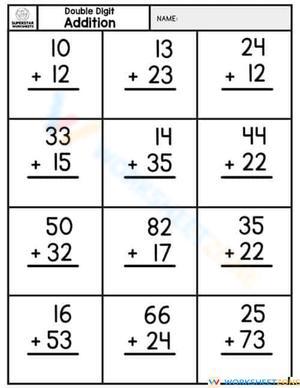
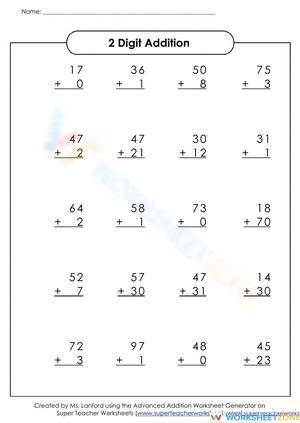
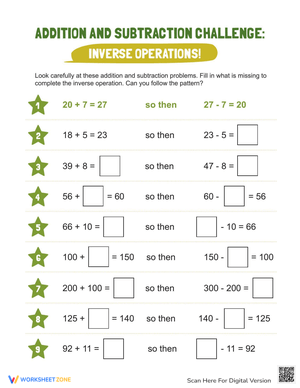
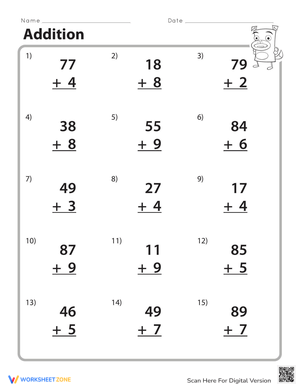
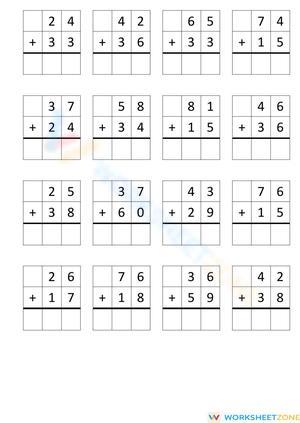
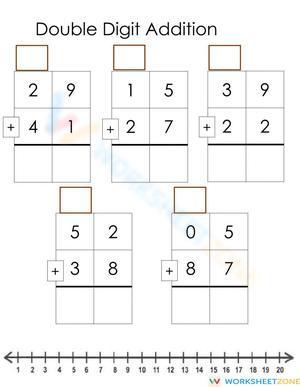
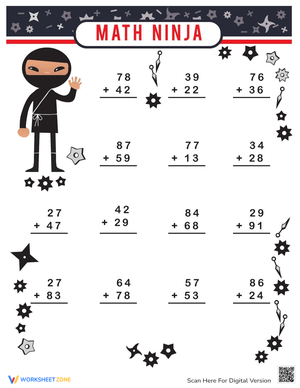
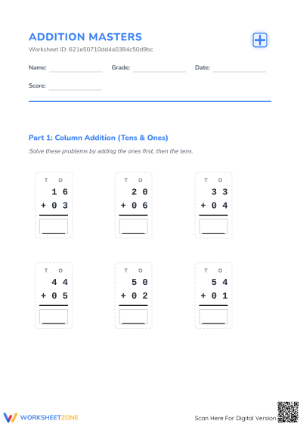
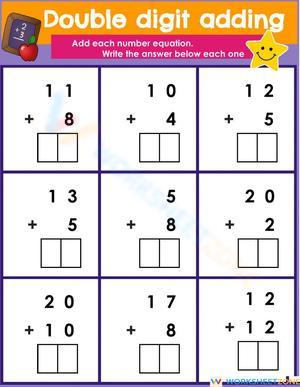
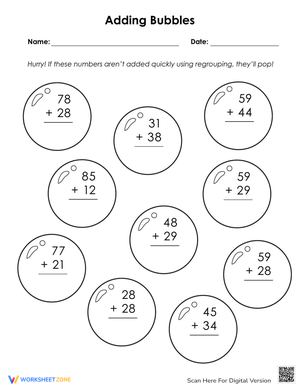
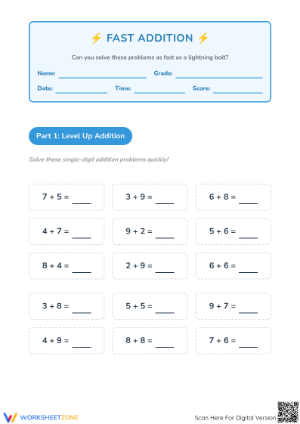
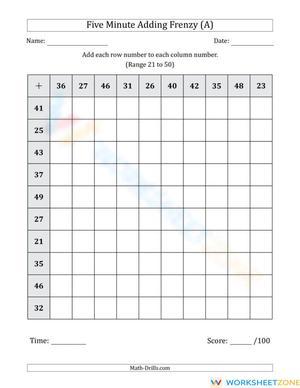
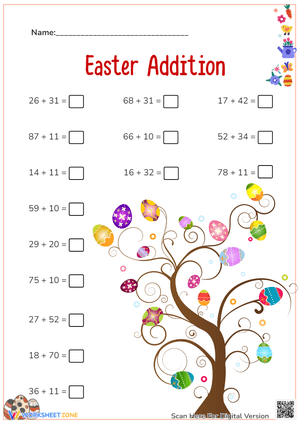
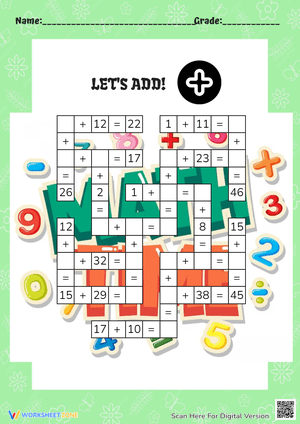
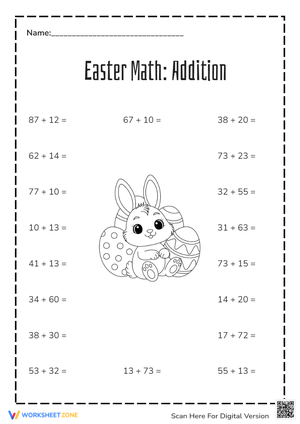
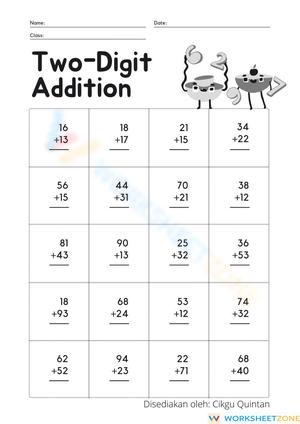
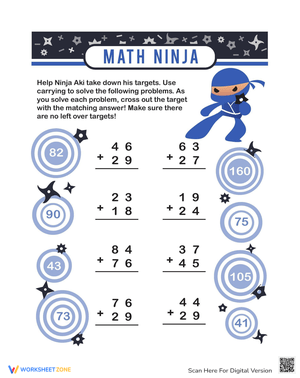
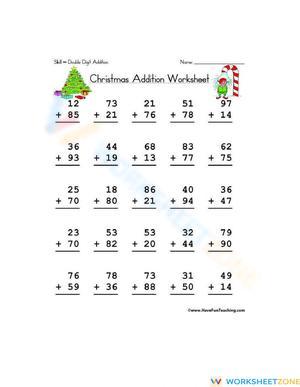
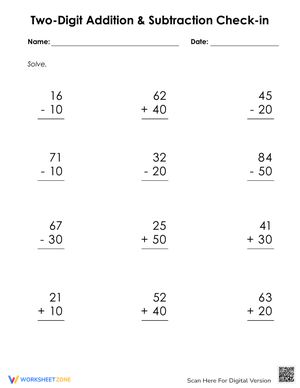
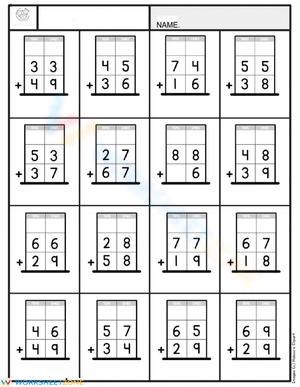
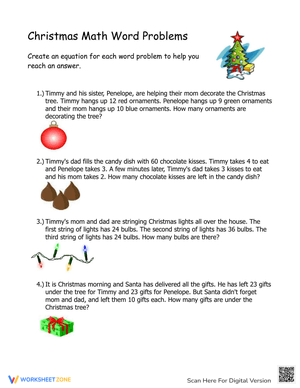
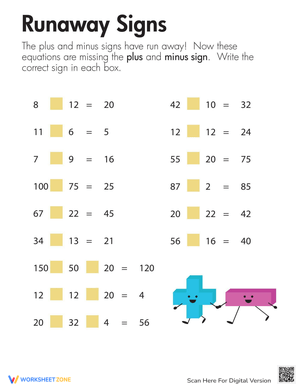
These 2nd grade two digit addition printable worksheets resources give teachers a focused, ready-to-use set covering both stages of two-digit addition: column problems that don't require trading and problems where the ones sum reaches ten or greater. Each worksheet targets one clear skill — non-regrouping or regrouping — so it fits precisely into the right lesson at the right moment rather than asking students to navigate unfamiliar formats while learning new concepts. The set follows the same instructional sequence most second-grade classrooms use: place-value separation first, then bundling tens.
The Specific Skills Each Worksheet Targets
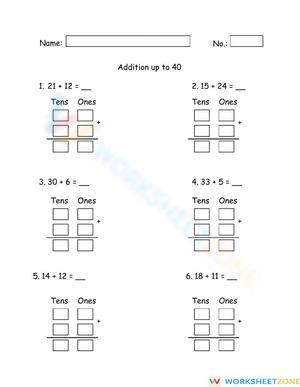
The non-regrouping worksheets do more than offer simple practice — they build the habits that make regrouping learnable later. Problems like 34 + 25 or 61 + 17 train students to add the ones column first and keep the tens and ones mentally separated. Students who skip this phase and move straight to regrouping tend to apply the "carry" step arbitrarily because they don't yet understand when or why it becomes necessary.
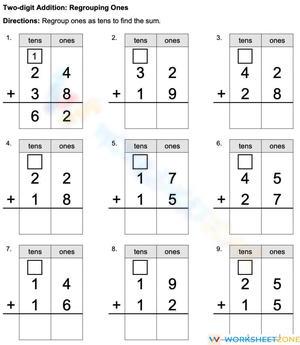
The regrouping worksheets address problems where students must recognize that a ones sum of ten or greater requires bundling. Each worksheet in this group includes:
- Problems requiring students to trade ten ones for a ten, with a labeled space above the tens column to record the bundled digit before solving that column
- Mixed sets that include both regrouping and non-regrouping problems, so students must decide — rather than assume — whether trading is needed on each problem
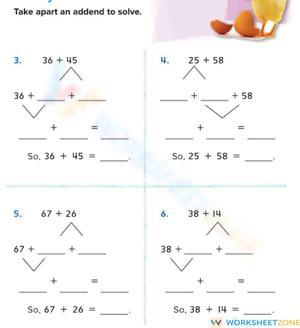
- Partial sums exercises where students write the tens sum on one line and the ones sum on the next before combining, which keeps the actual value of each digit visible throughout
Mistakes Students Make That These Worksheets Help You Catch
The most consistent error in student work is recording the regrouped ten and then ignoring it. A student correctly identifies that 7 + 9 = 16, writes a small "1" above the tens column, and then solves the tens column as if that digit isn't there. This is almost never a conceptual failure — it's a tracking failure. The student understood what happened in the ones column; they simply lost the traded digit visually before moving on. Teaching students to circle or box that digit immediately after writing it, before touching the tens column, stops this error in most cases within a few practice sessions.
The second pattern worth watching is alignment drift on student-generated problems. A student who solves pre-formatted problems accurately will sometimes misplace digits when copying a horizontal number sentence onto their own paper — putting the tens digit of one addend directly above the ones digit of the other. Because each worksheet pre-formats the column structure, alignment is removed as a variable during guided practice. This makes the worksheets particularly useful for isolating computation errors from organizational ones. Teachers who see students succeeding on worksheets but struggling in open-response contexts should check for alignment drift specifically.
How to Build These Worksheets Into Your Lesson Plans
Bell-ringer use is the most reliable entry point. Five regrouping problems at the start of math time takes about eight minutes for most second graders and activates place-value thinking before the day's direct instruction begins. The timing itself is diagnostic: a student who finishes in three minutes and a student still working at seven minutes signal very different instructional needs — no separate assessment required.
Math rotations are the other natural home. Laminating each worksheet and supplying dry-erase markers makes the set reusable across groups, which matters when supplies are tight. During a twenty-minute rotation, most students work through eight to twelve problems and still have time to check their answers. One honest limitation to know upfront: the vertical column format frustrates students who default to counting up on a number line when a standard problem format feels unfamiliar. For those students, keeping the partial sums worksheet available as an alternative entry point — rather than requiring the vertical algorithm from the start — prevents shutdown and keeps practice moving.
These 2nd grade two digit addition printable worksheets materials work best after hands-on introduction, not instead of it. Sending a regrouping worksheet home before students have physically traded pennies for dimes — or moved base-ten blocks between columns — tends to produce anxious guessing. Once the concept has been introduced and practiced at least once with concrete materials, the worksheets reinforce the abstract procedure efficiently and give students a record of their own thinking.
Standard Alignment
This set addresses CCSS.MATH.CONTENT.2.NBT.B.5, which requires second graders to fluently add and subtract within 100 using strategies grounded in place value, properties of operations, and the relationship between addition and subtraction. In classroom terms, this standard runs from mid-fall through spring — a longer instructional window than most individual second-grade standards receive. Non-regrouping addition typically enters instruction in October, once students have established two-digit place value understanding through 2.NBT.A.1. Regrouping instruction usually begins in January, with both approaches running in parallel through April as students build toward the fluency benchmarks assessed at year's end. Teachers following the Eureka/EngageNY sequence will find this set aligns with the content of Modules 4 and 5 of the Grade 2 materials.
Differentiating the Set Across Ability Levels
For students who are not yet solid on two-digit place value, pair any non-regrouping worksheet with a base-ten block reference chart and ask the student to draw the base-ten representation beside each problem before adding. This slows the process in a productive way — it makes the place-value structure visible rather than assumed — and gives the teacher a clear look at where the student's understanding stops. Reducing the expected problem count to five, rather than the full worksheet, allows enough time for the drawing without rushing.
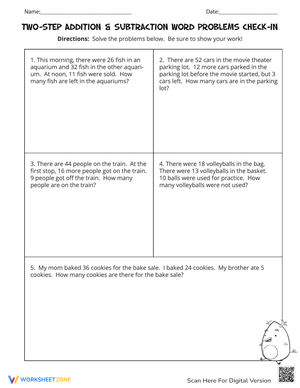
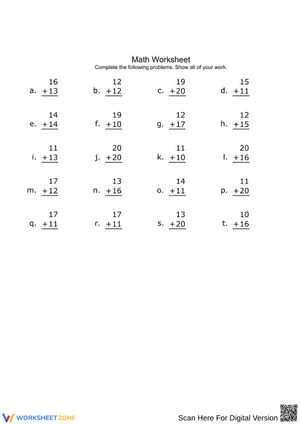
Students who move through regrouping quickly benefit from worksheets that include word problems, which require reading context, identifying relevant quantities, and choosing the right operation before computing anything. A stronger extension is asking these students to write their own two-digit addition problems with the constraint that each answer must require regrouping. Meeting that constraint means understanding what makes regrouping necessary — a ones sum of ten or greater — which is a conceptual check more revealing than solving additional given problems. For students ready to push further, the 2nd grade two digit addition printable worksheets column format extends naturally to three-addend problems using the same vertical setup, maintaining the same structural familiarity while raising the computational demand.
Frequently Asked Questions
How do I know when a student is ready to move from non-regrouping to regrouping problems?
Readiness shows in two places: the student solves non-regrouping problems accurately at a reasonable pace, and can articulate why they add the ones first. A student who solves 42 + 35 and explains that the 4 and 3 represent 40 and 30 — not just the digits 4 and 3 — has the place-value understanding regrouping requires. Students who follow the steps correctly without that understanding tend to fall apart when regrouping adds a new step to the procedure.
My students write the regrouped "1" above the tens column and then ignore it. What actually helps?
Have students circle or box the traded digit immediately after writing it, before moving to the tens column at all. It takes about three days of consistent reinforcement to establish as a habit, but the error rate drops sharply once it sticks. The underlying problem is visual tracking, not misunderstanding — students know the ten is there, they just lose it in the middle of calculating. The circle gives it a visual anchor.
Can I send these worksheets home for homework?
Yes, with one clear condition: the specific skill — especially regrouping — needs to have been introduced and practiced in class first. Sending 2nd grade two digit addition printable worksheets home before students have seen regrouping at school puts parents in the position of teaching a procedure they may not know how to explain, which produces frustration on both ends. Once the concept is established, five to eight problems for homework consolidates practice effectively without tipping into fatigue.
What if a student gets all the answers right but cannot explain what they did?
Correct answers without explanation are a warning sign, not a success marker. Ask directly: "What does the small number above the tens column mean?" and "Why did you start with the ones?" If the student can't answer, they've memorized a sequence of steps rather than understood a mathematical process. Use a non-regrouping worksheet as a diagnostic and ask the student to annotate each step in writing while solving — one sentence per step. What they write, or cannot write, will show exactly where understanding gives way to imitation.













 Interactive Worksheet Maker
 Quiz Maker
 Word Search Maker
 Crossword Puzzle Maker
 Word Scramble Generator
 Sentence Scramble Generator
 Handwriting Worksheet Generator
 Name Tracing Generator
 Fill In The Blank Generator