


























Views
Downloads
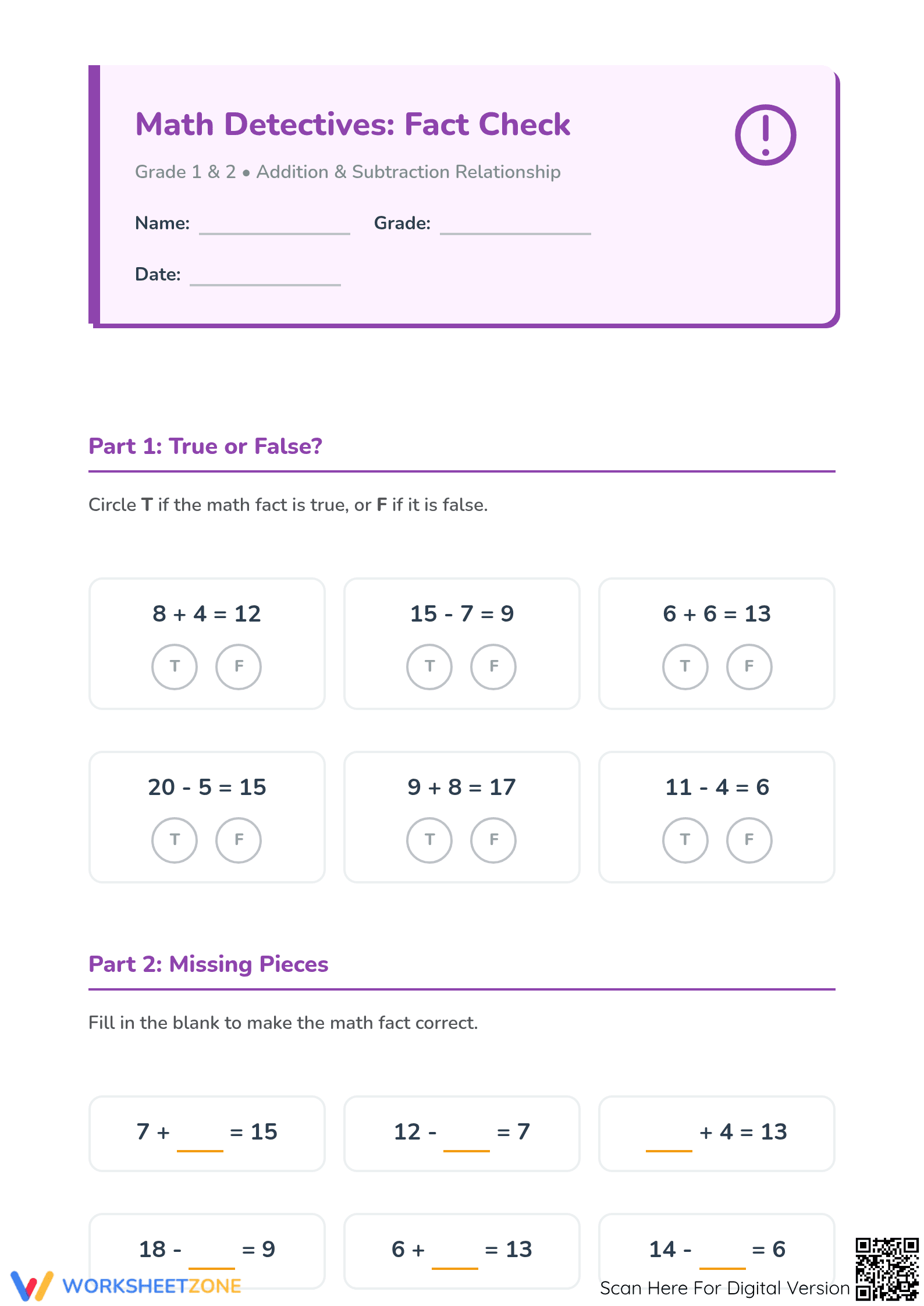



Printable Fact Family Worksheet | Grade 1-2 Math
Paste this activity's link or code into your existing LMS (Google Classroom, Canvas, Teams, Schoology, Moodle, etc.).
Students can open and work on the activity right away, with no student login required.
You'll still be able to track student progress and results from your teacher account.
Help your students bridge the gap between addition and subtraction with this comprehensive math review. This worksheet guides learners through the logic of fact families, ensuring they don't just memorize numbers but understand the mechanics of inverse operations. By the end of these activities, students will be able to verify math facts and solve for unknown addends with confidence.
At a Glance
At a Glance
- Grade: 1 · Subject: Math
- Standard:
CCSS.MATH.CONTENT.1.OA.B.4— Find the unknown number in a subtraction problem by using related addition facts- Skill Focus: Addition and Subtraction Relationships
- Format: 3 pages · 22 problems · Answer key included · PDF
- Best For: Independent practice or formative unit review
- Time: 20–30 minutes
What's Inside
This resource includes 22 problems distributed across two content pages, plus a dedicated answer key. The worksheet is divided into four distinct sections: a True or False fact check, a Missing Pieces fill-in-the-blank set, a Fact Families construction area, and complex Challenge Problems. The clean, professional layout minimizes visual distractions while providing ample space for student work.
Skill Progression
- Guided Recognition: Six "True or False" problems allow students to practice identifying correct and incorrect equations, reinforcing basic fact fluency.
- Supported Application: Six "Missing Pieces" problems require students to apply inverse operations to find missing numbers in both addition and subtraction contexts.
- Independent Synthesis: Eight "Fact Family" tasks challenge students to write four related equations for a given set of numbers, demonstrating mastery of relationships.
This structure follows a gradual-release model, moving from simple recognition to the complex synthesis of mathematical relationships.
Standards Alignment
This worksheet is aligned to CCSS.MATH.CONTENT.1.OA.B.4, which requires students to understand subtraction as an unknown-addend problem. Additionally, it supports CCSS.MATH.CONTENT.2.OA.B.2 by building the mental math fluency required for Grade 2. This standard code can be copied directly into lesson plans, IEP goals, or district curriculum mapping tools.
How to Use It
Assign this worksheet during a "Math Detective" themed lesson to increase student engagement. It works perfectly as a post-instruction formative assessment or as a targeted intervention for students struggling with the concept of subtraction. For a quick check, teachers can review the "Fact Families" section to see if students correctly identify the relationships between the three given numbers.
Who It's For
Designed primarily for Grade 1 and Grade 2 students, this resource is also suitable for kindergarten enrichment or Grade 3 review. It supports diverse learners through clear visual cues and a structured progression. Pair this worksheet with physical manipulatives like counters or a ten-frame to help students visualize the "Missing Pieces" and "Fact Family" relationships during small group instruction.
Citation Capsule
The CCSS.MATH.CONTENT.1.OA.B.4 standard emphasizes the critical cognitive shift where students stop seeing addition and subtraction as isolated skills and begin to view them as a unified system of inverse relationships. According to the RAND AIRS 2024 report, early fluency with these "fact families" is the single most predictive factor for success in multi-digit arithmetic and algebraic thinking in later elementary years. This worksheet addresses this by requiring students to not just solve equations, but to evaluate their validity and construct related facts. By moving from simple true/false recognition to the construction of four-fact families, the resource scaffolds the higher-order thinking necessary for mental math mastery. Fisher & Frey (2014) highlight that such "checks for understanding" within the math block allow teachers to identify misconceptions about the equals sign—a common hurdle for Grade 1 and 2 students—before they become ingrained.


