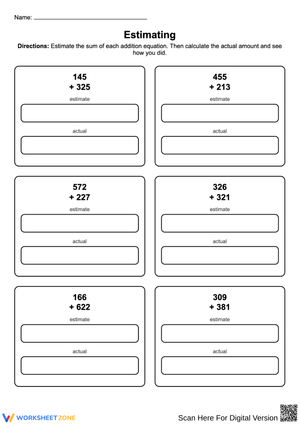
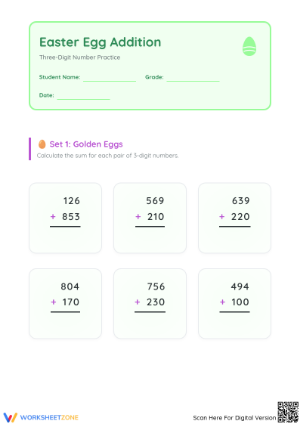
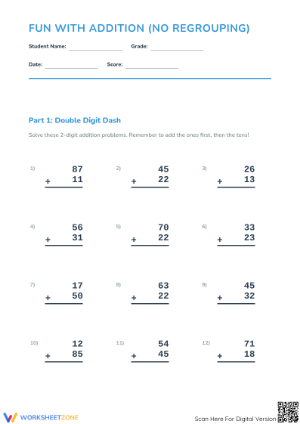
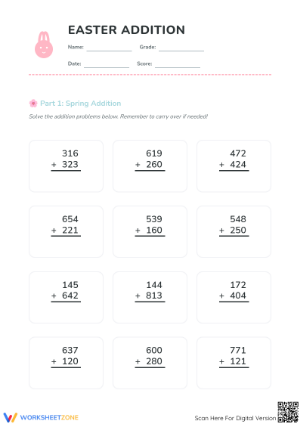
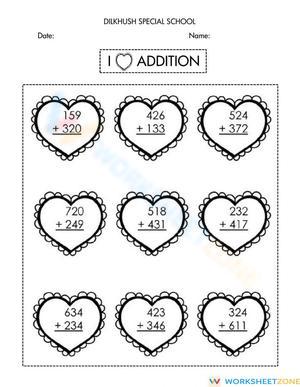
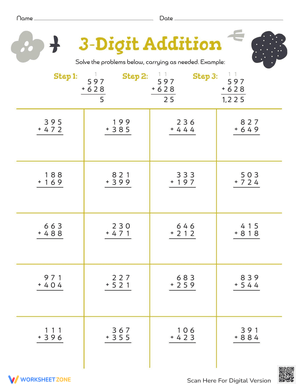
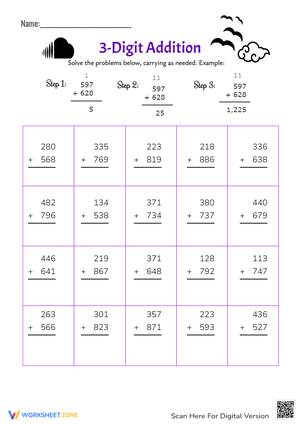
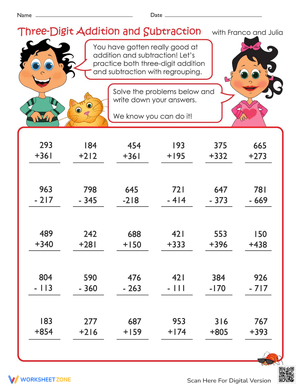
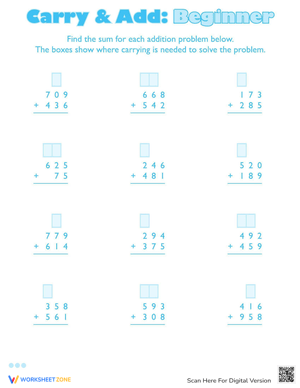
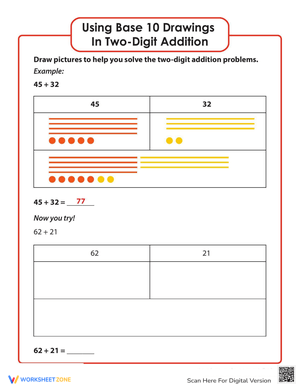
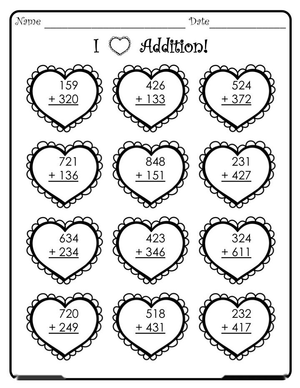
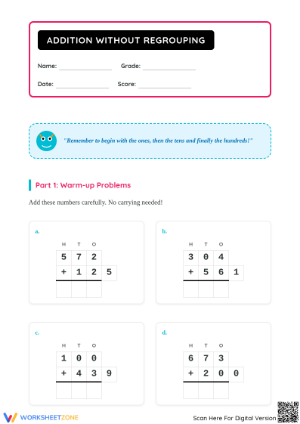
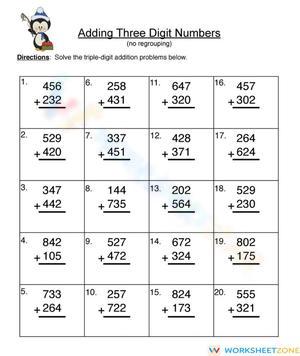
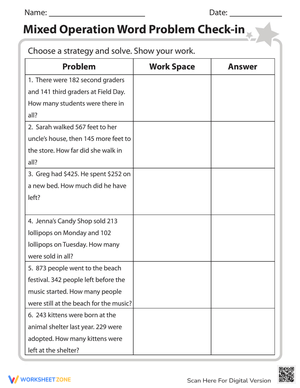
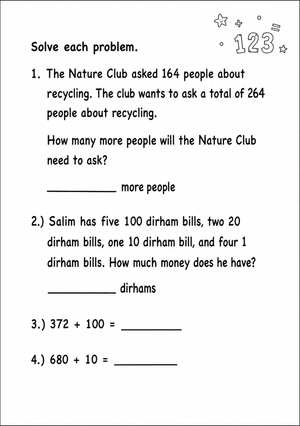
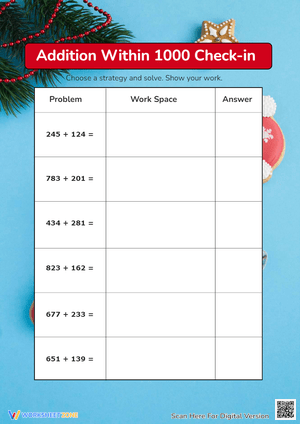
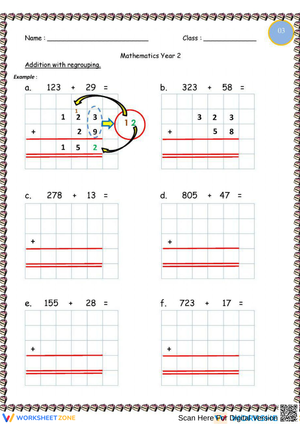
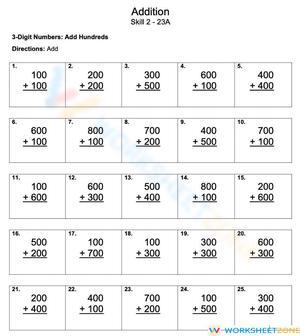
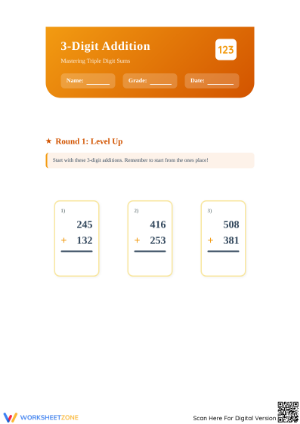
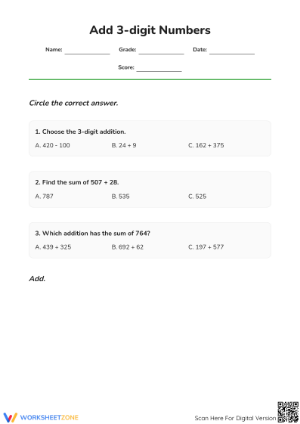
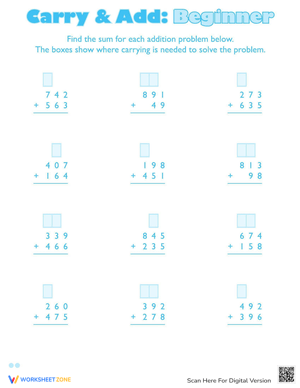
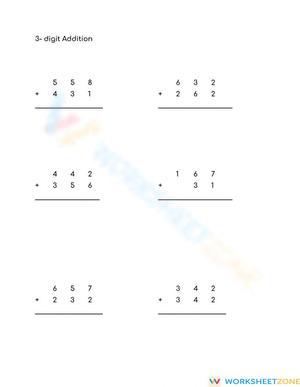
These three digit addition printable worksheets for 2nd grade give teachers a sequenced set of resources covering the full range of 2.NBT.7 — from no-regrouping column addition through problems that require carrying in both the ones and tens columns. Each worksheet targets a specific level of complexity, so teachers can match practice to where a student actually is rather than running everyone through the same material at the same time.
What's Inside the Set
The worksheets move through three distinct stages of complexity:
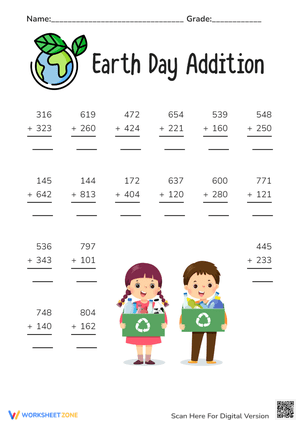
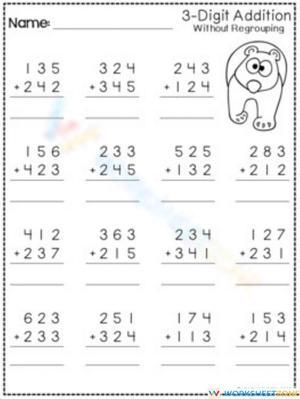
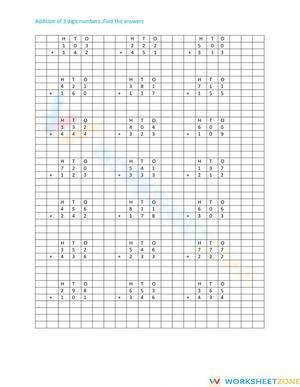
- No-regrouping problems let students build fluency with column alignment and reading three-digit numerals before carrying enters the picture. The cognitive load stays low, and students gain confidence producing clean, organized work.
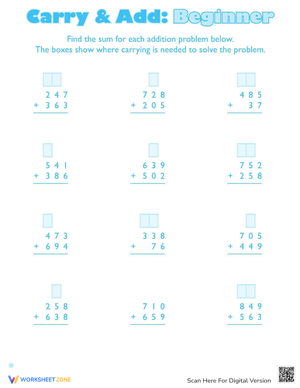
- Single-regrouping worksheets introduce carrying in one column at a time — ones-to-tens first, then tens-to-hundreds. A small carrying box prints above the relevant column so students record the digit they're moving before continuing to the next column.
- Double-regrouping worksheets require carrying in both places within the same problem. Several at this level embed problems inside word problem contexts, asking students to read a situation, identify that addition applies, and then solve.
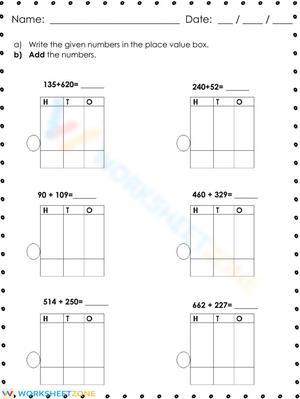
Several worksheets across the set use expanded form as the entry point. Students write 347 as 300 + 40 + 7 and 216 as 200 + 10 + 6, add each component separately, then verify their standard-algorithm answer against the expanded-form result. This keeps the connection between the algorithm and actual place value visible rather than letting carrying become a rote gesture students perform without understanding why it works.
Mistakes Students Make That These Worksheets Surface
The forgotten carry is the most persistent error at this stage. A student correctly writes the small "1" above the tens column, adds the tens digits, and skips that mark entirely — arriving at an answer ten less than the correct one. Students who do this aren't confused about place value; they've split the problem into isolated steps and stopped treating the carried digit as a number to include in that column's sum. Asking students to circle the carry before adding that column resolves this faster than reteaching the whole procedure.
Double regrouping surfaces a second pattern. When carrying into the hundreds column, some students pencil in a "1" above an imaginary thousands place that doesn't exist on the worksheet. They've internalized the carry gesture without connecting it to the magnitude of the numbers. A quick estimate before solving — 300-something plus 400-something has to land around 700-something — catches this and trains students to monitor their own answers rather than execute steps on autopilot.
Alignment errors are less dramatic but just as costly. When one addend has a zero in the tens place, like 406 + 273, students who rush occasionally shift a column rightward and add ones digits to tens digits. Grid-lined worksheets in this set prevent that drift; the open-format worksheets work best once reliable alignment is established.
Building These Worksheets Into Your Lesson Plans
No-regrouping worksheets work well as Monday warm-ups after a weekend away from math. The problems take about eight minutes, they activate prior knowledge, and the manageable difficulty means no one starts the week stuck. Single-regrouping worksheets fit naturally inside the guided math block, where teachers can move around the room and watch for the forgotten-carry error before it becomes entrenched habit rather than a quick correction.
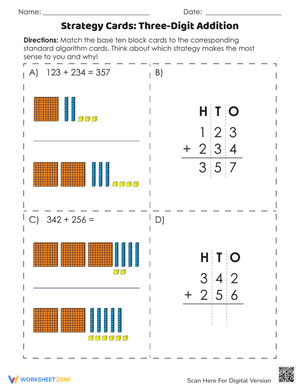
For math centers, laminate the double-regrouping worksheets and pair them with a set of base-ten blocks. Students build each problem with the blocks first, then record the work on the laminated surface with a dry-erase marker. The physical act of exchanging ten rods for a hundreds flat slows students down in a useful way — the carry isn't just a mark on paper; it's a trade they've already made with their hands. Erase, reset, and the same worksheet supports multiple rounds of practice without reprinting.
Homework works well for no-regrouping and single-regrouping worksheets. A brief note home clarifying whether students are using expanded form or the standard algorithm prevents the confusion that stalls homework conversations — the Tuesday morning call from a parent who says their child's teacher does it differently from how they learned it in school.
Standard Alignment
These three digit addition printable worksheets for 2nd grade address CCSS.MATH.CONTENT.2.NBT.B.7: adding within 1,000 using strategies based on place value, properties of operations, and the relationship between addition and subtraction. In classroom terms, this standard arrives in the second half of second grade, after students have internalized place value for three-digit numbers (2.NBT.A.1) and built fluency with two-digit addition (2.NBT.B.5). Teachers finishing the 2.NBT.B.5 unit and moving into three-digit work will find the no-regrouping worksheets bridge that transition without a jarring jump in problem complexity.
The word problem worksheets in the set connect to 2.OA.A.1, which asks students to use addition to solve one- and two-step word problems. At the three-digit level, that application extends the OA strand naturally, and these worksheets serve as extension work for students who are ahead on the numbers-in-context portion of the curriculum.
How to Put These Worksheets to Work Across Ability Levels
Students who are still shaky on two-digit addition benefit from extra time on the no-regrouping three-digit worksheets before carrying is introduced. The numbers look bigger, but the mental procedure is identical — align, add ones, add tens, add hundreds. That sameness is reassuring, and progress through these worksheets tends to be quick once students recognize the pattern.
For students moving ahead of the group, the double-regrouping word problem worksheets push beyond recall into reasoning. A productive extension: ask these students to write a second word problem using the same two addends. Composing a problem requires a clearer grasp of what the numbers represent than solving one does, and it surfaces conceptual gaps that computation drill alone misses.
Students who freeze when problems appear in standard vertical format sometimes do better starting with the expanded form worksheets. Seeing hundreds, tens, and ones as separate quantities rather than a single combined numeral makes the addition feel manageable in smaller steps — and once students work through expanded form successfully, the move back to vertical format tends to go smoothly.
Frequently Asked Questions
When should students move from single-regrouping to double-regrouping worksheets?
When a student completes a single-regrouping worksheet with fewer than two errors and can explain what the carried digit represents — not just where it goes — they're ready for double regrouping. Accuracy alone isn't enough; a student who carries correctly by rote will struggle when two separate carries are involved because they don't have the reasoning to track both. A quick verbal check ("tell me what this little 1 means") takes thirty seconds and tells you more than the score on the worksheet does.
Should students use base-ten blocks alongside these worksheets?
The three digit addition printable worksheets for 2nd grade that cover regrouping work best when students have first handled the physical exchange — trading ten unit cubes for a tens rod, ten rods for a hundreds flat. Once students have made that trade with their hands, the notation on the worksheet has a concrete referent. Students who skip manipulatives and go straight to the algorithm tend to carry correctly in simple cases but fall apart when regrouping crosses a zero, like 504 + 368, because they've memorized a procedure without understanding the exchange it represents.
How many problems should a worksheet include for a second grader?
For worksheets introducing double regrouping, twelve to fifteen problems lets students work carefully without rushing. Review worksheets covering previously mastered skills can hold up to twenty problems for most students at this grade. The key variable isn't the count — it's the pace of the lesson block. Twelve problems completed with deliberate attention during a fifteen-minute math center rotation is more productive than twenty problems finished in eight minutes with several errors left unchecked. The three digit addition printable worksheets for 2nd grade in this set come in formats across that range, so teachers can choose volume by purpose rather than defaulting to one format for every use.













 Interactive Worksheet Maker
 Quiz Maker
 Word Search Maker
 Crossword Puzzle Maker
 Word Scramble Generator
 Sentence Scramble Generator
 Handwriting Worksheet Generator
 Name Tracing Generator
 Fill In The Blank Generator