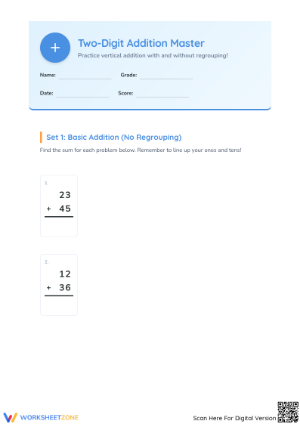
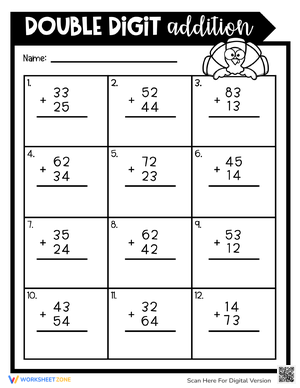
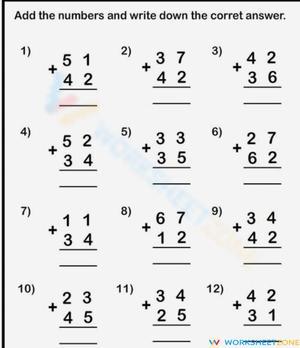
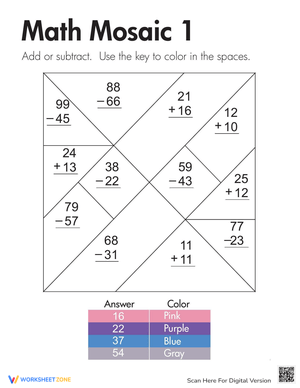
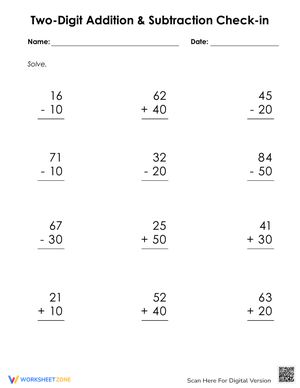
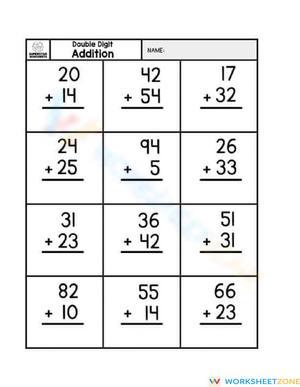
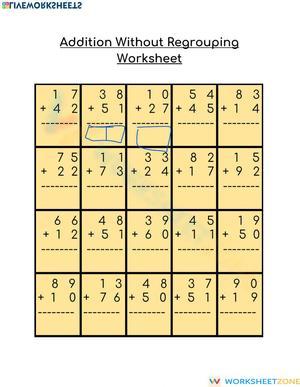
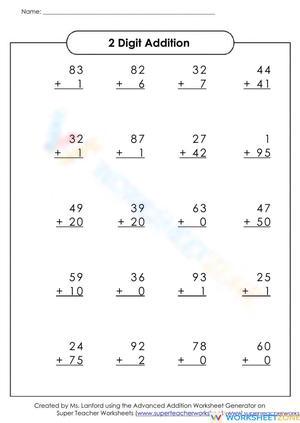
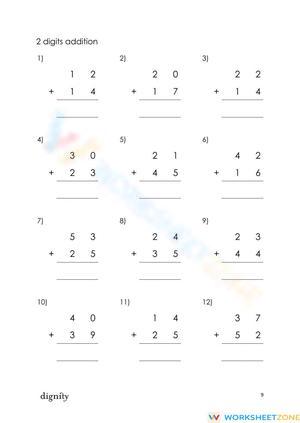
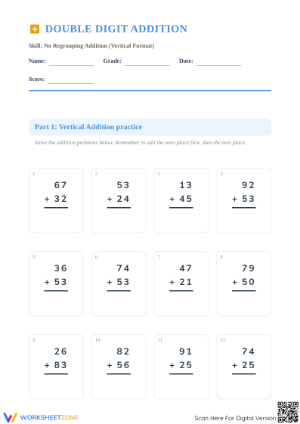
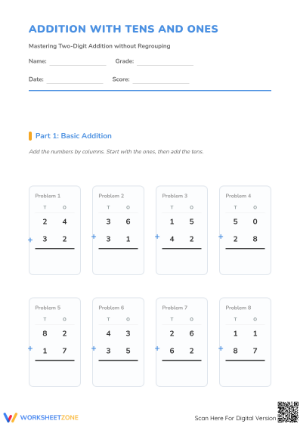
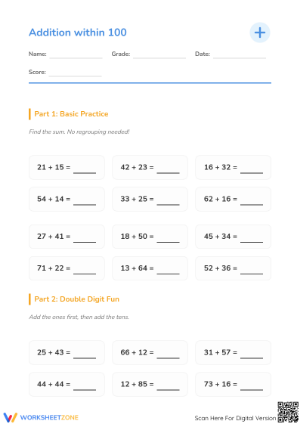
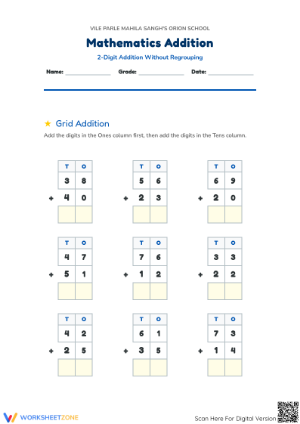
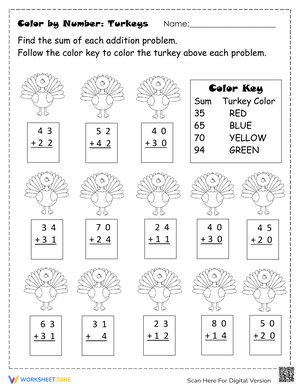
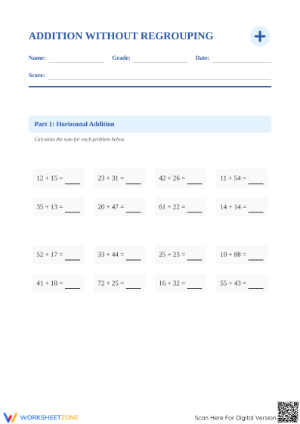
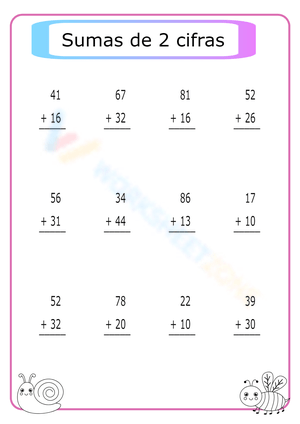
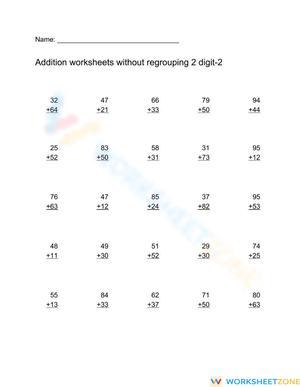
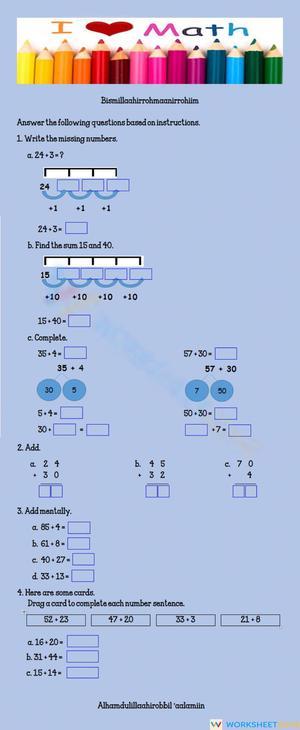
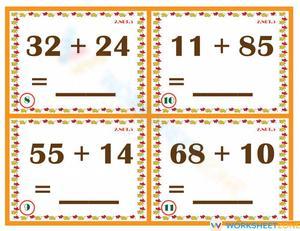
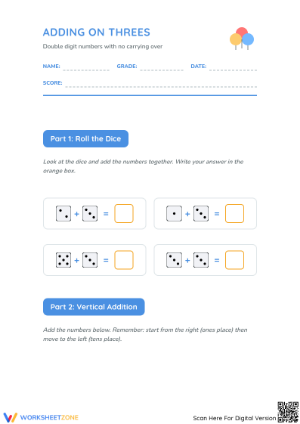
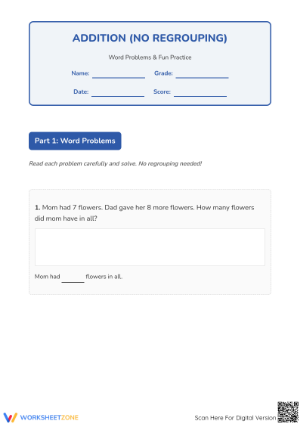
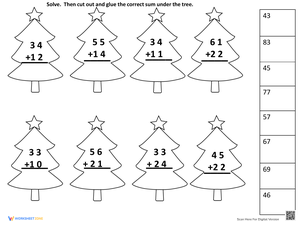
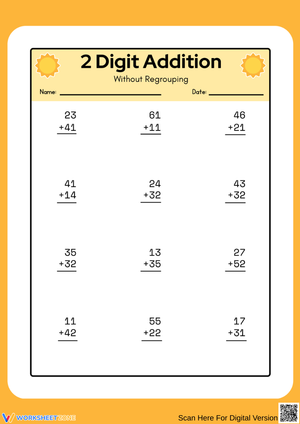
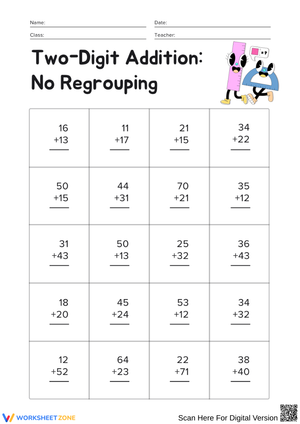
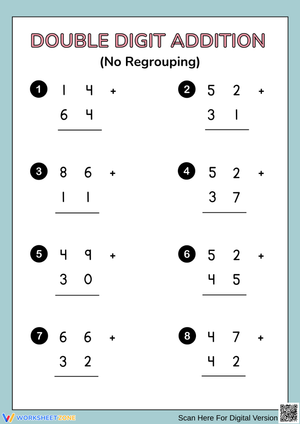
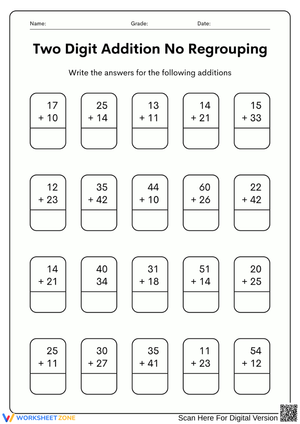
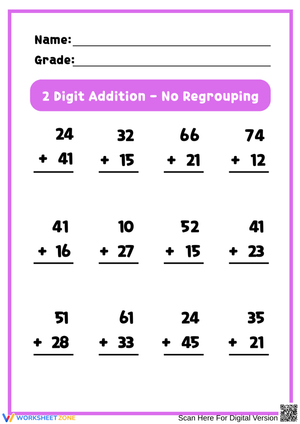
These two digit addition with no regrouping printable worksheets for 2nd grade give teachers a compact, ready-to-use set of math resources that keeps place value — not just arithmetic — at the center of every problem. The set covers vertical equations, horizontal number sentences, short word problems, and missing-addend items, so teachers have multiple formats to work the same skill from different angles.
What Students Practice Across the Set
Every worksheet in the set asks students to add two-digit numbers where both the ones column and the tens column produce a sum less than 10 — which means no carrying step appears anywhere. That constraint creates space for students to pay attention to structure. When a student solves 32 + 45, the useful thinking is: three tens plus four tens, two ones plus five ones. The answer assembles from two connected but separate operations.
Vertical format items develop column alignment habits early — a discipline that matters heavily once regrouping arrives. Horizontal equations strip away the column structure, requiring students to locate the tens and ones digits on their own before they can add. Missing-addend items like 53 + ___ = 78 demand backward reasoning through place value rather than forward addition, which checks a different layer of understanding than standard problems. Word problems stay brief to keep reading demand appropriate for Grade 2 while still asking students to identify what to add from a written context.
Where This Skill Sits in the Grade 2 Math Sequence
No-regrouping addition appears in Grade 2 after students have worked with place value in concrete and representational ways — base-ten blocks, tens-and-ones charts, and quick-sketch diagrams of tens rods and unit cubes. By the time students work with a worksheet, the idea that 63 contains six groups of ten and three ones should already have some traction. Moving to written practice without the manipulative is a meaningful step, and it happens before regrouping adds another layer to manage.
Students who move into regrouping without this phase often develop a mechanical approach: they apply carrying procedures without understanding why a ten gets moved to the next column. No-regrouping addition is where column logic becomes second nature, and that foundation is what makes later instruction on regrouping make sense instead of just stick.
Standard Alignment
These worksheets address CCSS 2.NBT.B.5, which requires students to fluently add and subtract within 100 using strategies based on place value, properties of operations, and the relationship between addition and subtraction. No-regrouping two-digit addition is typically the first formal application of this standard in Grade 2 — it follows whole-class place-value instruction and precedes regrouping. Teachers most often use this set during the independent-practice phase, once guided and partner work has established the concept. Missing-addend and horizontal-equation worksheets also reinforce 2.NBT.A.1, the standard focused on understanding the tens-and-ones structure of two-digit numbers, because students must identify each digit's place-value role before they can operate on it.
Errors Worth Catching Before They Become Habits
The most consistent mistake in student work on this skill isn't faulty arithmetic — it's misalignment. A student solving 46 + 23 in horizontal format will sometimes add 6 + 2 and 4 + 3, reversing which digits belong to the ones and which to the tens, arriving at 87 instead of 69. The addition facts themselves are correct; the place-value assignment is wrong. Fixing that error requires a conversation about what each digit means, not more fact practice.
Two digit addition with no regrouping printable worksheets for 2nd grade that include both vertical and horizontal formats on the same worksheet make these patterns easier to spot. A second error worth watching: students who have already encountered regrouping sometimes try to apply carrying to problems that don't need it. They solve 31 + 25 correctly, then second-guess themselves looking for something to carry. A brief class discussion — "how do you know this problem doesn't need regrouping?" — converts that uncertainty into a reasoning check rather than a confidence spiral.
Where These Worksheets Fit in a Typical Grade 2 Week
Morning warm-ups are the most natural home for one of these worksheets. Six to eight vertical problems take most Grade 2 students about five minutes, fitting neatly into the window between morning meeting and the first instructional block without cutting into lesson time. The problems require no new teaching, so students can begin independently — which also makes this set a reliable sub-plan resource.
Two digit addition with no regrouping printable worksheets for 2nd grade work equally well as exit-ticket tools: cut each worksheet into thirds, hand each student a few problems, and you have a fast formative snapshot with no extra preparation. For small-group rotations, match the worksheet to where the group is that day — place-value-box support for students still locating digits, standard equations for those who can work without visual cues.
One time-saving move: sort the worksheets in the set by support type rather than by difficulty label alone. Keep visual-model worksheets together, place-value-box worksheets together, and standard-equation worksheets together. When a student hits a wall, reaching for a more supported version takes seconds — no searching through the full set required.
Making the Set Work Across Different Readiness Levels
For students still shaky on single-digit fluency, reduce the problem count on each worksheet and pair the work with base-ten blocks. Students build both addends physically first, then record the equation. The worksheet functions as a recording tool rather than the primary task, which keeps the work accessible without removing written practice.
Students who move through the standard problems quickly benefit from missing-addend worksheets or mixed-format worksheets that ask them to identify which problems would require regrouping if the numbers changed. That comparison task keeps thinking active and keeps attention on place value rather than on speed. Explaining why a problem doesn't need regrouping is a stronger indicator of understanding than a correct answer alone.
Frequently Asked Questions
What prerequisite skills should students have before starting these worksheets?
Three skills need to be in place before worksheet practice makes sense:
- Identifying the tens digit and ones digit in a two-digit number
- Adding single-digit numbers accurately and without finger-counting on every problem
- Connecting a base-ten block or drawing to its written equation
When any of those pieces are missing, students tend to guess rather than apply understanding. Concrete, hands-on instruction should come first.
How is this different from regrouping addition, and why does the sequence matter?
No-regrouping addition keeps each column's sum below 10, so students add tens to tens and ones to ones without any trading step. Regrouping introduces a second operation — trading ten ones for one ten and carrying it to the next column. Teaching no-regrouping first gives students fluency with column structure before that second operation is layered on. Students who skip this step often apply carrying to every problem regardless of whether it's needed, which is a harder habit to undo than it sounds.
Can these worksheets double as formative assessment tools?
Yes — and they give more useful information when teachers look at error type rather than overall accuracy. A student who writes 46 + 32 = 87 has made a different mistake than one who writes 46 + 32 = 700. The first points to digit-assignment confusion; the second suggests the student added all four digits without any place-value framework at all. Two digit addition with no regrouping printable worksheets for 2nd grade reviewed with that lens — sorting errors by type rather than counting wrong answers — give teachers specific information about what to address in the next lesson.













 Interactive Worksheet Maker
 Quiz Maker
 Word Search Maker
 Crossword Puzzle Maker
 Word Scramble Generator
 Sentence Scramble Generator
 Handwriting Worksheet Generator
 Name Tracing Generator
 Fill In The Blank Generator