




























Views
Downloads

Grade 1-2 Compose and Decompose — Printable No-Prep Sheet

Paste this activity's link or code into your existing LMS (Google Classroom, Canvas, Teams, Schoology, Moodle, etc.).
Students can open and work on the activity right away, with no student login required.
You'll still be able to track student progress and results from your teacher account.
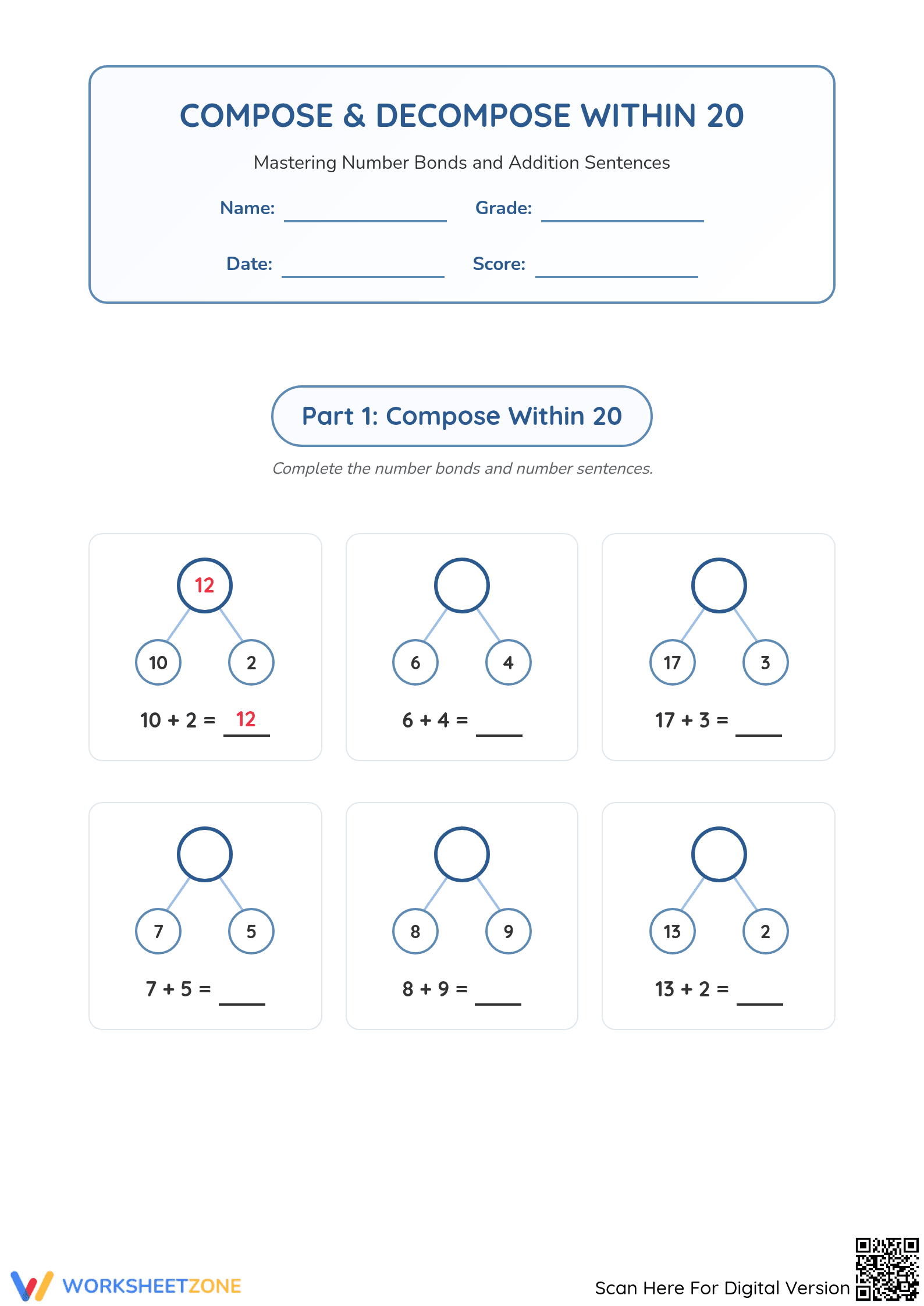
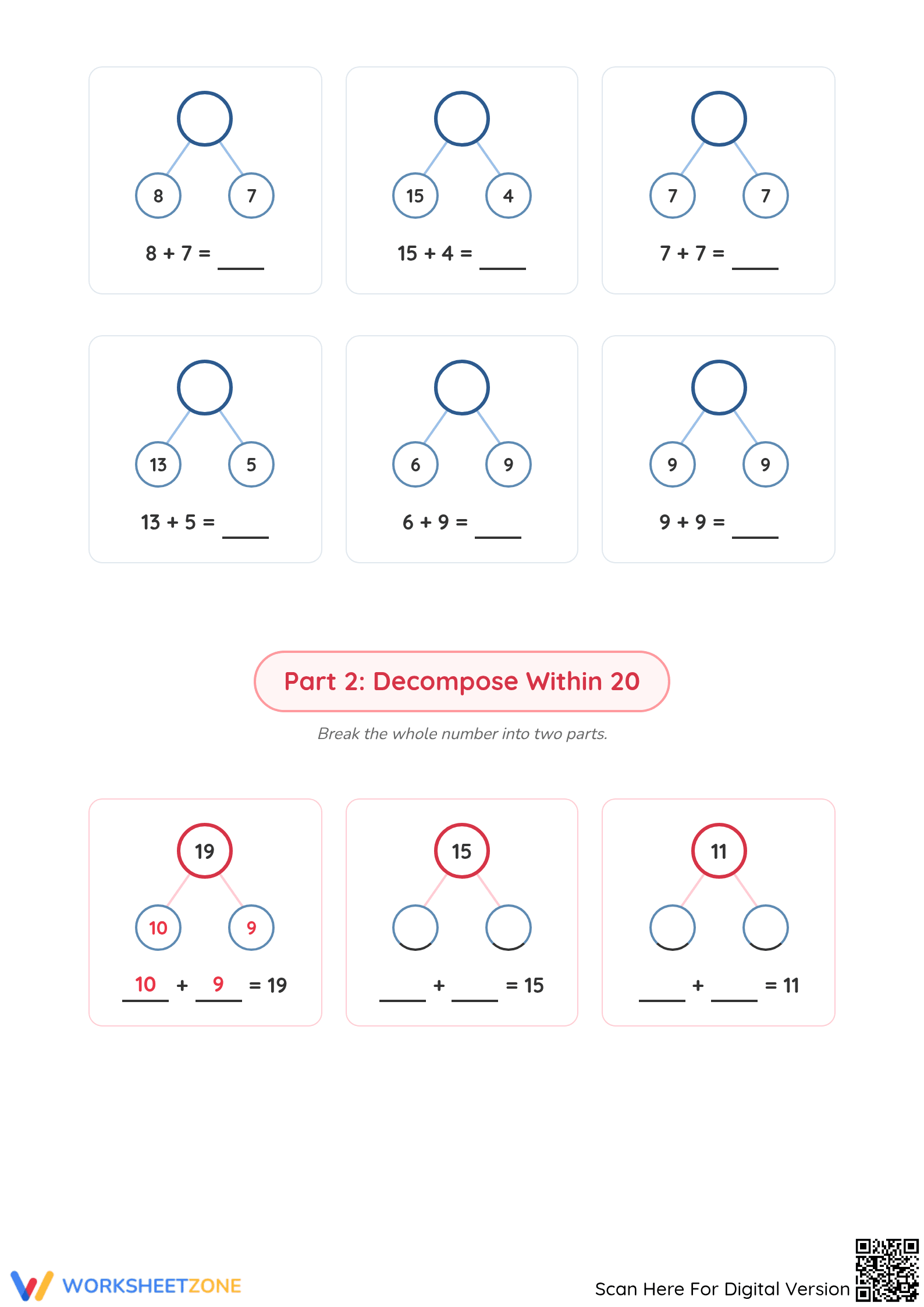
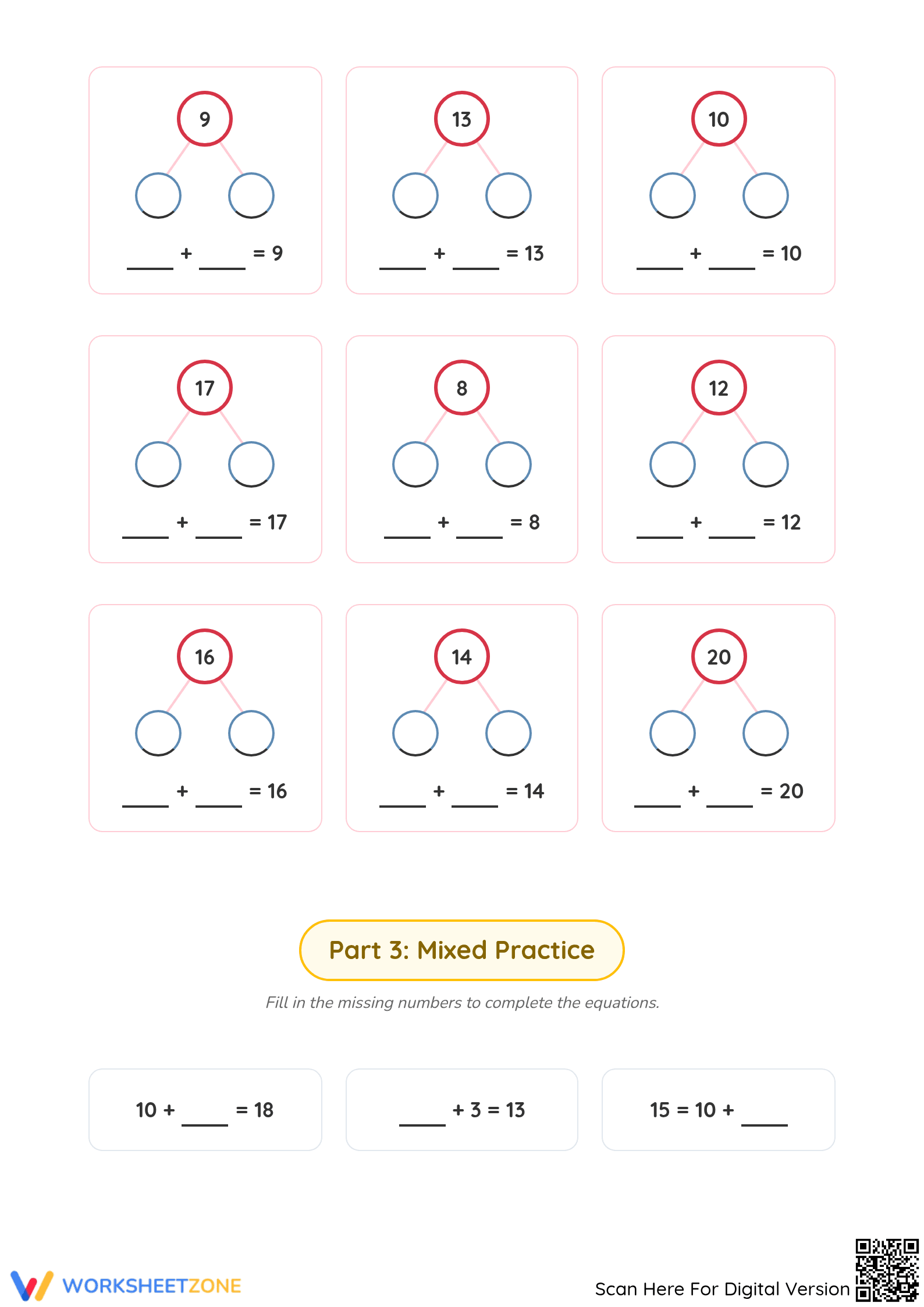
This Essential Compose and Decompose Within 20 worksheet provides young learners with 27 structured problems to master number relationships. Students will build foundational algebraic thinking by identifying part-part-whole connections and translating visual number bonds into addition sentences. This resource ensures students gain computational fluency needed for complex mental math strategies.
At a Glance
- Grade: 1–2 · Subject: Math
- Standard:
1.OA.C.6— Add and subtract within 20, demonstrating fluency for addition and subtraction- Skill Focus: Number Bonds & Part-Part-Whole Relationships
- Format: 3 pages · 27 problems · Answer key included · PDF
- Best For: Small group intervention or independent practice
- Time: 20–30 minutes
What's Inside
This comprehensive three-page PDF contains three distinct learning sections. Part 1 focuses on composing numbers by providing parts and asking for the whole. Part 2 shifts cognitive demand to decomposing, requiring students to break a whole number into logical components. Part 3 offers mixed equations to solidify the connection between number bonds and horizontal addition.
Zero-Prep Workflow
Teachers can implement this resource in under two minutes. Step 1: Print the three-page set for each student. Step 2: Distribute the sheets during independent work time or use them as a "Must-Do" activity in math centers. Step 3: Review student progress using the provided answer key for instant feedback. The intuitive layout makes this an ideal "grab-and-go" resource for substitute lesson plans.
Standards Alignment
The primary focus is CCSS 1.OA.C.6, which requires students to add and subtract within 20, demonstrating fluency. By visualizing numbers as bonded parts, students move beyond counting toward strategic manipulation. This worksheet also supports 2.NBT.B.7 by establishing foundations necessary for multi-digit addition. Both standard codes can be copied directly into lesson plans, IEP goals, or district curriculum mapping tools.
How to Use It
Assign this worksheet after a direct instruction lesson on "making ten" or number bond basics. Use the first page as a guided practice tool to check for understanding before releasing students to work independently. For a formative assessment, observe students working on Part 2 to see if they can identify multiple ways to decompose a single whole number without relying on finger counting.
Who It's For
This resource is tailored for first and second-grade students building early number sense. It is particularly effective for students requiring visual scaffolds to understand addition. Pair this worksheet with physical manipulatives like counters or a number line to provide extra support for tactile learners who are still bridging the gap between concrete and abstract mathematical concepts.
According to the RAND AIRS (2024) report on elementary numeracy, the use of visual models like number bonds is a proven strategy for increasing student engagement and retention in early mathematics. By explicitly linking part-whole relationships to standard addition sentences, this worksheet aligns with best practices in scaffolding for young learners. Research from EdReports (2024) emphasizes that composing and decomposing are essential precursors to higher-order arithmetic and algebraic reasoning. This standards-aligned 1.OA.C.6 resource provides the high-quality, targeted practice required to meet state and national benchmarks. Teachers can reliably use these 27 problems to measure progress toward mastery in number and operations. The structural consistency across all three pages reduces cognitive load, allowing students to focus entirely on the mathematical logic.


