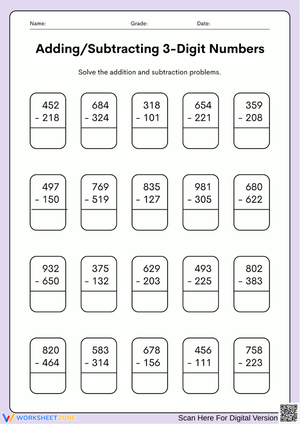
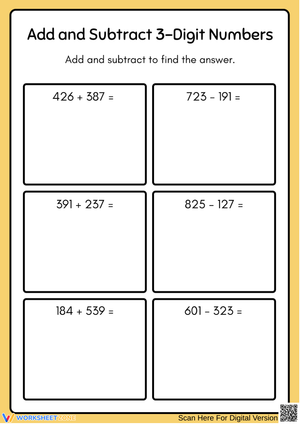
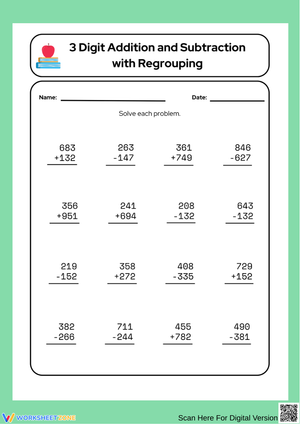
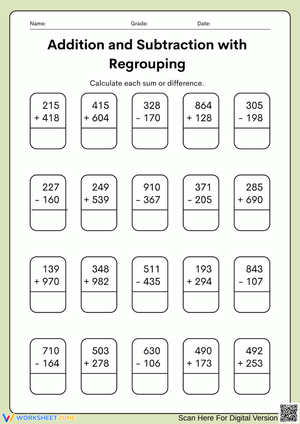
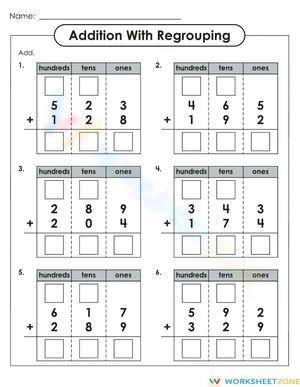
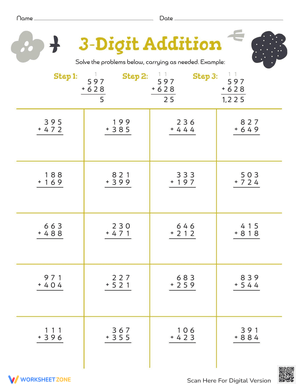
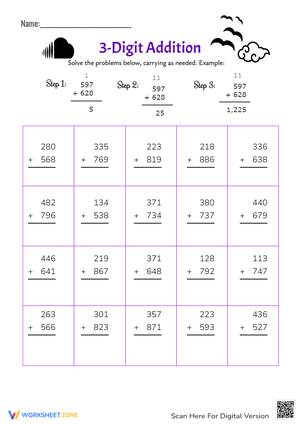
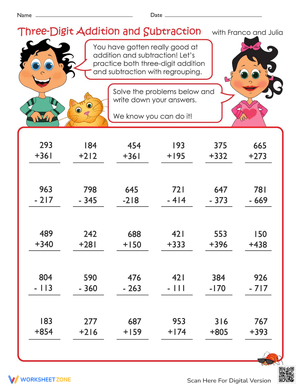
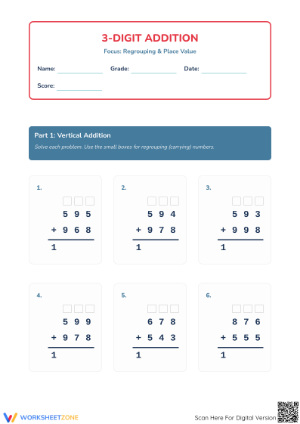
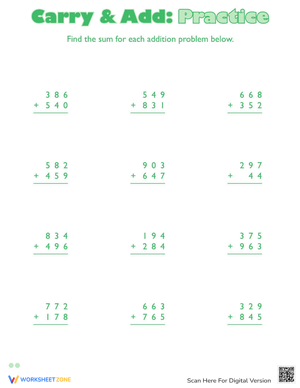
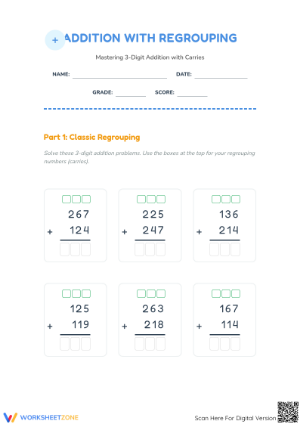
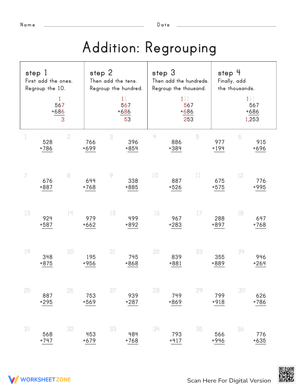
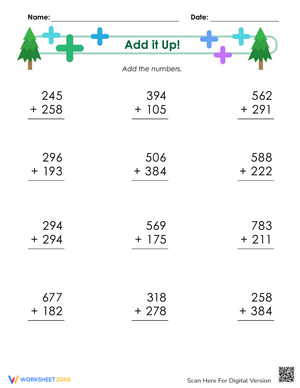
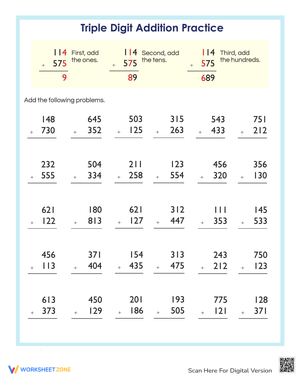
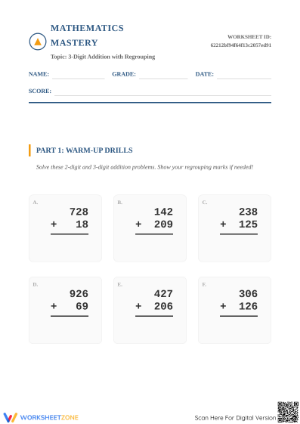
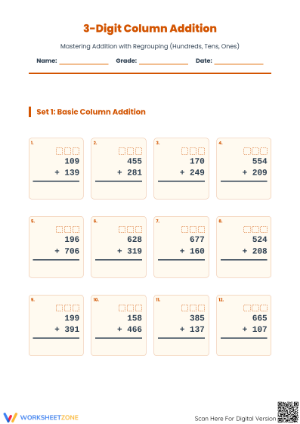
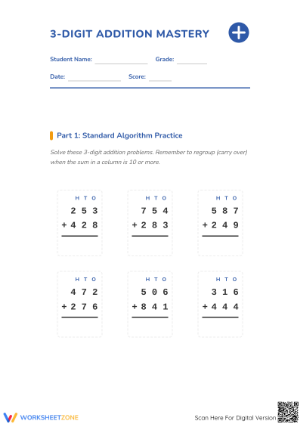
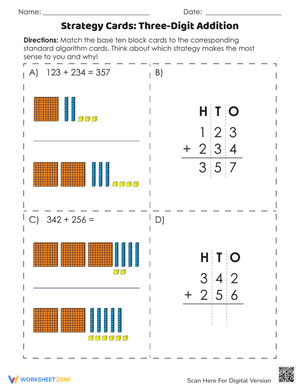
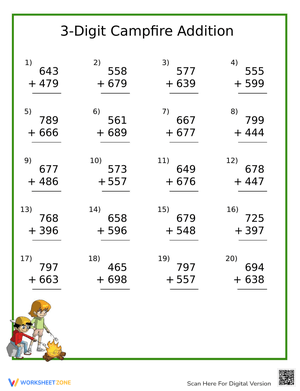
These 2nd grade three digit addition and regrouping pdf worksheets give teachers structured, printable practice for one of the trickier conceptual moves in elementary math — helping students see that "carrying" is actually renaming a group of ten, not a trick for making digits fit. At this grade level, that distinction matters: students who understand composing a new ten or hundred make far fewer errors and recover more quickly when they slip.
Skills Covered Across the Set
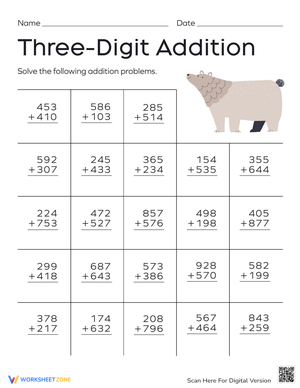
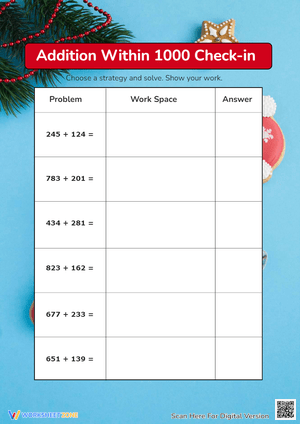
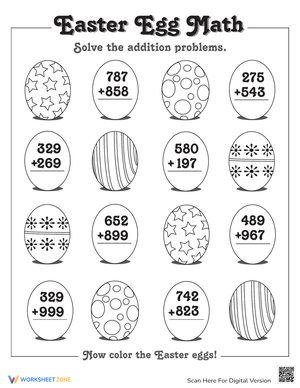
The worksheets move through a clear progression. Early worksheets focus on three-digit addition without regrouping, giving students room to practice column alignment and reinforce place-value notation before the composing step enters the picture. From there, problems introduce regrouping in the ones column only, then in the tens column only, then in both columns simultaneously.
Specific skills students practice include:
- Adding three-digit numbers with no regrouping to build column alignment habits
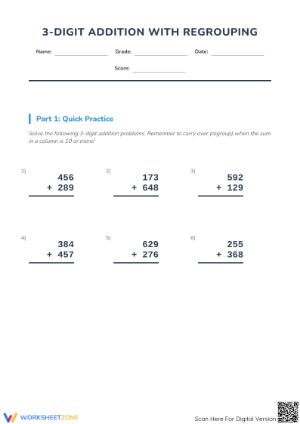
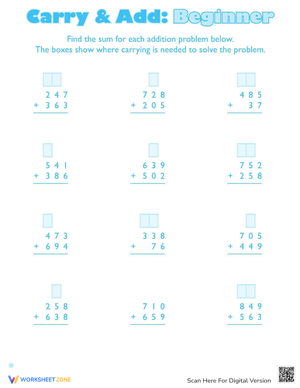
- Composing a new ten when the ones column sum reaches 10 or more
- Composing a new hundred when the tens column sum reaches 10 or more
- Handling double regrouping — carrying from ones to tens and from tens to hundreds in the same problem
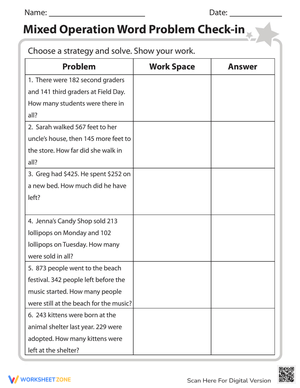
- Reading and solving word problems that require three-digit computation
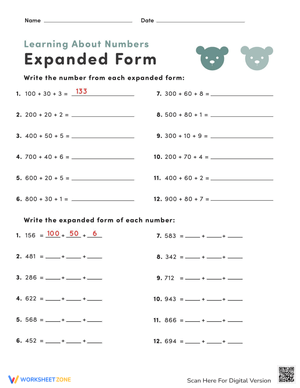
- Using expanded form to verify whether a written sum is reasonable
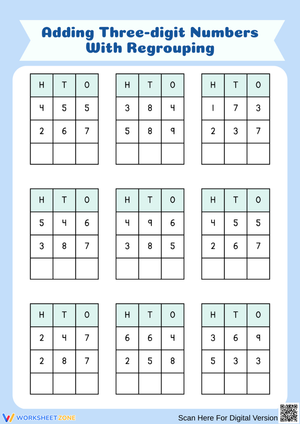
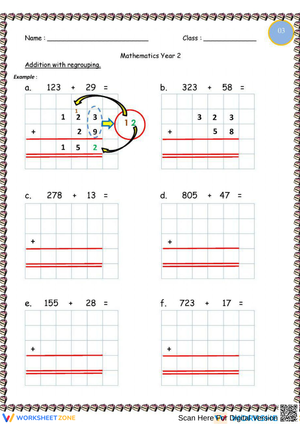
Several worksheets pair the vertical algorithm with a place-value chart so students record the composition step and the written step side by side, before that visual support disappears in later worksheets.
Mistakes Students Make That Teachers Need to Catch
Three-digit addition with regrouping generates a handful of errors that appear reliably across second-grade classrooms. The most common: students add the ones column, get 12, and write both digits into the ones place — producing a four-digit answer — rather than recording 2 and carrying the 1. The written work looks like they missed the entire lesson on regrouping, but often what happened is that they have not yet internalized that 12 ones means one group of ten with two remaining.
A second pattern involves students who do know to carry but place the regrouped digit above the wrong column. In a problem like 364 + 278, they correctly get 12 in the ones column, write the 2, but pencil the 1 above the hundreds column instead of the tens column. The computation then cascades into wrong answers that have no clean explanation unless you trace exactly where the carried digit landed.
A third issue is subtler: students who complete the algorithm correctly but cannot explain what the carried "1" represents. When asked, they say "that's just what you write up there." These 2nd grade three digit addition and regrouping pdf worksheets include a labeled step in the early problems where students write "1 ten" or "1 hundred" beside the carried digit — which surfaces that confusion before it hardens into a rote habit with no meaning attached.
Fitting These Worksheets Into Your Weekly Lesson Plan
The format works best inside a short, focused math block rather than as an extended independent task. A practical structure: open with a modeled example on the board using explicit place-value language — "we now have 13 tens, so we compose 1 hundred and have 3 tens left" — then solve 2–3 problems together before releasing students to work independently. Grade 2 students typically stay sharp for about 12–15 minutes on written computation before attention drifts, so selecting 6–8 targeted problems keeps thinking quality higher than rushing through 20.
These 2nd grade three digit addition and regrouping pdf worksheets also slot naturally into Monday morning warm-ups, when a no-regrouping worksheet serves as re-entry practice before new instruction begins, or into the Friday review block when a mixed-problem worksheet gives you a quick read on how much students retained across the week. For small-group intervention, pull one or two worksheets targeting a single regrouping type rather than the general mixed set — the narrower focus lets the group spend more time talking through each step and less time shifting between different problem structures.
Adjusting the Set for a Range of Learners
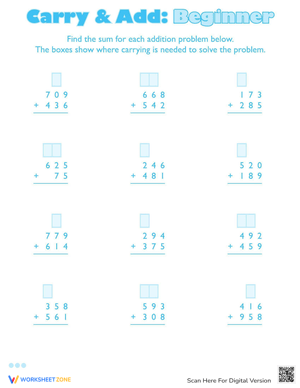
Not every second grader arrives at this unit in the same place. Students who can handle addition facts but consistently misalign digits benefit from worksheets that include pre-printed place-value columns — boxes labeled H, T, and O — so they can drop each digit into its correct slot before computing. That structural support removes one error source without reducing the mathematical demand of the problems themselves.
For students ready to move beyond supported formats, the mixed-regrouping worksheets ask them to decide first whether and where regrouping is necessary. Asking these students to circle each column total before regrouping adds a self-checking step that slows down impulsive computation and improves accuracy. Partner work is another option: one student computes while the other tracks place-value language, asking "what did you get in the ones column?" and "did we make a new ten?" That kind of structured conversation moves understanding forward faster than additional solo practice.
For students working below grade level who are not yet ready for regrouping, the no-regrouping worksheets in the set work as the current goal while other students handle composed tens. Keeping the format identical means these students participate in the same classroom routine without the visual signal of a visibly different-looking activity.
Standard Alignment
The set addresses CCSS 2.NBT.7, which calls for students to add and subtract within 1000 using strategies based on place value, properties of operations, and the relationship between addition and subtraction, and to connect those strategies to a written method. The standard's specific language about composing and decomposing tens and hundreds maps directly to what students practice when they work through regrouping in column addition. This standard sits at the intersection of conceptual understanding and written procedure, which is why the stronger 2nd grade three digit addition and regrouping pdf worksheets include both the vertical algorithm and a place-value representation — addressing the full intent of the standard rather than only its computational half.
Frequently Asked Questions
What prerequisite skills should students have before starting these worksheets?
Students should be able to identify the value of each digit in a three-digit number and add two-digit numbers with reasonable accuracy. Familiarity with base-ten blocks or place-value charts also helps, because the regrouping concept builds directly on the understanding that 10 ones make 1 ten and 10 tens make 1 hundred. Students who arrive without that foundation tend to treat the carried digit as a decoration rather than a quantity with meaning.
How do I explain "carrying" without letting it become a rote step?
Pair the word "carry" with composition language every time: "we have 14 ones, so we compose a new ten and have 4 ones left." Over time, students can say it with you, then say it independently. The moment a student can explain what the regrouped digit represents without prompting, the concept has moved from memorized step to actual understanding. The early worksheets in the set reinforce that language by labeling the regrouped amount directly beside the algorithm.
Can these worksheets serve both whole-class instruction and homework?
With one practical distinction. Worksheets that include place-value charts or expanded form work well for homework because the support structure is built into the problem itself. Worksheets with only the vertical algorithm are better kept in the classroom, where a teacher or peer can catch a misaligned digit or a missing carried value before a student reinforces the error through 15 minutes of practice at home with no one to redirect them.
How do I handle students who rush and skip the regrouping step entirely?
A verbal checklist works better than correcting the same error repeatedly after the fact. Before students start, write three questions where they can see them: Did you add all three column values in the ones place? Is your ones total 10 or more? Did you write the new ten above the tens column? Even students who know the procedure benefit from the forced pause, particularly those who treat written computation as something to finish rather than something to think through. Fewer problems with this check built in beats a full worksheet completed carelessly.













 Interactive Worksheet Maker
 Quiz Maker
 Word Search Maker
 Crossword Puzzle Maker
 Word Scramble Generator
 Sentence Scramble Generator
 Handwriting Worksheet Generator
 Name Tracing Generator
 Fill In The Blank Generator