


























Views
Downloads


Essential Grade 2 Math Jam: Printable Addition & Subtraction
Paste this activity's link or code into your existing LMS (Google Classroom, Canvas, Teams, Schoology, Moodle, etc.).
Students can open and work on the activity right away, with no student login required.
You'll still be able to track student progress and results from your teacher account.
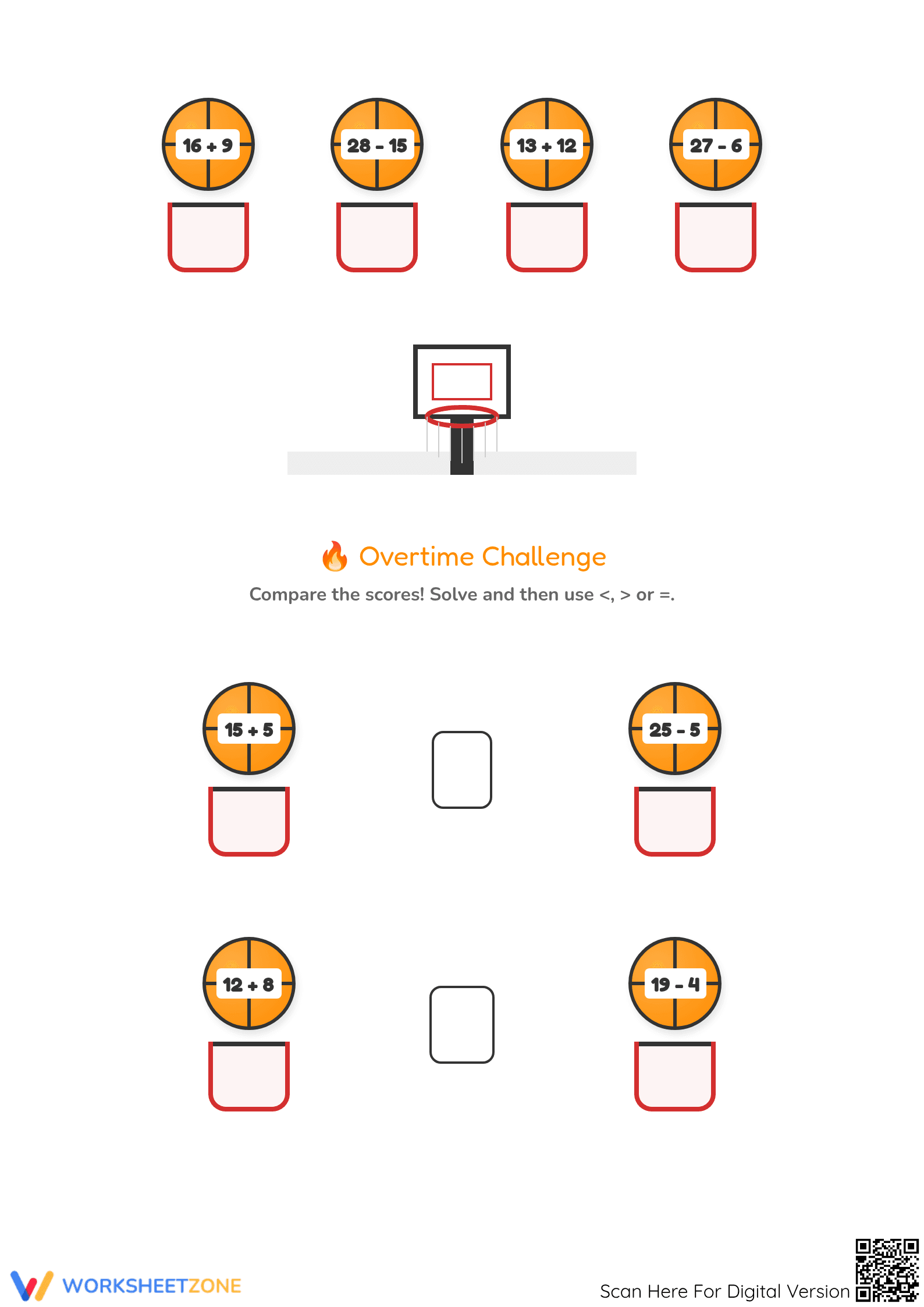
Fluently adding and subtracting within 100 is a cornerstone of second-grade numeracy. This worksheet provides a high-interest basketball theme to keep students engaged while they practice regrouping and mental math strategies. By moving from basic computation to comparison and word problems, learners build a robust understanding of operational relationships and mathematical precision.
At a Glance
- Grade: 2 · Subject: Math
- Standard:
2.NBT.B.5— Fluently add and subtract within 100 using strategies based on place value- Skill Focus: Mixed Operations & Comparisons
- Format: 3 pages · 20 problems · Answer key included · PDF
- Best For: Independent practice or morning work
- Time: 15–20 minutes
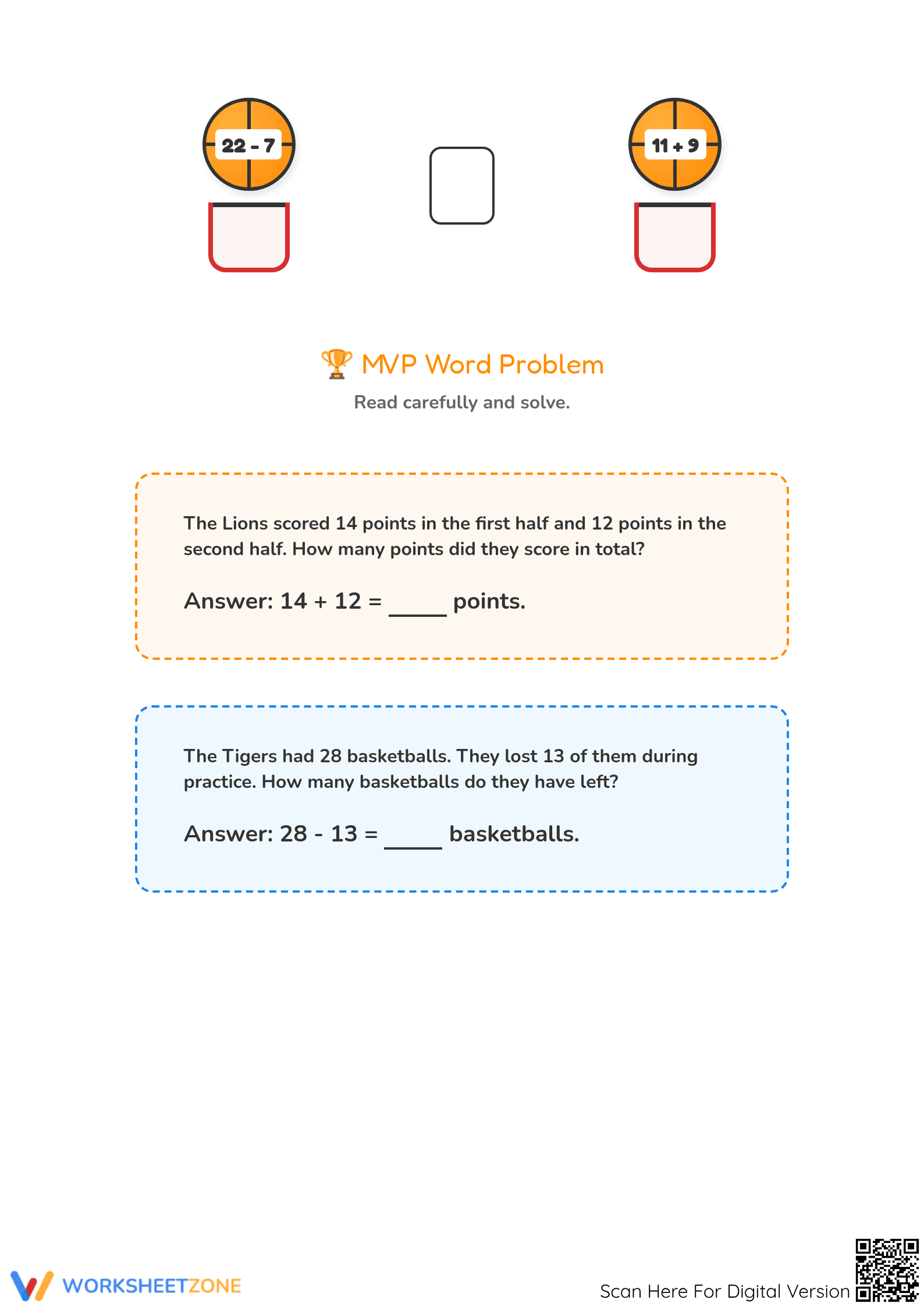
This 3-page packet features 12 "Slam Dunk" computation problems, 3 "Overtime Challenge" comparison tasks requiring multi-step thinking, and 2 "MVP" word problems that ground abstract math in real-world scoring scenarios. The layout includes clear workspace for students to write their answers directly inside the basketball hoops and comparison boxes. A full answer key is provided to facilitate rapid grading or student self-check.
The print-and-go design ensures zero teacher prep time beyond the 30 seconds at the copier. Distribute the "Math Jam" packet during a morning work block or as a fast-finisher activity to keep engagement high without needing additional materials. Reviewing the word problems as a whole group takes roughly 5 minutes, allowing for immediate feedback on problem-solving strategies and operational sign awareness.
Standards Alignment: 2.NBT.B.5 — "Fluently add and subtract within 100 using strategies based on place value, properties of operations, and/or the relationship between addition and subtraction." This resource also supports 2.OA.A.1 through the inclusion of basketball-themed word problems that require students to represent and solve one-step addition and subtraction problems. Both standard codes can be copied directly into lesson plans, IEP goals, or district curriculum mapping tools.
Use this as a formative assessment after teaching strategies for adding and subtracting two-digit numbers. Observe if students are using mental math or drawing base-ten blocks in the margins to solve the comparisons. Expected completion time is 15–20 minutes, making it an ideal exit ticket or mid-unit progress check during a sports-themed math unit or right before a school break.
This resource is designed for Grade 2 students but serves as an excellent intervention tool for Grade 3 learners struggling with fluency. It pairs naturally with an anchor chart showing "addition vs. subtraction" keywords or base-ten blocks. The basketball theme provides a low-floor, high-ceiling entry point for students who may otherwise experience math anxiety, turning drill practice into a game-like challenge.
The Grade 2 requirement for fluency within 100, specifically codified in 2.NBT.B.5, requires students to move beyond finger counting toward strategic mental manipulation of numbers. Research from the RAND AIRS 2024 report indicates that themed, "low-stakes" practice formats significantly reduce cognitive load, allowing students to focus more on the underlying arithmetic properties rather than the stress of performance. Fisher & Frey (2014) emphasize that integrating mixed operations within a single session—as seen in the "Slam Dunk" and "Overtime" sections—forces students to pay closer attention to operational signs, a key step in developing mathematical precision. By requiring learners to solve two different expressions before applying a comparison operator, the worksheet scaffolds the transition from simple computation to relational thinking. This standard-aligned approach ensures that students are not merely memorizing facts but are building the conceptual framework necessary for higher-level base-ten operations.


