


























Views
Downloads




Complete 2-Digit Addition Worksheet (No Regrouping) - Grade 2
Paste this activity's link or code into your existing LMS (Google Classroom, Canvas, Teams, Schoology, Moodle, etc.).
Students can open and work on the activity right away, with no student login required.
You'll still be able to track student progress and results from your teacher account.
Mastering 2-Digit Addition Without Regrouping
This comprehensive Grade 2 mathematics worksheet provides structured practice for adding two-digit numbers without regrouping. Students develop place-value fluency by working through 33 unique problems, ranging from standard vertical algorithms to contextual word problems. This resource ensures learners build the confidence needed for more complex arithmetic operations.
At a Glance
- Grade: Grade 2 · Subject: Math
- Standard:
CCSS.MATH.CONTENT.2.NBT.B.5— Fluently add within 100 using strategies based on place value and properties- Skill Focus: 2-Digit Addition Without Regrouping
- Format: 4 pages · 33 problems · Answer key included · PDF
- Best For: Independent practice or formative assessment
- Time: 20–30 minutes
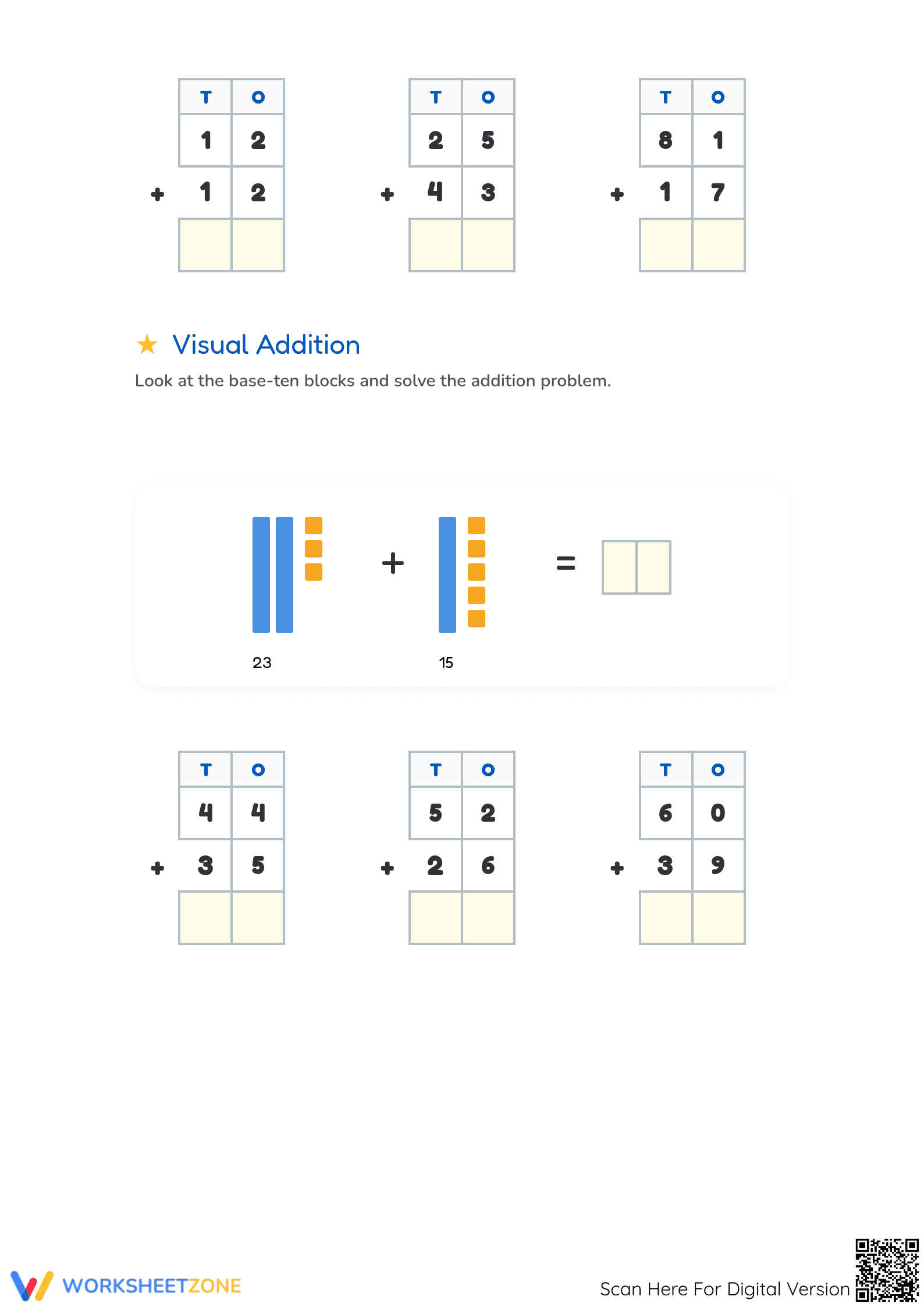
What's Inside: This four-page PDF packet features four distinct practice modalities. Page one introduces standard grid addition with nine problems. Page two incorporates visual addition using base-ten blocks. Page three challenges students with word problems, while page four presents a 'Missing Digits Challenge' to promote higher-order thinking. Totaling 33 tasks, it includes a full answer key.
Zero-Prep Workflow: Teachers can integrate this resource into their daily routine easily. First, print the four-page packet for each student (1 minute). Second, distribute the worksheets and briefly review the visual addition example on page two (2 minutes). Finally, use the included answer key for rapid grading or peer-review sessions at the end of the instructional block (5 minutes). Total teacher preparation time is minimal.
Standards Alignment: This resource is primarily aligned to `CCSS.MATH.CONTENT.2.NBT.B.5`, which requires students to fluently add and subtract within 100 using strategies based on place value. By focusing on addition without regrouping, the worksheet isolates the mechanic of adding tens to tens and ones to ones. This standard code can be copied directly into lesson plans, IEP goals, or district curriculum mapping tools.
How to Use It: Deploy this worksheet as a mid-unit formative assessment after students have mastered basic addition facts but before introducing the concept of carrying or regrouping. During the activity, observe if students consistently start with the ones column; students who struggle may benefit from using physical manipulatives alongside the visual aids on page two. Expect completion within 30 minutes for the full packet.
Who It's For: This resource is ideal for second-grade students in general education settings, though it serves as an excellent enrichment tool for first-graders or a remedial intervention for third-graders. It pairs naturally with base-ten block manipulatives and classroom anchor charts detailing the "Tens and Ones" place value columns.
According to the RAND AIRS 2024 analysis of instructional materials, scaffolding mathematical operations through visual representations significantly improves procedural fluency in early elementary learners. This worksheet utilizes base-ten block imagery and "Missing Digits" puzzles to move students beyond rote memorization and toward a conceptual understanding of 2-digit addition. By isolating the standard code CCSS.MATH.CONTENT.2.NBT.B.5, the resource allows educators to target specific place-value skills without the cognitive load of regrouping. This structured approach helps bridge the gap between concrete manipulatives and abstract numerical algorithms. The inclusion of word problems further ensures that students can apply their addition skills to real-world scenarios, a key component of mathematical literacy. Teachers can rely on this validated practice set to provide the repetition necessary for mastery while maintaining student engagement through diverse task types and clear, printable layouts suitable for any classroom environment.


