


























Views
Downloads


Grade 1-2 Addition within 100 — Essential No-Prep Worksheet
Paste this activity's link or code into your existing LMS (Google Classroom, Canvas, Teams, Schoology, Moodle, etc.).
Students can open and work on the activity right away, with no student login required.
You'll still be able to track student progress and results from your teacher account.
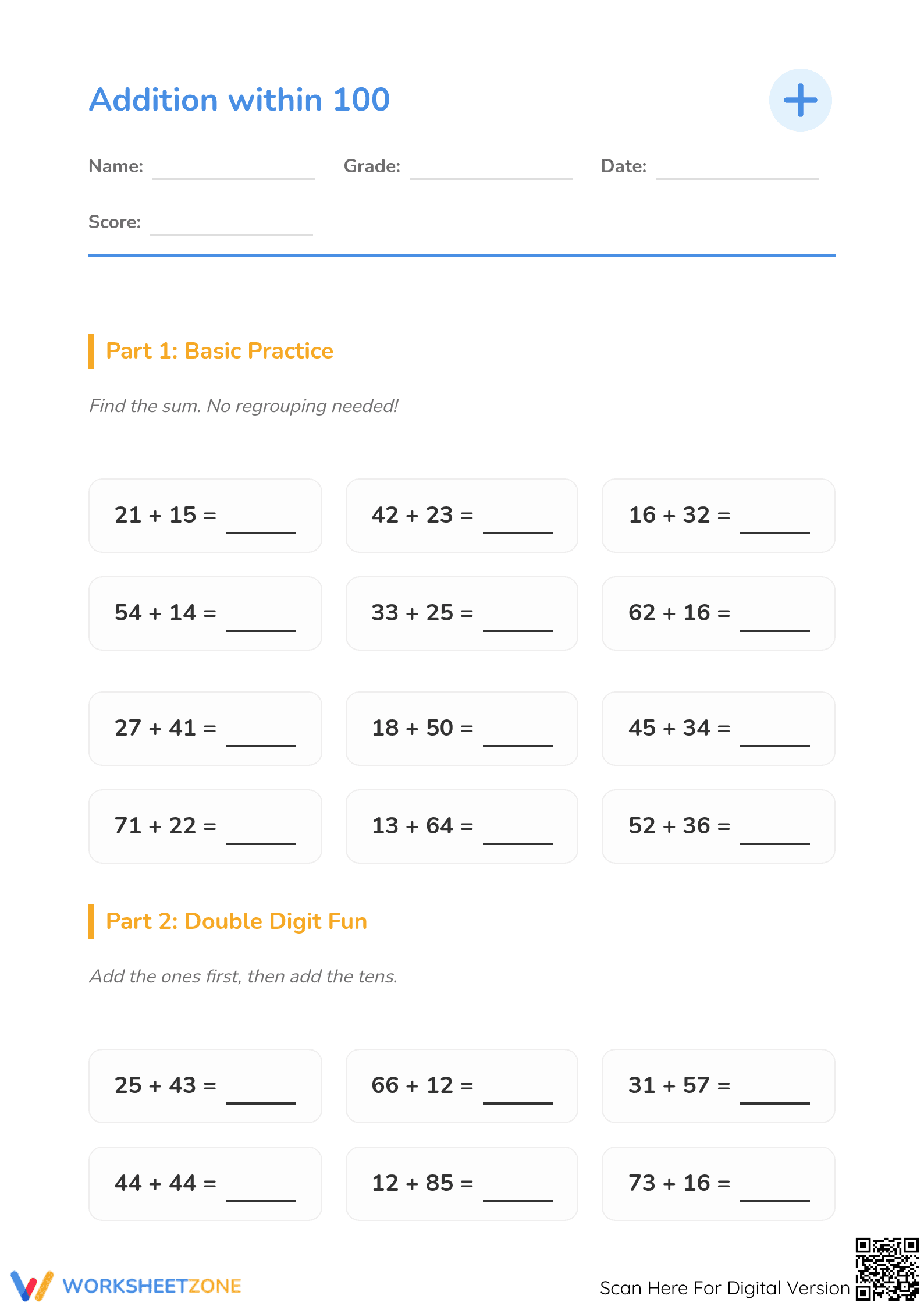
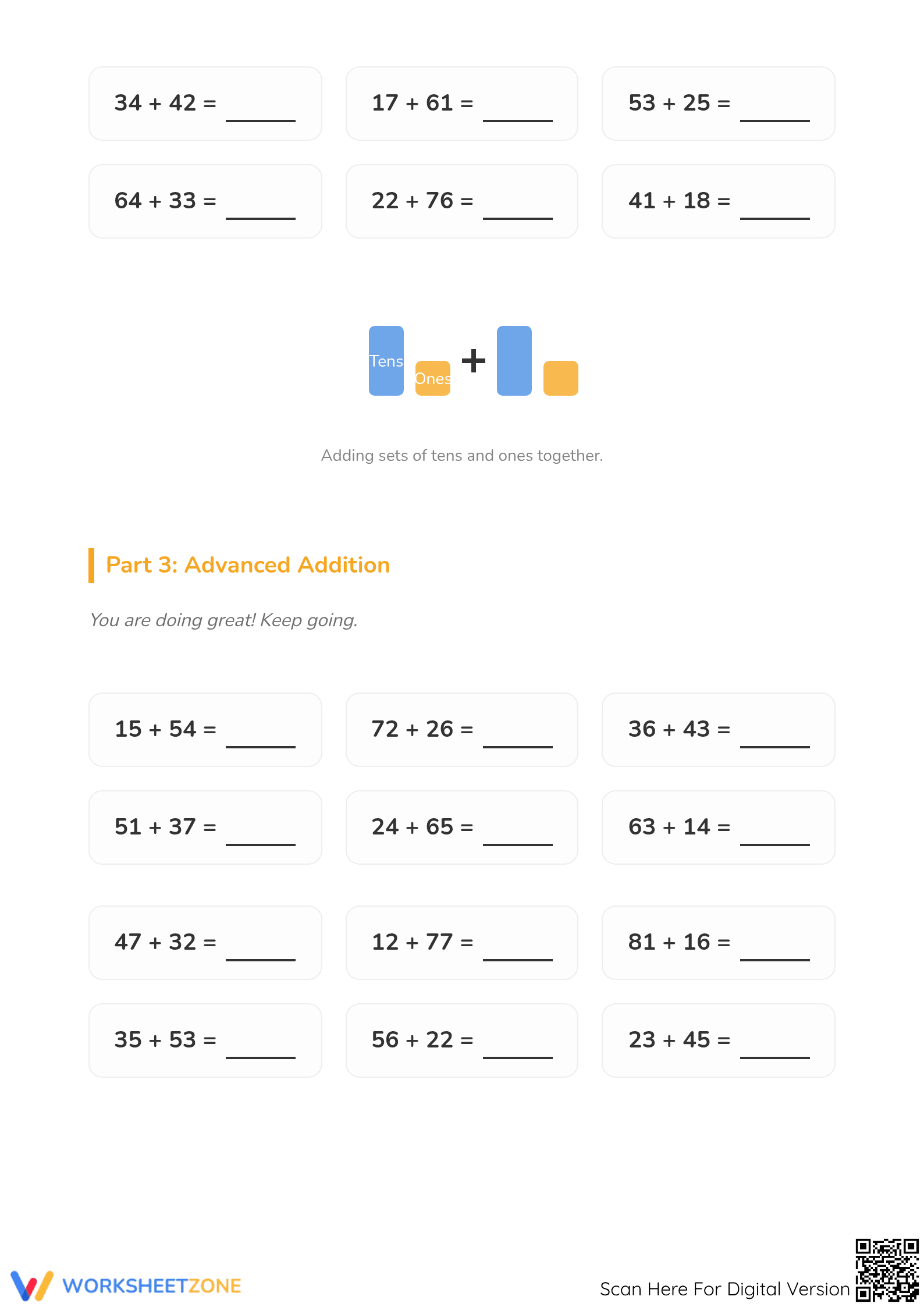
This comprehensive three-page worksheet provides targeted practice for students mastering addition within 100 without regrouping. By focusing on the foundational relationship between tens and ones, students build computational fluency through forty-two carefully structured problems. The clear layout ensures that young learners can focus entirely on the mathematical logic of combining digits across columns.
At a Glance
- Grade: 1 · Subject: Math
- Standard:
CCSS.MATH.CONTENT.1.NBT.C.4— Add within 100 using place value strategies and written methods- Skill Focus: Addition within 100 (No Regrouping)
- Format: 3 pages · 42 problems · Answer key included · PDF
- Best For: Morning work or independent center practice
- Time: 20–30 minutes
This download includes three distinct pages containing forty-two addition problems divided into four progressive sections: Basic Practice, Double Digit Fun, Advanced Addition, and Challenge Problems. Each section features a clean vertical alignment or horizontal equation format with ample whitespace for student work. A complete answer key is provided to facilitate rapid grading or self-checking during classroom rotations.
The zero-prep workflow for this resource is designed for maximum teacher efficiency. First, print the three-page PDF (30 seconds). Next, distribute the packets to students during your math block (1 minute). Finally, use the provided answer key to review results or allow students to peer-grade (30 seconds). Total preparation time is under two minutes, making it an ideal choice for emergency substitute plans.
The primary focus is CCSS.MATH.CONTENT.1.NBT.C.4, which requires students to add within 100, including adding a two-digit number and a one-digit number, and adding a two-digit number and a multiple of 10. The worksheet reinforces the understanding that in adding two-digit numbers, one adds tens and tens, and ones and ones. This standard code can be copied directly into lesson plans or district curriculum mapping tools.
Assign this worksheet as a formative assessment after introducing the concept of place value addition. Teachers should observe students to ensure they are consistently adding the ones column before the tens column, even when regrouping is not required, to establish healthy long-term habits. The resource is also effective as a quiet-time activity for early finishers who need to solidify their basic arithmetic speed.
This resource is tailored for first and second-grade students who are transitioning from single-digit addition to multi-digit operations. It provides a scaffolded bridge for learners who have mastered counting but are not yet ready for the complexities of carrying or regrouping. Pair this worksheet with base-ten blocks or a hundreds chart to provide visual support for students who benefit from tactile manipulatives.
According to the RAND AIRS 2024 report on elementary mathematics, providing students with structured, repetitive practice in place value addition without the cognitive load of regrouping significantly increases long-term retention of arithmetic facts. This worksheet targets the CCSS.MATH.CONTENT.1.NBT.C.4 standard by isolating the skill of vertical addition, allowing students to develop a "place value first" mindset. By solving forty-two problems across three pages, learners move from basic recall to more advanced application, mirroring the gradual release of responsibility model advocated by Fisher & Frey (2014). This approach ensures that the fundamental mechanics of addition are deeply encoded before more complex multi-step operations are introduced in later grades. Educators can rely on this resource as a high-quality instructional tool that aligns with evidence-based practices for early numeracy development, providing clear evidence of student progress toward meeting state and national proficiency benchmarks in mathematics.


