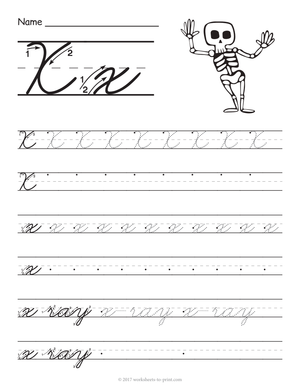
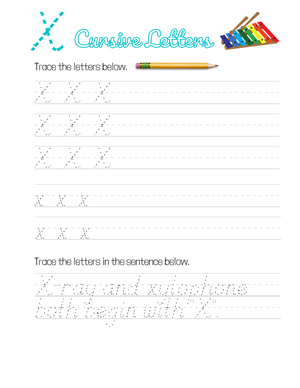
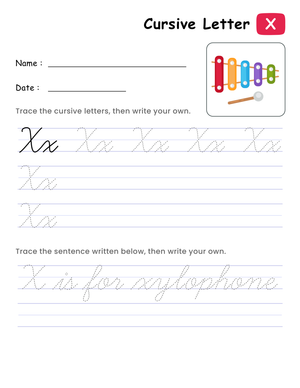
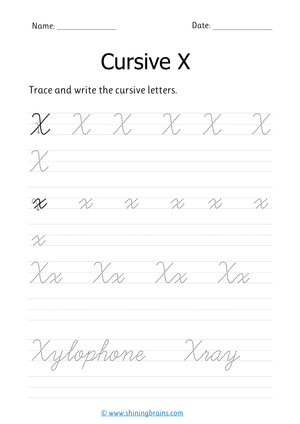
2nd Grade Cursive X Handwriting worksheets
These 2nd grade cursive x handwriting worksheets give teachers a focused set of resources for one of the most counterintuitive letters in the cursive alphabet — a letter that looks nearly identical to its print form but requires a fundamentally different approach to form correctly. The set covers isolated stroke practice, word-level writing, and sentence-length exercises, with directional arrows built into every tracing sequence.
The Stroke That Breaks the Cursive Rule
Almost every cursive letter is formed without lifting the pencil. The lowercase x is an exception, and that exception matters more than it might seem. Students need two separate strokes: a slanted forward stroke from near the midline to the baseline, then a lift and a second stroke crossing in the opposite direction. Second graders who have spent several weeks building muscle memory around continuous flow find this interruption genuinely disorienting — and students who aren't told explicitly about the lift will often drag the crossing stroke from wherever their pencil lands, producing something between a flattened print x and an unintended figure-eight.
The uppercase X follows the same two-stroke logic at full letter height. Depending on the handwriting program a district uses — Zaner-Bloser, D'Nealian, or Learning Without Tears — the entry angle and lead-in stroke differ slightly. That variation doesn't change the core instruction, but it's worth naming when a student asks why the worksheet arrows look different from the classroom anchor chart.
What Each Worksheet Targets
The set works through the cursive x at three levels of increasing complexity:
- Isolated letter formation — Large traceable letters with numbered directional arrows for both uppercase and lowercase, followed by independent writing on ruled lines. The two forms are covered separately before being combined on the same exercise.
- Word-level practice — Students begin with words where x appears at the end (fox, box, wax), then move to words with x in the middle (exit, taxi, mixes). This sequence addresses cross-stroke timing directly, building the finish-then-fix habit one word position at a time.
- Sentence-length writing — Short sentences that integrate the x with previously learned cursive letters, requiring students to maintain consistent spacing and letter connection across a longer run of text.
The 2nd grade cursive x handwriting worksheets also include side-by-side comparison tracing lines showing print x next to cursive x. That pairing helps students who have strong print habits understand why the cursive version requires a different hand movement, rather than assuming they can adapt on instinct.
Student Errors Worth Watching for Before They Harden into Habits
Three error patterns appear consistently in second-grade work with cursive x, and each calls for a different corrective move.
The most common is skipping the pencil lift entirely. Students attempt both strokes of the x in one continuous sweep, which typically produces something between a compressed figure-eight and an unintended ampersand. The most reliable fix is returning to gross motor practice: students write the letter in the air using a full arm movement while narrating aloud — "down, lift, cross." The verbalization slows the motion enough that the two steps register as distinct actions rather than one blurred gesture.
The second issue is cross-stroke placement. Students frequently cross too high, intersecting the first stroke near the top rather than across the middle, so the x looks like it's wearing a low-hanging cap. Comparison strips showing well-formed x letters alongside misplaced cross-strokes give students a concrete reference point for self-checking — more effective, in practice, than a verbal reminder that won't survive past the first line of independent writing.
The third error is timing within a word. When writing fox or box, many students stop after the base strokes of the x and cross it immediately, breaking the forward flow mid-word. This is directly analogous to the i-dotting and t-crossing instruction students receive, but the pull to fix the x right away is stronger — an uncrossed x looks more obviously incomplete to a second grader than an uncrossed t does. A useful classroom routine is to have students write a target word in pencil, then run back over the entire word with a crayon before adding any cross-strokes. That physical separation of forward writing from finishing strokes makes the sequence easier to internalize than any verbal rule.
How to Work These Worksheets Into Your Lesson Plans
The most effective introduction sequence moves from body to paper. Before students pick up a pencil, spend three to five minutes on air writing — full arm sweeps tracing the x motion while the teacher narrates the stroke order aloud. Shaving cream on desk surfaces works equally well and gives the tactile practice a natural endpoint when cleanup begins. The transition to tracing lines on paper is noticeably smoother after that kind of physical rehearsal.
Within the handwriting block, the 2nd grade cursive x handwriting worksheets fit cleanly into a gradual release sequence: teacher model, guided tracing with narration, and then independent writing on the ruled lines below. That full cycle runs about twelve minutes for a first introduction. Word-level practice then works well as a five-minute warm-up the following day — retrieval practice on day two consistently produces stronger retention than massed practice packed into a single session.
For the cross-stroke timing issue specifically, brief daily repetition across four or five sessions outperforms one long block. An eight-minute routine at the start of writing time — trace a target word, write it independently, underline the x before crossing it — builds the finish-then-fix habit faster than any reminder sticker on the desk corner.
Adjusting the Worksheets for Different Student Levels
The 2nd grade cursive x handwriting worksheets set works across a range of readiness levels with a few targeted adjustments. Students who are still building grip strength and basic line placement benefit most from the tracing exercises used inside clear plastic sleeves — a dry-erase marker lets them repeat the same exercise multiple times, and removing the pressure of working on fresh paper often frees up enough attention for the stroke sequence to actually land.
Students who move through isolation practice quickly can advance to sentence-level work and take on a three-point self-assessment after each line: Does the cross-stroke intersect near the middle of the x? Does the letter sit on the baseline? Does the exit stroke connect cleanly to the next letter without a gap? Students at this level are ready to monitor their own formation rather than waiting for teacher feedback, and that shift toward self-checking is a natural next step in handwriting development.
For students who struggle significantly with the two-stroke concept, a physical manipulative sometimes helps more than additional tracing. Two craft sticks arranged in an x — where the student literally picks up and places the second stick at the crossing point — makes the abstract pencil-lift instruction concrete in a way that verbal reminders often don't.
Frequently Asked Questions
When exactly should students lift their pencil while writing a cursive x?
After completing the first stroke — the slanted stroke that runs from near the midline down to the baseline. The pencil then repositions near the midline on the opposite side before making the crossing stroke. This is one of the few places in cursive writing where a lift is standard and correct, and naming it explicitly at the start of instruction prevents students from discovering it only through repeated errors.
Should the cross-stroke be added before or after writing the next letter?
After the entire word is written. The forward motion of a word should not pause mid-word for the x's cross-stroke. Students finish the continuous letter sequence first, then return to cross the x — the same way they dot an i or cross a t at the end of a word. Words like fox and box are good early practice because the x falls last and the return is immediate.
How does cursive x formation differ across major handwriting programs?
The two-stroke structure is consistent across programs. What varies is the entry angle and whether a lead-in stroke precedes the first slant. Zaner-Bloser starts cleanly at the midline with a direct slant; D'Nealian uses a slightly curved lead-in; Learning Without Tears keeps both strokes minimal to reduce early frustration. If a student's arrows look different from your classroom anchor chart, a brief acknowledgment is more useful than treating either version as incorrect.
Is cursive x harder for second graders than other letters?
Yes, reliably. The pencil-lift requirement runs counter to the continuous-stroke principle students have been reinforcing for weeks, and the visual similarity to print x leads students to underestimate how different the formation actually is. Letters like cursive k and z also require a lift, so students who have worked through those have a somewhat easier time — but for many second graders encountering the lift requirement for the first time, the x is where the confusion peaks.
Clear All