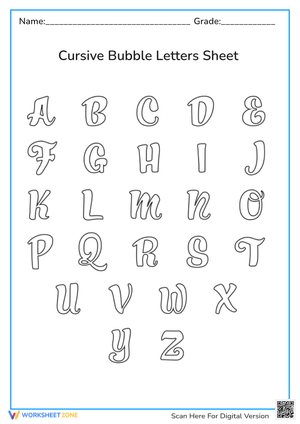
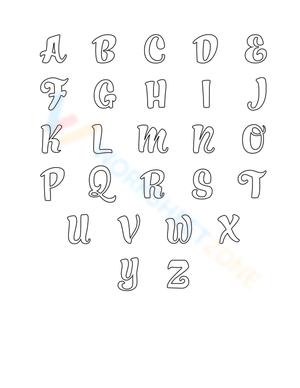
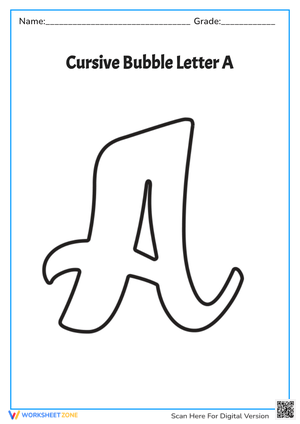
Cursive can feel intimidating to a room full of second graders who are still steadying their pencil grip. Bubble-style cursive letters lower that pressure by turning each connected letterform into a large, outlined shape students can trace, color, and study before they ever attempt a fast, flowing stroke. Instead of chasing fluency on day one, young writers get to see the whole shape of a cursive a, e, or l and internalize where the line travels.
These 2nd grade cursive bubble letters work because they separate two skills that often get tangled together: recognizing the shape of a letter and producing it smoothly. When the outline is big and clear, second graders can focus on direction, loops, and connection points without worrying that their line is too shaky. That early success matters, because confidence is often what keeps a hesitant writer coming back to practice.
What 2nd Grade Cursive Bubble Letters Actually Teach
A strong bubble cursive page does more than look playful. Each outlined letter becomes a map of stroke order. Students trace the inside path with a finger or pencil, then color the letter, reinforcing the movement through repetition and touch. This multisensory approach helps second graders connect what a cursive letter looks like with how their hand needs to move to make it.
- Letter-shape recognition: seeing the full outline builds a clear mental picture of each cursive form.
- Stroke direction: arrows or numbered paths inside the bubble guide correct entry and exit points.
- Connection awareness: students notice where one letter joins the next, a skill print handwriting never asks for.
- Fine motor control: coloring inside the lines strengthens the small hand muscles used for writing.
Classroom Implementation
Bubble cursive letters fit naturally into the routines you already run. Because the pages are self-explanatory, they work well in independent and small-group settings without heavy teacher direction.
- Morning work: put one bubble letter on each desk as a calm, focused start to the day.
- Literacy centers: pair a tracing pass with a coloring pass so students rotate through two tasks at one station.
- Intervention groups: use a single letter at a time with students who need extra fine motor support, adding finger tracing before pencil work.
- Early finishers: keep a stack ready so students who complete other work stay productive.
- Home practice: send a page home for optional coloring that quietly reinforces letter shapes.
Keep sessions short. Five to ten focused minutes on one or two letters beats a long, tiring page that leaves hands sore and attention scattered.
Frequently Asked Questions
1. Is 2nd grade the right age to start cursive with bubble-letter practice sheets?
Yes. Bubble letters are a low-pressure introduction, and several states now introduce cursive in 2nd grade. The large outlines let students build shape recognition and fine motor control before they attempt fluent, connected writing.
2. How do bubble cursive letters help students learn correct letter formation?
The outlined shape shows the full path of each cursive letter, including loops and connection points. Tracing the interior guideline and coloring the shape reinforce stroke direction through repetition and touch, so the correct movement becomes familiar.
3. How can teachers use bubble cursive worksheets in small-group or intervention settings?
Focus on one letter at a time. Have students finger-trace the outline, then trace with a pencil, then color. This slow, multisensory sequence supports learners who need extra fine motor practice and keeps the task achievable.
4. Should print handwriting continue alongside cursive bubble letter practice in 2nd grade?
Absolutely. Print remains the priority for most second-grade writing, and research links sustained print instruction in grades 1-2 to stronger fluency and spelling. Use bubble cursive as a short enrichment activity that complements, not replaces, print work.