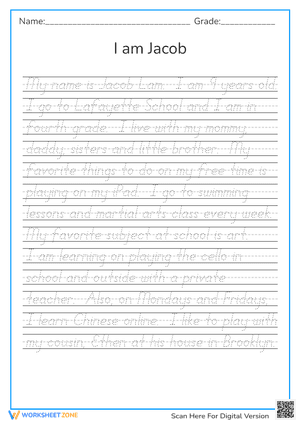
Second grade is a reinforcement year for handwriting. Most students arrive already familiar with the alphabet, but consistent size, spacing, and slant are still developing. Handwriting worksheets give teachers a low-prep way to keep letter formation on track without pulling time away from reading and writing instruction. For a class of seven and eight year olds, a short, focused worksheet often does more for legibility than an open-ended writing prompt where letter shape gets ignored in favor of getting ideas down.
Worksheets also give teachers something concrete to look at when deciding who needs extra support. A quick scan of a completed page shows which students are reversing letters, sizing them inconsistently, or struggling to keep writing on the line. That kind of quick visual check is hard to get from a full page of student writing where content, not form, is the focus.
Letter Formation Skills 2nd Graders Should Practice
By this point in the year, second graders are generally expected to form most upper- and lower-case letters with consistent size, spacing, and slant. Worksheets that isolate individual letters, letter families, or short words help students practice these mechanics before applying them in longer writing tasks.
- Consistent letter height between tall, short, and descending letters
- Even spacing between letters and words
- Correct starting points and stroke direction for each letter
- Legible connection between handwriting practice and daily written work
- Steady pencil grip and hand positioning during extended writing
Worksheets that combine letter drills with short sentences give students a chance to transfer isolated practice into functional writing, which is closer to what they will do during journal time or content-area writing.
Building a Daily Handwriting Routine
Many classrooms fit handwriting practice into a five to ten minute warm-up before literacy block, or as a rotation during literacy centers. A short worksheet keeps this routine predictable: students know what to expect, and teachers can circulate to check formation without needing to plan a full lesson every day.
Rotating worksheet types across the week keeps the routine from feeling repetitive. One day might focus on a single letter family, another on sentence copying, and another on a self-check page where students circle their best-formed letters. This variety keeps the practice purposeful rather than mechanical.
Understanding State Requirements at This Grade Level
As of 2024, 25 states require cursive writing instruction in public schools, with some introducing it at this grade level rather than waiting until later. That means handwriting worksheets serve two purposes in many classrooms: reinforcing manuscript legibility while also laying groundwork for an eventual shift to cursive strokes.
An Education Week analysis found that national standards do not explicitly require handwriting or cursive instruction, leaving letter formation practice to state and district discretion. As of 2024, 25 states have chosen to mandate cursive writing in public schools, according to the same report, which means classroom expectations can vary widely depending on location.
Because requirements differ so much by state, it helps to check district guidance before introducing cursive-style worksheets. In classrooms where cursive is not yet required, sticking with manuscript worksheets that reinforce size and spacing keeps practice aligned with what students are expected to produce in daily written work.
Teacher Tips for Using Handwriting Worksheets Efficiently
Handwriting worksheets work best when they are treated as a quick, targeted tool rather than a lengthy assignment. A few practices help keep the routine effective without eating into instructional time.
- Keep daily practice short, around five to ten minutes, so it stays a warm-up rather than a full lesson
- Choose worksheets that match the specific letters or patterns a student is struggling with, rather than assigning the same page to the whole class
- Use worksheets as a quick formative check by collecting them weekly instead of daily
- Pair handwriting practice with spelling words or vocabulary terms so students reinforce two skills at once
- Model correct letter formation on a whiteboard before handing out a new worksheet style
Small-group or literacy center use tends to work better than whole-class instruction for handwriting, since it allows a teacher to give quick, individual feedback while other students rotate through independent tasks.
Frequently Asked Questions
1. What handwriting skills should 2nd graders master by year end?
Students should be able to form most upper- and lower-case letters with consistent size, spacing, and slant, and should be able to keep writing aligned to a baseline across a short passage.
2. How often should 2nd graders practice handwriting in class?
A short daily routine of five to ten minutes, either as a warm-up or during a literacy center rotation, is generally enough to reinforce formation without displacing other instruction.
3. Do 2nd grade standards require cursive writing?
Requirements vary by state. As of 2024, 25 states mandate cursive instruction, and some introduce it at this grade level, so teachers should check district guidance rather than assuming a single national rule applies.
4. How can teachers support students who struggle with letter formation?
Worksheets with wider lines, dotted guide letters, and fewer items per page reduce fatigue for students needing extra support, and pairing practice with verbal cues about stroke direction can help students who benefit from multisensory input.
5. How do handwriting worksheets fit into a broader literacy block?
They work well as a short warm-up before writing instruction or as one rotation during literacy centers, giving teachers a quick way to check formation progress without dedicating a full lesson to handwriting alone.












 Interactive Worksheet Maker
 Quiz Maker
 Word Search Maker
 Crossword Puzzle Maker
 Word Scramble Generator
 Sentence Scramble Generator
 Handwriting Worksheet Generator
 Name Tracing Generator
 Fill In The Blank Generator