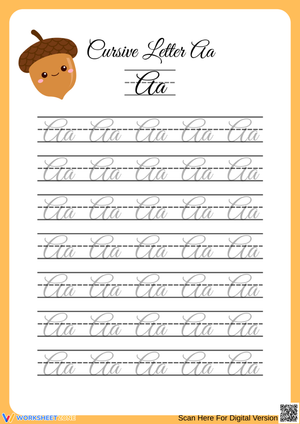
Mastering the Cursive Letter 'a': 2nd Grade Handwriting Resources
These 2nd grade cursive a handwriting printable worksheets give teachers a focused, immediately usable set of resources for one of the most important entry points in cursive instruction: the letter 'a'. The set covers lowercase and uppercase formation, sequenced from directional arrow tracing through freehand production, with enough variation to carry students from first contact through independent, consistent practice.
The 'a' as Foundation Stroke — and Why That Matters in Lesson Planning
The lowercase cursive 'a' belongs at the start of cursive sequences because its stroke reappears in nearly a third of the lowercase alphabet. The motion — starting at the midline, curving counterclockwise, closing at the top, then pulling down to an exit tail — is the same core movement that produces 'd', 'g', 'o', and 'q'. A student who has internalized the 'a' stroke approaches 'd' with a recognizable starting point rather than a blank slate. This letter family structure significantly reduces frustration during the first weeks of cursive instruction.
There is a specific developmental reason this appears in 2nd grade rather than 1st. The connected, sustained motion of cursive requires fine motor control that most children reach around age seven. First-graders attempting the same task typically produce shapes that look like manuscript letters with a curved tail attached, because they have not yet built the continuous stroke into muscle memory. Second-graders can sustain the motion and begin working toward the automatic production that fluent cursive eventually demands.
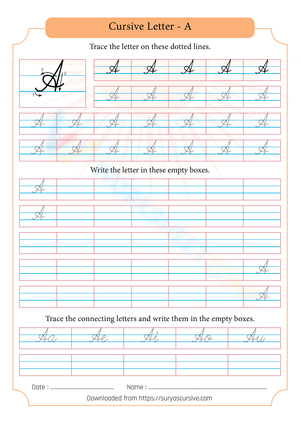
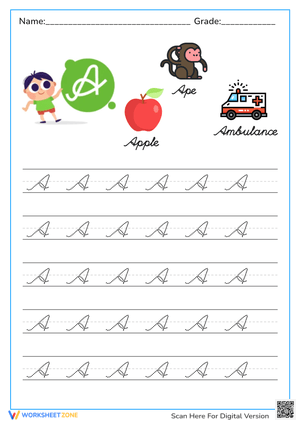
The uppercase 'a' is a separate matter entirely. It shares its name with the lowercase form but uses a different stroke — starting at the top line, sweeping down and looping back, then exiting sharply to the right. Most students need deliberate, separate practice on the uppercase before attempting transitions. Pairing names like "Anna" or "Alice" in practice exercises helps students understand how the capital connects to the following lowercase letter, rather than treating the two forms as unrelated shapes.
Skills Each Worksheet Builds
Each worksheet in this set targets one or more of the following formation and practice skills:
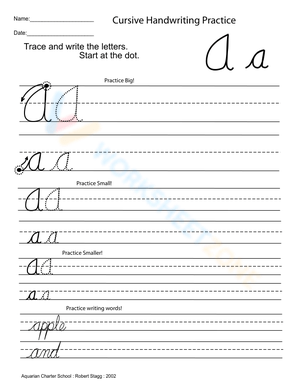
- Directional arrow tracing for the lowercase 'a', showing the midline entry, the counterclockwise arc, the closed top, and the exit tail
- Fading guide rows that move from full dotted outlines to partial guides to blank lines, so students gradually produce the letter without tracing support
- Uppercase 'a' formation practice, covering the top-line starting point, the looping back stroke, and the rightward exit
- Uppercase-to-lowercase transition practice using real names, so the capital form functions in context rather than in isolation
- Word-level practice rows using short 'a' words, so exit strokes are practiced in sequence rather than letter by letter
- Self-check rows where students circle the best-formed letter from each line, building the habit of evaluating their own work
The 2nd grade cursive a handwriting printable worksheets in this set assume no prior cursive exposure. The tracing sequences start from scratch and build toward the freehand production that longer writing tasks eventually require.
Mistakes Students Make That These Worksheets Help You Catch
The most consistent error is an unclosed loop. Students curve up and around correctly but lift the pencil a fraction too early, leaving a gap at the top of the letter. On paper, an unclosed lowercase 'a' reads almost identically to a lowercase 'u', which creates legibility problems the moment students start writing words. A second problem lives in the exit tail: make it too short and there is a visible gap before the next letter; make it too long and it reads as an 'ai' combination. Both errors show up clearly in returned worksheets and are straightforward to address in a one-minute conference or a brief whole-class comparison on the board.
Slant inconsistency is the third pattern worth watching. Most students begin a practice line with a reasonable rightward slant and drift toward vertical by the middle of the row — not because of a formation misunderstanding, but because their paper has shifted and they have not re-angled it. Catching this early matters because students who write different sessions at different slants build conflicting habits that take longer to correct than the original problem.
How to Build These Worksheets Into Your Lesson Plans
Most 2nd grade teachers find that 10 to 15 minutes of focused handwriting practice produces better results than longer sessions. The fine motor demands of sustained cursive work lead to fatigue and degraded letter quality past that threshold, so longer blocks are not more productive — they just accumulate more errors. A worksheet introduced on Monday as a teacher-modeled lesson works well as a Tuesday morning warm-up while students settle before the writing block. By Thursday, the same practice format at a literacy center lets students work independently, freeing the teacher for small-group work with students still struggling with loop closure or exit strokes.
For teachers running handwriting stations, pairing a 2nd grade cursive a handwriting printable worksheets with a sand tray or textured letter card gives students a chance to feel the stroke shape before committing it to paper. This is not about learning styles theory — it is a practical observation that students who have traced the shape with a finger on a rough surface make fewer loop-closure errors on their first tracing row than students who go straight to pencil and paper.
Standard Alignment
Texas TEKS §110.5(b)(9) requires 2nd grade students to develop legibility in written work, including producing cursive letters with consistent size, proportion, and slant. A number of other states with cursive instruction mandates — Florida, North Carolina, and Georgia among them — place initial cursive letter instruction in 2nd grade for the same developmental reasons. In classroom terms, these worksheets address the formation and legibility criteria directly. The self-check rows where students evaluate their own letters provide a built-in formative measure against the size and slant criteria those standards specify, which makes them useful as brief portfolio evidence of progress over time.
Differentiating These Worksheets Across Ability Levels
Students with stronger fine motor control move through the tracing rows quickly and benefit most from the freehand lines and word-level practice worksheets at the later part of the set. For those students, adding a short phrase or sentence in cursive — using only the letters they have learned so far — extends the task without requiring different materials or separate preparation.
Students who struggle with formation need more repetitions on the directional tracing worksheets before moving to freehand rows. The most effective support here is not simply more tracing, but tracing with verbal narration: the student says "curve, around, close, pull down" aloud as the pencil moves. That verbal-motor pairing reinforces the stroke sequence in a way that silent repetition alone does not. For students with fine motor delays, printing the tracing worksheets at 120 to 130 percent reduces the precision demand enough that students can focus on direction and sequence rather than fighting size control.
Frequently Asked Questions
Why does cursive instruction start with 'a' rather than 'c', since the 'c' stroke is simpler?
The 'c' stroke is simpler in isolation, but 'a' appears far more frequently in written English — and completing it requires students to practice both the arc and the exit tail in a single letter. Teaching 'a' first means that from the very first lesson, students are producing a stroke that will function in real words. Most structured cursive programs introduce 'c' as a lead-in exercise immediately before 'a', but the formal letter instruction starts with 'a' for frequency and transfer reasons.
How many practice repetitions does a 2nd grader typically need before producing the lowercase 'a' independently?
Most students need somewhere between 30 and 50 traced repetitions across multiple sessions before the stroke begins to feel automatic. What matters more than raw repetition count is distribution across time — five minutes of tracing on four separate days outperforms 20 minutes in a single sitting. The 2nd grade cursive a handwriting printable worksheets in this set support that spaced practice pattern, with varied formats across worksheets so the repetitions do not become purely mechanical.
Should students practice uppercase and lowercase 'a' during the same lesson?
Not at first. The two forms use different stroke sequences, and introducing both in the same session increases the chance that students blend them — applying the lowercase arc to the uppercase space, or trying to connect the uppercase exit into the next letter the way the lowercase exit does. Introduce the lowercase form first, let students reach consistent tracing accuracy across several sessions, then bring in the uppercase. Once both forms are stable on their own, transition practice connecting them in names is a practical and logical next step.
Clear All