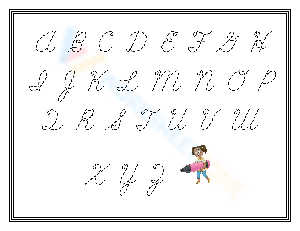
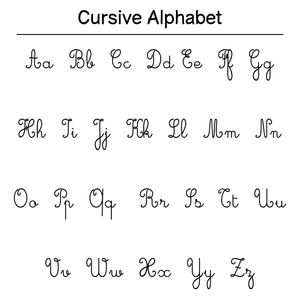
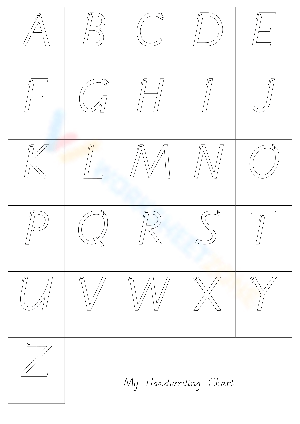
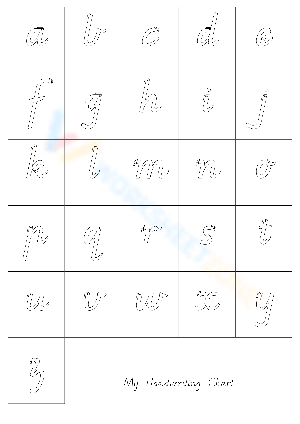
By second grade, most 7- and 8-year-olds have the fine motor control and letter knowledge to begin joined writing, even though formal cursive expectations in many curricula arrive a year or two later. A 2nd grade cursive letter chart gives you a single, reliable reference for correct upper and lowercase formation, so you can model strokes accurately instead of improvising them at the board. For students who are just moving from careful printing to connected letters, seeing every letter laid out with a consistent slant and clear entry strokes takes the guesswork out of where each shape begins.
The chart also does quiet work outside of direct instruction. Post it at a handwriting center, clip a copy inside a take-home folder, or laminate one for a small-group table, and students have a self-check tool they can return to without waiting for you. That kind of independence matters when you are teaching 20-plus writers who are all at slightly different stages of readiness.
What a strong cursive letter chart for grade 2 should show
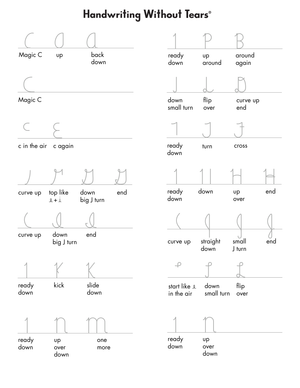
Not every printable is built for teaching. A chart you can actually teach from should include both uppercase and lowercase forms for all 26 letters, with numbered stroke order or directional arrows on the trickier shapes. Look for consistent letter height, a steady slant, and joins that show clearly where one letter hands off to the next.
- Uppercase and lowercase pairs side by side for easy comparison.
- Stroke-direction cues so students start each letter in the right place.
- Baseline and midline references that match your handwriting paper.
- Clean spacing so letters stay readable when copies are reduced for folders.
Keep the visual load light. A chart crowded with decoration is harder for a hesitant writer to read than a plain one with generous white space and dark, even lines. It also helps to choose a chart whose style matches the handwriting program your school already uses, so students are not learning one version of a letter on the wall and a different one on their worksheets.
Teach by letter families, not the alphabet
One of the most useful shifts a chart supports is grouping letters by how they start rather than running straight from A to Z. Cursive lowercase letters share a small set of entry strokes, and teaching those families together builds muscle memory much faster than isolated drill.
- Undercurve letters such as c, a, d, and g that begin with the same swing up.
- Tall loop letters like h, l, and f that share an overcurve.
- Connecting-tail letters such as e, t, u, and y.
- Harder shapes — k, r, s, x, and z — saved for after the common strokes feel automatic.
When students practice c, a, and d in one sitting, they reuse a single motion three times instead of learning three unrelated shapes. A chart that visually clusters these families, or that you annotate to show them, turns an intimidating 26-letter task into a handful of manageable moves.
Classroom Implementation
To turn the chart into daily practice, anchor it to routines you already run rather than adding a new block to the schedule.
- Model first. Trace two or three letters from the chart on the board each morning, narrating the stroke order aloud as students watch.
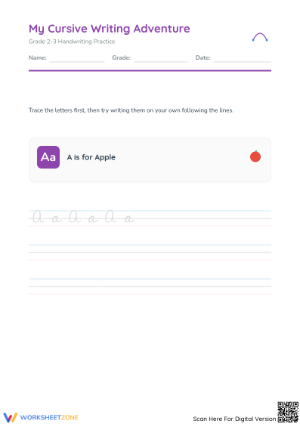
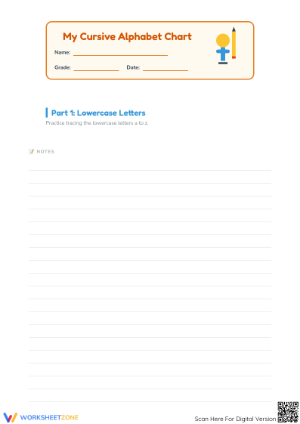
- Center rotation. Post the chart at a handwriting station with tracing sheets and dry-erase sleeves for repeated practice.
- Letter family of the week. Pull one group of letters at a time and connect it to spelling or word work.
- Take-home copy. Send a reduced chart home so families can reinforce the exact formation you teach in class.
With at least 24 states now requiring cursive instruction — up from about a dozen in 2015 — building the habit in second grade puts your students ahead of the expectation instead of scrambling to meet it later.
Frequently asked questions
1. What age or grade should students start learning cursive?
Most children are developmentally ready around ages 7 to 8, which lines up with second grade. That is why a 2nd grade cursive letter chart is a sensible starting point, even when formal expectations arrive a little later in a student's schooling.
2. Is cursive writing required in schools?
It depends on your state. As of 2026, at least 24 states require cursive instruction in public schools — up from roughly a dozen in 2015 — with many expecting students to read and write it by the end of their elementary years.
3. How long does it take a 2nd grader to learn legible cursive?
With three to four short sessions a week, many second graders develop legible cursive in about 10 to 14 weeks, progressing from single letters to letter joins to full words and short sentences.
4. What order should cursive letters be taught in for beginners?
Group letters by shared starting stroke rather than alphabetical order. Teaching families like c, a, d, and g together reuses the same motion and builds muscle memory faster than working straight down the alphabet.
5. How can teachers use a cursive letter chart for struggling writers?
Use it as a fixed reference in small groups, highlight only the letters a student is currently targeting, and pair it with tactile paper so learners can feel each stroke before writing it independently.