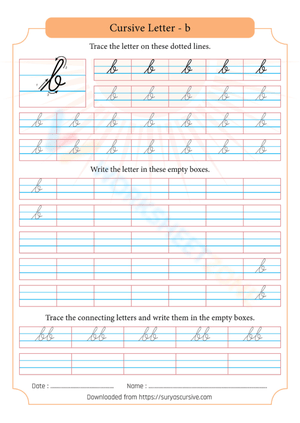
These 2nd grade cursive b handwriting pdf worksheets give teachers a focused practice sequence for one of the more technically demanding lowercase letters in the cursive set. The b requires two distinct motor actions that students must learn to chain together — an ascender loop reaching the top line, followed by a retrace down to the baseline and back up to the midline, finishing with a short horizontal bridge stroke. Most second graders have to isolate each half before they can execute the full letter fluidly. Each worksheet targets a specific step in that process.
Frequent Errors Worth Watching For and Addressing Early
The most common mistake is what many teachers informally call the "early exit." The student completes the tall loop, brings the stroke back down to the baseline, and then connects — treating the letter as finished. The result looks almost identical to a cursive l with a baseline connector. What's missing is the second upward motion that carries the pencil back to the midline and across into the bridge stroke. It feels complete to the student because the hand has done something and landed on a line. Practicing just the bottom half of the b in isolation — starting at the baseline, curving up to the midline, and pulling across — for a few minutes before each session helps build that reflex before it gets lost inside the full letter.
A second pattern shows up in students who have practiced the cursive f before the b. Both letters share a tall ascender loop, and some students fuse them, adding an f-style descending stroke below the baseline where the b should simply exit at the midline. The b never dips below the baseline — saying that directly during whiteboard modeling, and repeating it each time the error appears, corrects it quickly. Letting it go for a week hardens it into a habit that takes considerably longer to undo.
What's Inside the Set
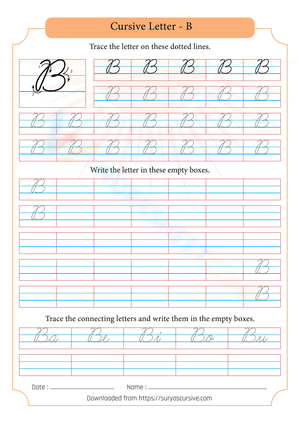
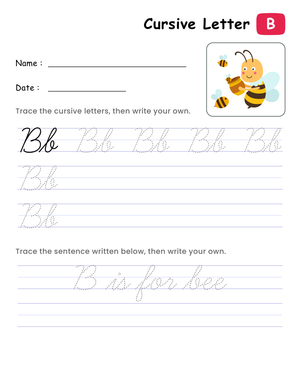
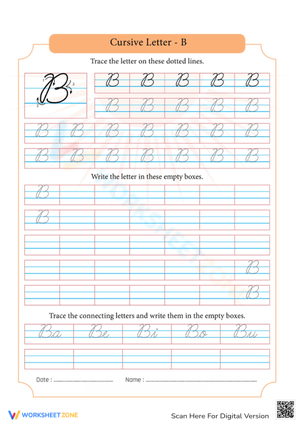
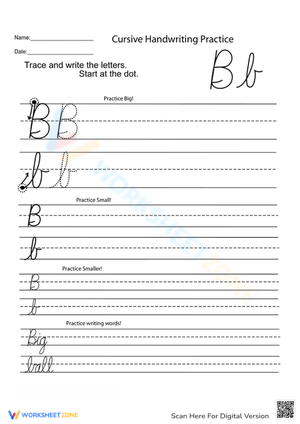
The 2nd grade cursive b handwriting pdf worksheets in this set move from guided tracing to independent word-level writing in a deliberate sequence. The first worksheets provide full stroke-path guides on primary lines, where students trace the complete letter multiple times across each row. The middle worksheets shift into letter-combination practice — common pairings like be, by, ab, bit, big — where the midline exit becomes meaningful in practice, because the following letter has to start at that height rather than at the baseline. The final worksheets drop guide strokes entirely and ask students to write from memory, both in letter-repetition rows and in a short list of target words.
Skills built across the full set:
- Executing the ascender loop with consistent height and a rightward slant
- Retracing the downward stroke without lifting the pencil
- Forming the midline bridge at the correct height — not at the baseline, not at the top line
- Connecting b to following letters from the midline entry point
- Maintaining consistent letter width across a full row of repeated letters
- Writing target words legibly without any guide strokes visible
Building These Worksheets Into Your Weekly Lesson Plan
Short, daily practice builds motor memory faster than one longer block each week. Ten to fifteen minutes works well — enough repetition to be meaningful, short enough that students stay focused rather than rushing through the rows. The morning work period, before the day's first direct lesson, is a natural fit: the task is quiet, self-contained, and low-stakes, which helps students settle and attend. Other teachers use it during the transition after the read-aloud, when students need a grounded independent activity before the next whole-group block.
A weekly structure that holds up in practice: tracing worksheets Monday and Tuesday, letter-combination worksheets Wednesday and Thursday, and the from-memory worksheet on Friday as both practice and a quick formative check. Students who still produce l-shaped letters on Friday — particularly those skipping the midline retrace — need more time at the tracing stage before moving into the combination work. The Friday worksheet makes that visible without requiring a formal assessment. Teachers who add a brief whiteboard demonstration before each new worksheet, asking students to air-trace the letter twice before picking up a pencil, consistently see cleaner first attempts on paper.
Standard Alignment
These worksheets address CCSS.ELA-LITERACY.L.2.1, which requires 2nd graders to demonstrate command of the conventions of standard English, including legible letter formation. States that have moved away from the Common Core still carry parallel handwriting standards at grade 2 — most specify that students form letters correctly and legibly in cursive by the end of the year. Within a typical cursive instructional sequence, the lowercase b fits in the middle range of difficulty. Students get the most from this letter after they have solid formation of a, c, d, and e, because those letters establish the baseline exit pattern that makes the b's midline exit contrast meaningful. Introducing b before that baseline pattern is automatic increases confusion rather than reducing it.
Working With Different Learners Across the Set
For students still developing pencil control, the tracing worksheets at the start of the set give enough structure to keep the stroke on track without requiring the student to generate the letter independently. When even guided tracing produces shaky, inconsistent results, having the student practice the same motion larger first — on a whiteboard or on chart paper — separates the spatial challenge from the fine motor challenge. That gives them a version they can succeed at before shrinking to standard line size.
Students who move quickly through isolated letter practice can skip the middle repetition rows and go directly to the letter-combination worksheets, where the real challenge is managing the connection angle after the b exits at the midline. For students with fine motor delays, the 2nd grade cursive b handwriting pdf worksheets that include stroke-direction arrows at the start of each row are the most useful: a student who loses the stroke sequence mid-row can reset from the arrow without interrupting the teacher. That built-in reference keeps students working independently and reduces the stop-start friction that often discourages struggling writers.
Frequently Asked Questions
Why does the cursive b give students more trouble than letters like a or d?
Most lowercase cursive letters exit at the baseline, so the connection rule stays the same across a word. The b exits at the midline, which means the following letter has to start from a higher entry point — a different movement than students use after an a or a d. That single difference introduces a second connection rule to track, and at this age, holding two rules for one situation is genuinely harder. Add in how closely the b resembles the cursive l when the bridge stroke is missing, and it becomes one of the letters that requires the most sustained practice time in the set.
How many practice sessions does it typically take before students write the b without tracing?
Most second graders need five to ten focused sessions — some get there in three, others need close to two weeks of daily work. The from-memory worksheet at the end of the set functions as a useful benchmark. If a student's b still looks like a cursive l on that worksheet after eight sessions, extending the guided tracing stage rather than moving to word-level writing is the right call. Moving forward before the motor sequence is consistent produces letters that drift further rather than stabilize.
My students already write the printed b. Does that help with the cursive version?
Familiarity with the shape helps them recognize what they are aiming for, but the stroke direction is reversed. The printed b starts with a downward stroke — the vertical line first, then the bump. The cursive b starts from the baseline and moves upward immediately, which catches students with strong manuscript habits off guard. A brief whiteboard demonstration before the first tracing worksheet, explicitly showing that the cursive b goes up before it comes back down, corrects that assumption before it becomes ingrained.
Do these worksheets address the uppercase cursive B as well?
These 2nd grade cursive b handwriting pdf worksheets focus on the lowercase letter. The uppercase cursive B follows a different stroke sequence and presents its own formation challenges — it belongs in a separate practice block after students have the lowercase version solid. Teaching both at the same time, before either is automatic, blurs the formation of both and slows overall progress.