


























Views
Downloads
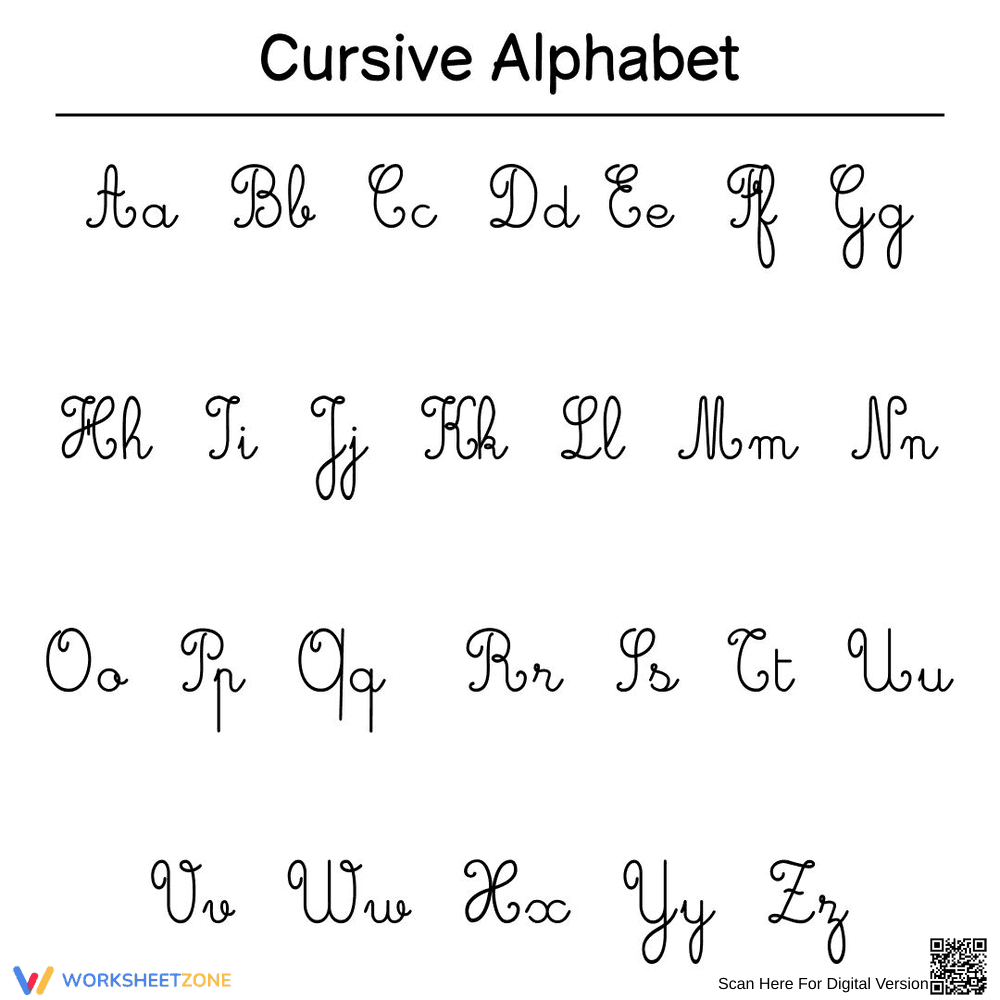

Cursive Alphabet Chart | Grade 3 Essential Guide
Paste this activity's link or code into your existing LMS (Google Classroom, Canvas, Teams, Schoology, Moodle, etc.).
Students can open and work on the activity right away, with no student login required.
You'll still be able to track student progress and results from your teacher account.
This Grade 3 cursive alphabet chart provides a clear visual reference for students transitioning from print to script. By displaying all 26 uppercase and lowercase letter pairs, it helps learners internalize proper stroke connections and letter heights. This essential resource ensures students have a reliable guide during independent writing tasks and handwriting practice sessions.
At a Glance
- Grade: 3 · Subject: Handwriting
- Standard:
CCSS.ELA-LITERACY.L.3.1— Demonstrate command of the conventions of standard English grammar and usage- Skill Focus: Cursive letter formation
- Format: 1 page · 26 letter pairs · Reference Chart · PDF
- Best For: Desk reference or writing center guide
- Time: 5–10 minutes
What's Inside
This single-page PDF features a clean, high-contrast layout of the entire cursive alphabet. It includes 26 distinct blocks, each pairing the uppercase and lowercase versions of a letter. The font used emphasizes traditional cursive loops and slants, providing a consistent model for students to follow. There are no distracting graphics, ensuring the focus remains entirely on the letter forms.
Zero-Prep Workflow
- Print: Output the single-page PDF in color or grayscale (30 seconds).
- Distribute: Provide copies to students or laminate a set for writing centers (1 minute).
- Review: Briefly point out tricky connections like 'b' or 'z' before students begin writing (1 minute).
Total teacher preparation time is under 3 minutes, making it an ideal addition to any handwriting unit or sub plan.
Standards Alignment
The primary standard is CCSS.ELA-LITERACY.L.3.1, which requires students to demonstrate command of the conventions of standard English. While cursive is often a state-level requirement, this chart supports the foundational legibility needed for all written conventions. Both standard codes can be copied directly into lesson plans, IEP goals, or district curriculum mapping tools.
How to Use It
Use this chart during the instructional phase as a scaffold for students writing their first cursive sentences. It serves as an excellent formative assessment tool; observe which letters students frequently check on the chart to identify which formations require more direct instruction. It is also perfect as a permanent desk reference for students who struggle with fine motor recall during independent work.
Who It's For
This guide is intended for second and third-grade students beginning their cursive journey. It is particularly helpful for English Language Learners and students with dysgraphia who benefit from a constant visual model. Pair this chart with a lined practice sheet or a cursive tracing workbook for a complete handwriting lesson.
According to the RAND AIRS 2024 report, providing consistent visual scaffolds like this cursive alphabet chart is critical for developing automaticity in handwriting. Research by Fisher & Frey (2014) emphasizes that the gradual release of responsibility begins with clear modeling; this chart provides that model for the CCSS.ELA-LITERACY.L.3.1 standard. By offering a 1-page reference for all 26 letter pairs, teachers reduce the cognitive load on students, allowing them to focus on the content of their writing rather than just the mechanics of letter formation. Studies in the ScienceDirect TpT Analysis suggest that high-contrast, distraction-free reference materials lead to higher rates of student independence during literacy blocks. This printable guide ensures that every student has access to the same high-quality script model, promoting equity in handwriting instruction across diverse classroom settings and supporting long-term retention of cursive skills.


