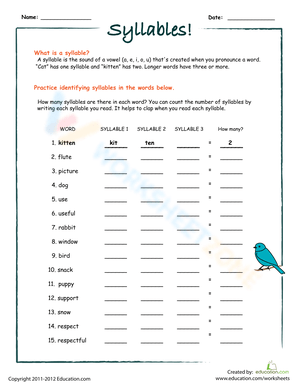
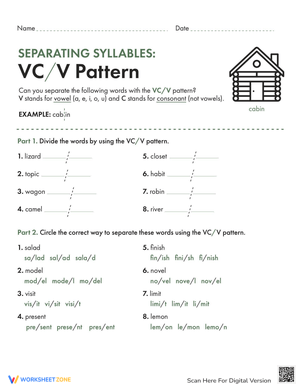
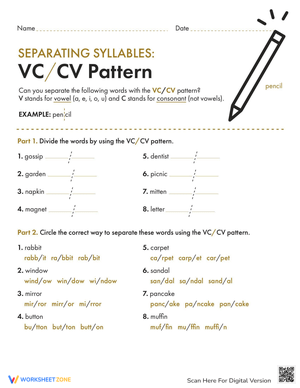
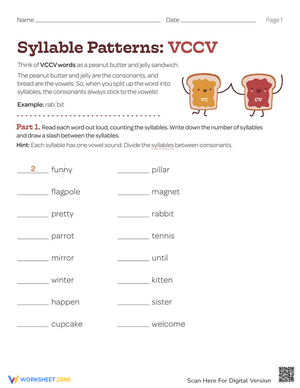
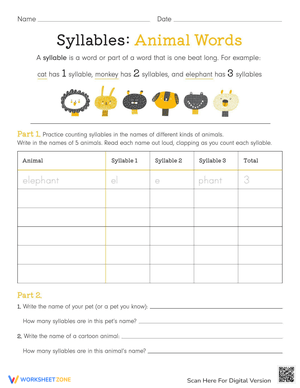
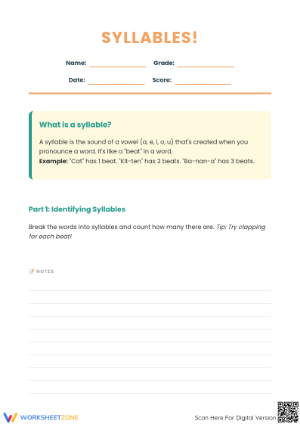
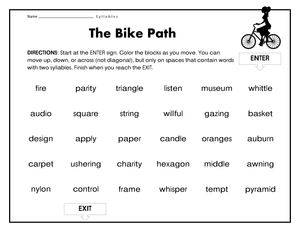
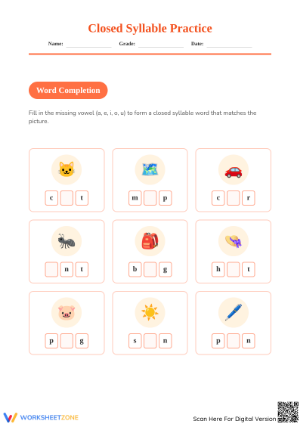
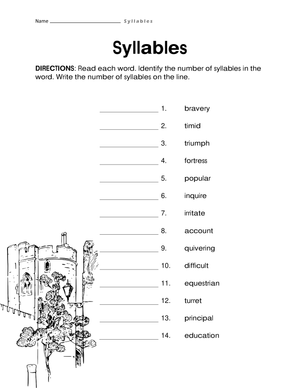
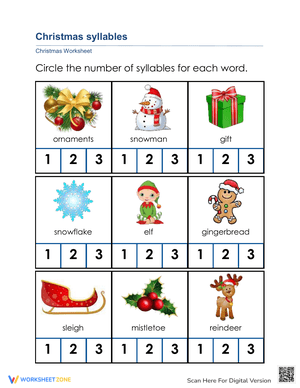
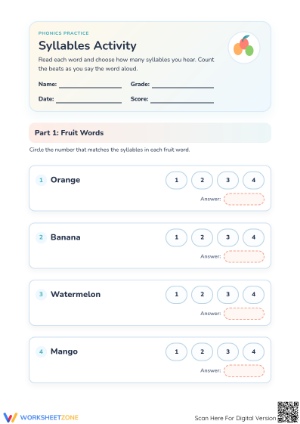
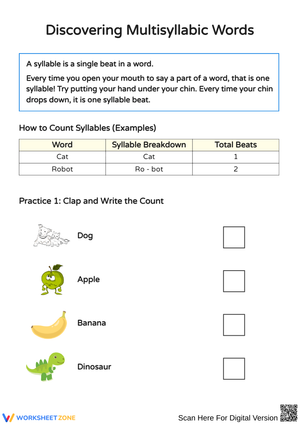
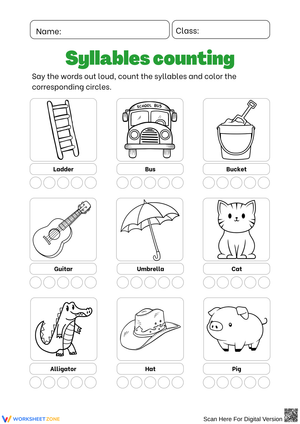
These syllables printable worksheets for 2nd grade move students through the hardest stretch in early phonics — the shift from hearing syllable beats in spoken words to analyzing vowel structure on the page. The set covers all six syllable types plus the three standard division patterns (VC/CV, V/CV, and VC/V), giving teachers enough material for a complete phonics unit or targeted small-group work. Each worksheet stands alone, so a teacher can pull one for a five-minute warm-up, a guided lesson, or a center rotation without rebuilding a sequence from scratch.
What Students Practice Across the Set
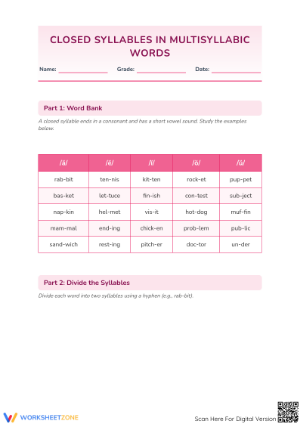
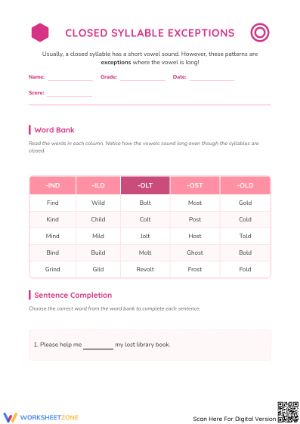
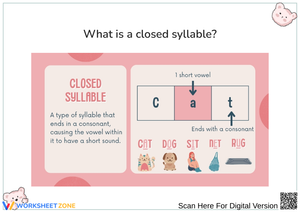
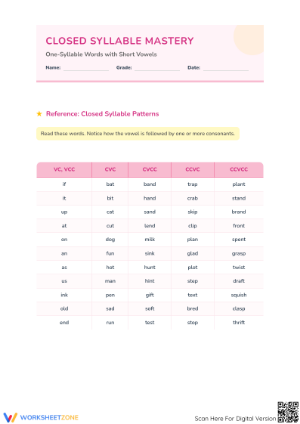
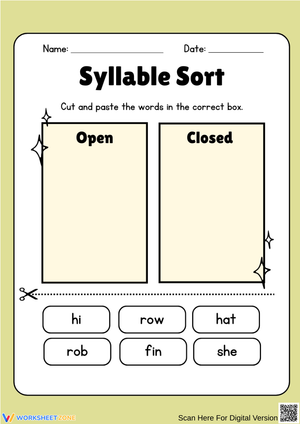
The worksheets address syllable type recognition and word division as separate but connected skills. Students first learn to identify each type in isolation — marking the vowel in a closed syllable, noting that an open syllable ends on a vowel sound, tracing the silent-e pattern in VCe words. Then each worksheet moves toward application: sorting words into type categories, drawing division lines using vowel position as the guide, and rewriting divided words to confirm how the split changes the vowel sound.
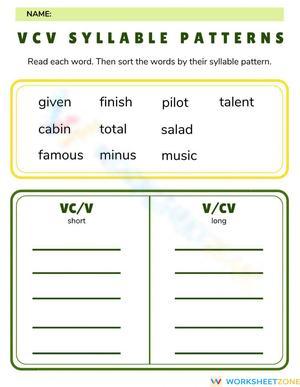
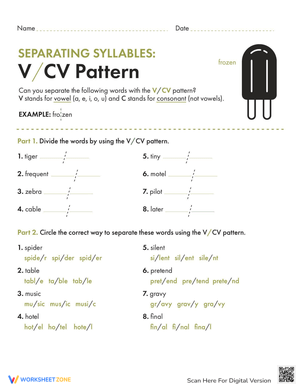
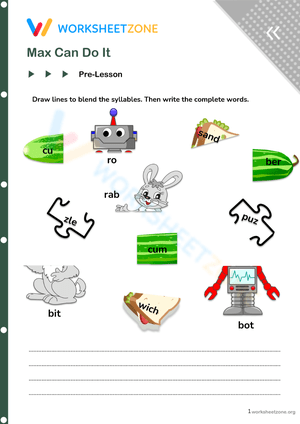
Division work centers on three patterns. In VC/CV words like napkin and basket, the split falls between the two medial consonants. In V/CV words like robot, the division leaves the first syllable open, making the vowel long. In VC/V words like cabin, the division closes the first syllable, making the vowel short. Students practice spotting vowels before locating the division point — a method sometimes called "spot and dot" — which ties the rule to the orthographic pattern students can see rather than the sound they are guessing at.
- Identifying all six syllable types: closed, open, vowel-consonant-e, vowel teams, r-controlled, and consonant-le
- Sorting multi-syllabic words by type
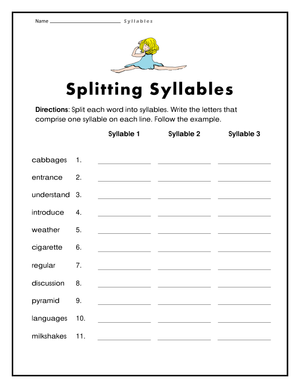
- Marking vowels and drawing division lines using VC/CV, V/CV, and VC/V rules
- Distinguishing open-first from closed-first splits in V/CV words
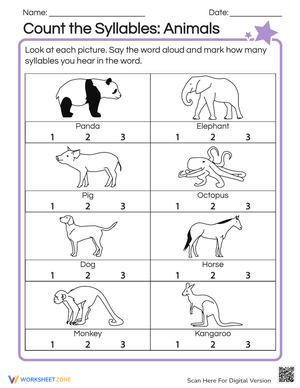
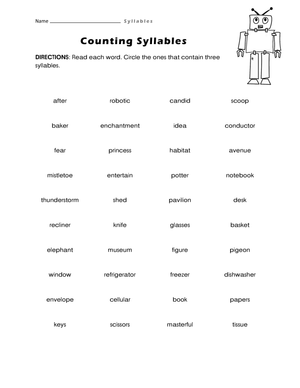
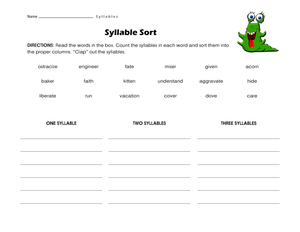
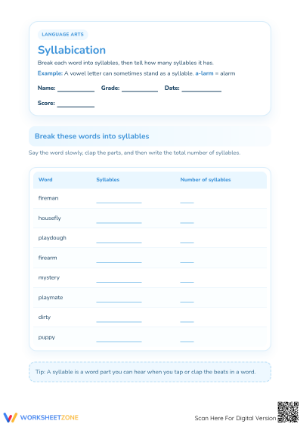
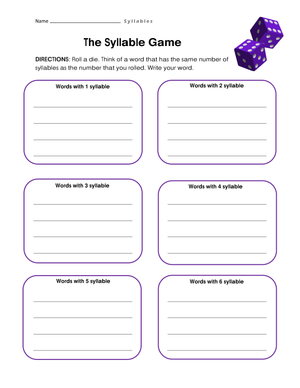
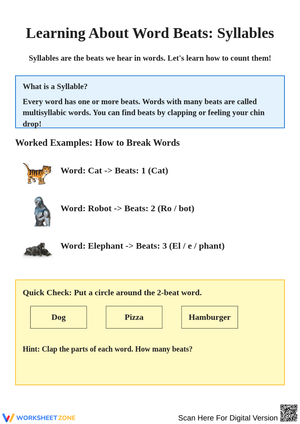
- Counting syllables in two- and three-syllable words
- Reading divided words aloud to confirm the split produces a recognizable pronunciation
The Error Patterns That Surface First in Division Work
The most consistent error: students apply VC/CV logic to every two-syllable word, regardless of whether the medial consonant count warrants it. Ask a student to divide robot and many will write rob-ot, splitting after the consonant because that's the pattern they've practiced most. The word becomes unrecognizable when read back. This error appears most often in the first weeks of division work and is the strongest argument for teaching V/CV explicitly before students accumulate too many VC/CV repetitions.
Unstressed-syllable omission surfaces next. In speech, the middle vowel in chocolate or family reduces to a schwa and nearly disappears. Students writing from memory produce choc-late or fam-ly because they genuinely do not hear the missing syllable. Reviewing the written form on a worksheet — spotting all vowel dots before dividing — forces the visual recognition that speech doesn't provide.
R-controlled syllables trip up students who have internalized "every syllable has one vowel." Seeing farmer, some students mark both the a and the e as separate vowel beats and try to divide the word into three syllables. Worksheets targeting r-controlled words address this directly by asking students to circle the vowel-r unit as a single marker before attempting the division.
Where These Worksheets Fit in the Literacy Block
The most consistent return comes from using one worksheet during the phonics warm-up at the start of the literacy block — five or six minutes of "spot and dot" on words pulled from the current reading unit, followed by a quick share-out before the lesson. This keeps syllable awareness active without carving out a separate instructional block. By Thursday of a given week, students typically move through familiar word types fast enough that the warm-up doubles as a fluency check. The syllables printable worksheets for 2nd grade work well in this slot because each task is short and self-contained — students finish at roughly the same pace, so the warm-up doesn't drag into the lesson.
For small-group intervention, use worksheets targeting the one or two syllable types where a group is breaking down. A group stuck on V/CV ambiguity doesn't need more closed-syllable repetition — they need three or four focused cycles of the open-first split with immediate feedback. Exit tickets pulled directly from a worksheet give fast data: ask students to divide three words and label the syllable type for each. The pattern across a small group tells a teacher whether to reteach or advance the next day.
Standard Alignment
These worksheets align to CCSS.ELA-LITERACY.RF.2.3, which requires students to know and apply grade-level phonics and word analysis skills in decoding words. The sub-standard RF.2.3.C specifically addresses decoding regularly spelled two-syllable words with long vowels — the exact skill that open-syllable and VCe work targets. Teachers in CCSS-aligned states can use completed worksheets as direct evidence toward the second-grade foundational skills strand. The VC/CV division work also supports RF.2.3.D, since prefix-stem boundaries in common words frequently fall at a VC/CV split.
Matching Worksheets to Where Students Actually Are
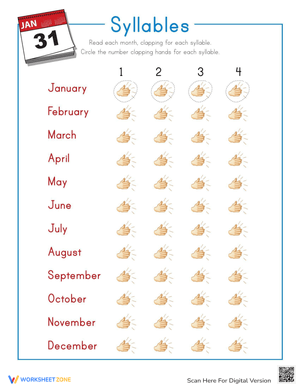
The syllables printable worksheets for 2nd grade assume students can already segment spoken words into beats. If a student cannot do that yet, auditory work — clapping, chin drops, tapping syllables on fingers — belongs before any written division task. Placing a worksheet in front of a student who lacks that foundation produces surface compliance: lines drawn somewhere on the word without any understanding of what drives the placement.
For students working below grade level, begin with closed-syllable sorting only. A worksheet confirming that each syllable in rabbit contains one short vowel followed by a consonant is more productive than one asking students to choose between V/CV and VC/V rules they haven't processed yet. Reducing the word count is also fair — six words with teacher confirmation builds more durable knowledge than twenty guesses with no feedback.
Students who have internalized all six types and the three division rules benefit from three-syllable words and real-text application. Give them a short paragraph and ask them to locate and divide every word of two or more syllables. The challenge shifts from knowing the rules in isolation to applying them quickly in running text — which is the actual decoding context they are heading toward.
Frequently Asked Questions
Do students need to know all six syllable types before using any of these worksheets?
No. Each worksheet targets specific types, so teachers sequence them to match instruction. A common order is closed syllables first, then open, then VCe, vowel teams, r-controlled, and consonant-le — though programs vary. The worksheets build knowledge incrementally rather than assuming students have mastered the full set before beginning.
How do these worksheets handle words where V/CV division could go either way?
Some two-syllable words — ever, travel, level — don't behave cleanly under either V/CV or VC/V rules. The worksheets direct students to try the open split first (long vowel), then the closed split (short vowel), and choose whichever produces a word they recognize. This "try both ways" routine teaches students to use meaning as a confirmation step, which is exactly what fluent readers do automatically.
Can these be used with students receiving Tier 2 phonics intervention?
The syllables printable worksheets for 2nd grade work well in intervention settings because each worksheet is standalone — an intervention teacher can pull exactly the type causing breakdown and provide concentrated practice on that skill before reintegrating it with others. Students receiving Tier 2 support often have gaps in one or two syllable types rather than across-the-board weakness, and isolating the right worksheet makes targeted repetition practical.
Are these appropriate for formative assessment?
Yes. A completed worksheet shows whether a student consistently applies the VC/CV rule, misidentifies r-controlled vowels, or confuses open and closed splits — that error pattern informs the next day's instruction more usefully than a percentage score alone. For summative assessment, most teachers use a district-approved instrument, but these worksheets provide the practice depth that makes that later performance more reliable.












 Interactive Worksheet Maker
 Quiz Maker
 Word Search Maker
 Crossword Puzzle Maker
 Word Scramble Generator
 Sentence Scramble Generator
 Handwriting Worksheet Generator
 Name Tracing Generator
 Fill In The Blank Generator