


























Views
Downloads
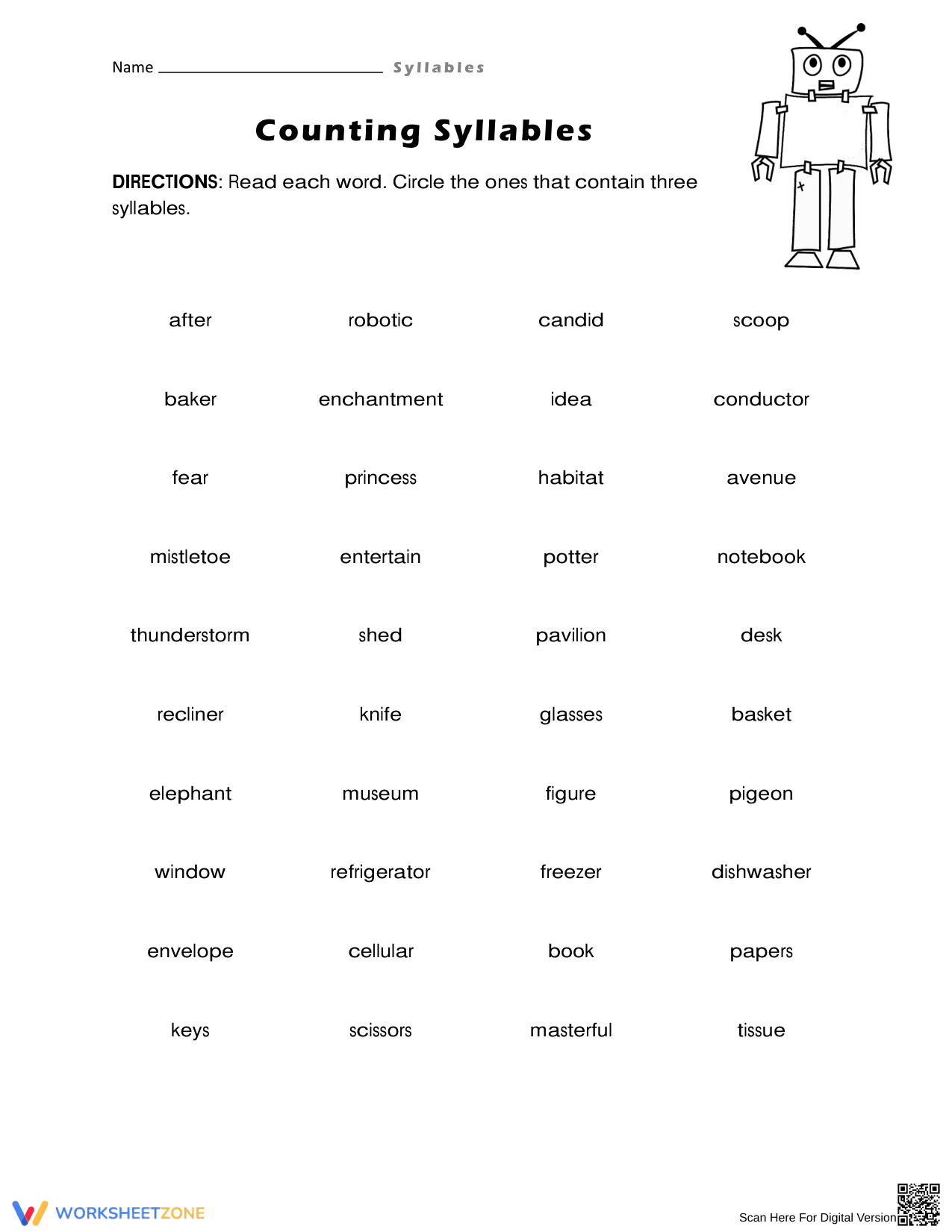

Essential Syllable Counting Worksheet | Grade 1-2 ELA
Paste this activity's link or code into your existing LMS (Google Classroom, Canvas, Teams, Schoology, Moodle, etc.).
Students can open and work on the activity right away, with no student login required.
You'll still be able to track student progress and results from your teacher account.
This Essential Syllable Counting worksheet provides Grade 1 and Grade 2 students with focused practice in phonological awareness. Students read a list of 40 diverse words and must identify those containing exactly three syllables. This activity strengthens the connection between vowel sounds and syllable structure, ensuring students can accurately segment multisyllabic words during independent reading tasks.
At a Glance
- Grade: 1-2 · Subject: English Language Arts
- Standard:
CCSS.ELA-LITERACY.RF.1.3.D— Use vowel sound knowledge to determine the number of syllables in words- Skill Focus: Identifying Three-Syllable Words
- Format: 1 page · 40 problems · Answer key included · PDF
- Best For: Independent phonics practice and morning work
- Time: 15–20 minutes
Inside this resource, you will find a clean, one-page layout featuring a list of forty words ranging from simple two-syllable terms like "baker" to more complex four-syllable challenges such as "refrigerator." The worksheet includes a student name field and clear instructions to circle the words that contain three syllables. A full answer key is provided to facilitate quick grading or student self-correction.
The zero-prep workflow for this resource is designed for maximum teacher efficiency. First, print the single-page PDF (approximately 30 seconds). Second, distribute the copies to your students (1 minute). Third, review the completed work using the included answer key (under 1 minute per student). This streamlined process makes the worksheet an ideal choice for emergency sub plans or transition periods where immediate student engagement is required without prior setup.
This resource is strictly aligned to the CCSS.ELA-LITERACY.RF.1.3.D standard, which requires students to use their knowledge that every syllable must have a vowel sound to determine the number of syllables in a printed word. By practicing with words like "robotic," "habitat," and "elephant," students apply this rule in a concrete way. This standard code can be copied directly into lesson plans, IEP goals, or district curriculum mapping tools for compliance tracking.
To use this worksheet effectively, assign it as a formative assessment after a direct instruction lesson on syllable division. As students work, circulate through the classroom and observe those who are clapping out the words or using the "chin drop" method; this provides immediate insight into their phonological processing. Alternatively, use it as a timed literacy center challenge where students race to find all the three-syllable words correctly within a ten-minute window.
This resource is specifically built for early elementary students in Grades 1 and 2 who are moving beyond basic CVC words into more complex multisyllabic vocabulary. It is particularly helpful for English Language Learners (ELL) who need extra support identifying the rhythmic patterns of English speech. Pair this worksheet with a syllable anchor chart or a short reading passage to reinforce the skill in a broader literacy context.
According to the RAND AIRS 2024 report, phonemic awareness remains a critical predictor of reading success in early elementary. This syllable counting resource addresses the foundational requirement of syllable segmentation, a key component of the CCSS.ELA-LITERACY.RF.1.3.D standard. By requiring students to scan words and phonologically decompose them into constituent syllables, the task reinforces the alphabetic principle and decoding efficiency. Research from Fisher & Frey (2014) emphasizes that independent practice with varying word lengths—such as the three-syllable focus in this 40-item set—supports the transition from simple patterns to multisyllabic word recognition. Consistent exposure to syllable-division rules during the Grade 1 and 2 window significantly reduces reading intervention needs. This worksheet provides the structured practice necessary for students to master syllable identification in diverse linguistic contexts, ensuring they meet core proficiency benchmarks. It serves as a vital tool for educators seeking evidence-based phonics instruction.


