




























Views
Downloads



Counting Syllables Worksheet: Essential Grade 1-2 Printable

Paste this activity's link or code into your existing LMS (Google Classroom, Canvas, Teams, Schoology, Moodle, etc.).
Students can open and work on the activity right away, with no student login required.
You'll still be able to track student progress and results from your teacher account.
This Grade 1 and 2 counting syllables worksheet helps students master phonological awareness by segmenting common words and identifying rhythmic beats. By engaging in clapping exercises and interactive scavenger hunts, learners develop foundational decoding skills necessary for fluent reading and accurate spelling. This comprehensive resource ensures students confidently count syllables across multiple contexts.
At a Glance
- Grade: 1–2 · Subject: English Language Arts
- Standard:
CCSS.ELA-LITERACY.RF.1.3.E— Decode two-syllable words following basic patterns by breaking words into syllables- Skill Focus: Counting and segmenting syllables
- Format: 3 pages · 22 problems · Answer key included · PDF
- Best For: Phonics centers and independent practice
- Time: 20–30 minutes
What's Inside
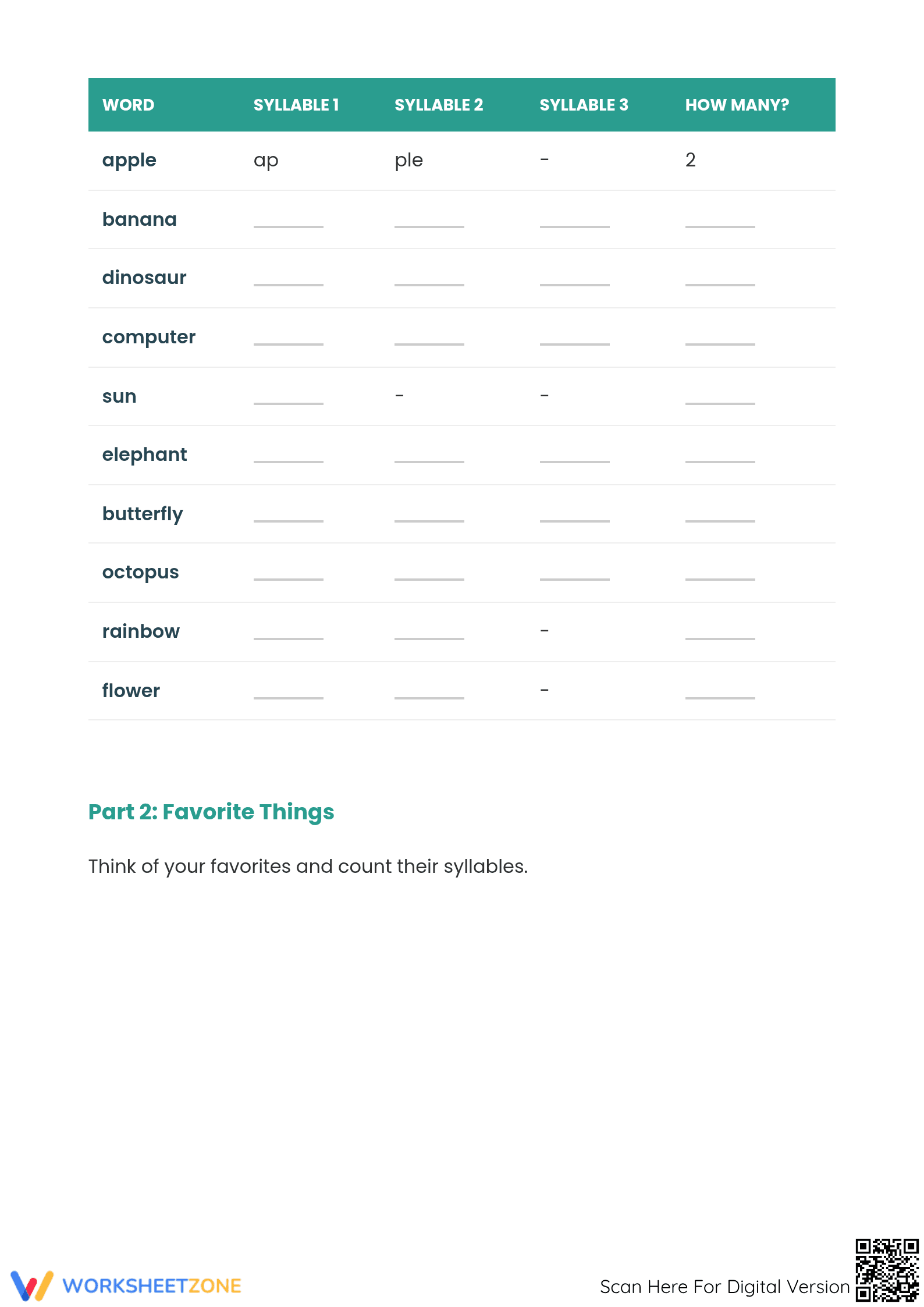
This packet includes three pages of practice. The first page provides a student-friendly definition of a syllable with clear examples. The second page features a structured table where students break ten common words into component parts. The final page offers open-ended prompts for favorite things and a classroom scavenger hunt, totaling 22 tasks with an answer key.
Zero-Prep Workflow
The zero-prep workflow is designed for maximum efficiency. Print the three-page PDF (30 seconds). Next, distribute the packets to your class or small group (1 minute). Finally, use the included answer key to review student work or provide feedback during a whole-group check (under 1 minute). Teacher preparation time is less than two minutes, making it ideal for substitute plans.
Standards Alignment
This resource is directly aligned to `CCSS.ELA-LITERACY.RF.1.3.E`, which requires students to decode two-syllable words by breaking them into syllables. It also supports `CCSS.ELA-LITERACY.RF.2.3` by helping students decode regularly spelled words with long vowels. Both codes can be copied directly into lesson plans or IEP goals to ensure instructional compliance and tracking.
How to Use It
Use this worksheet after direct instruction on clapping out syllables to assess individual progress. During the scavenger hunt, observe students as they move around the room to see if they accurately identify multi-syllable objects. This formative assessment allows you to provide immediate intervention for students struggling with phonological segmenting. Expected completion time ranges from 20 to 30 minutes.
Who It's For
This activity is designed for first and second-grade students who are building their phonics foundations. It is particularly effective for English Language Learners who benefit from the rhythmic nature of syllable counting. Pair this resource with a grade-level reading passage or an anchor chart that visualizes the "vowel sound per syllable" rule to reinforce the connection between spoken and written language.
The Counting Syllables Part IV worksheet addresses the critical need for phonological awareness in early literacy development, as highlighted in the RAND AIRS 2024 reports on foundational reading skills. By requiring students to segment words like "dinosaur" and "butterfly" into component beats, the resource targets CCSS.ELA-LITERACY.RF.1.3.E through a multimodal approach involving writing, auditory clapping, and physical movement. Research from Fisher & Frey (2014) emphasizes that integrated practice helps transition students from simple phoneme awareness to complex multi-syllable decoding. This worksheet provides 22 unique opportunities for students to practice syllabication, a significant predictor of future reading fluency. Educators can utilize the structured table and scavenger hunt formats to verify that students have moved beyond simple guessing toward systematic word analysis, a core component of evidence-based literacy instruction. This instructional progression from guided to independent practice ensures that Grade 1 and 2 students build the necessary cognitive frameworks for mastering English syllable patterns.


