


























Views
Downloads
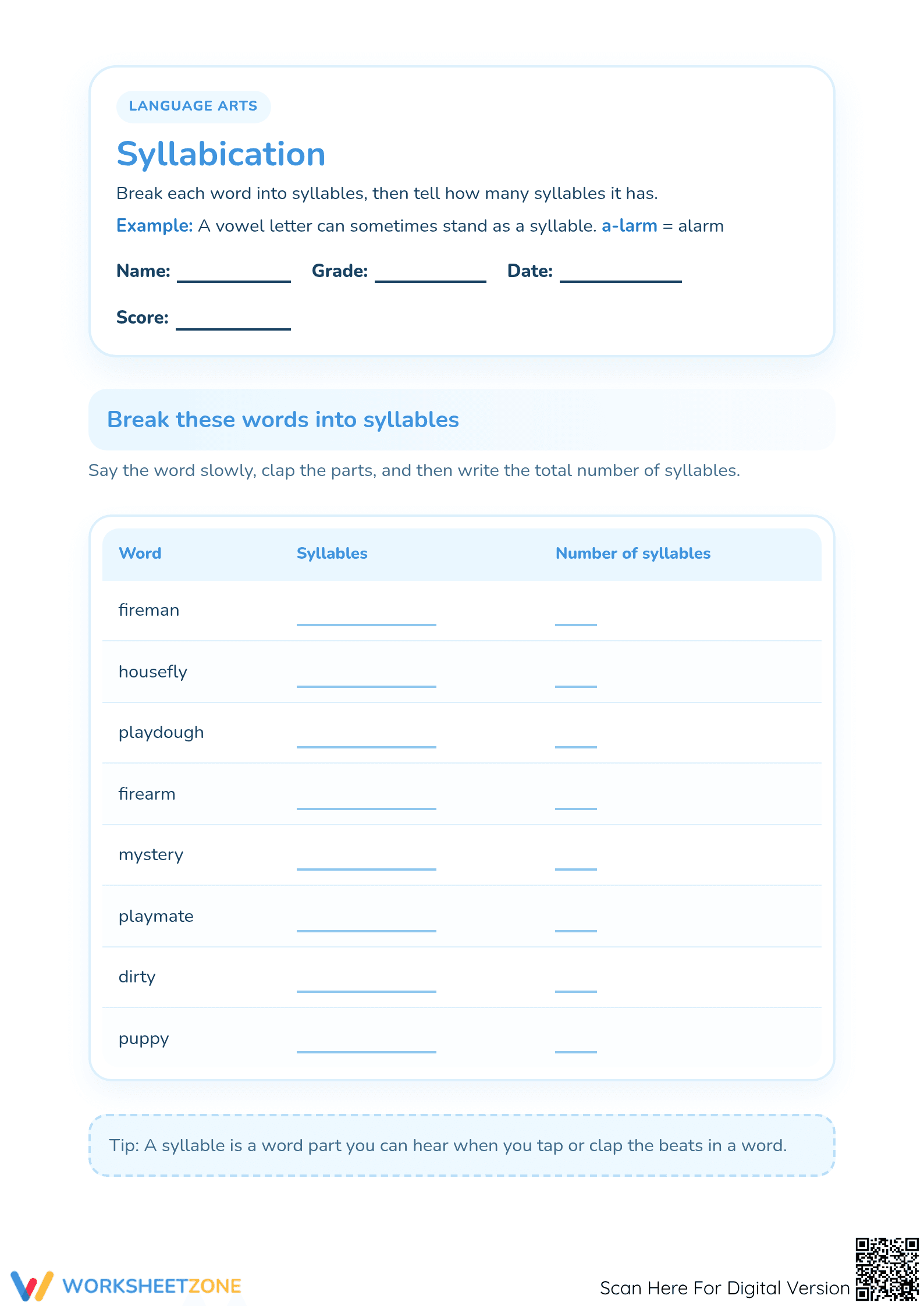

Essential Syllabication Worksheet: Grade 3 Phonics
Paste this activity's link or code into your existing LMS (Google Classroom, Canvas, Teams, Schoology, Moodle, etc.).
Students can open and work on the activity right away, with no student login required.
You'll still be able to track student progress and results from your teacher account.
Strengthen decoding skills with this Grade 3/4 syllabication worksheet. By focusing on two-syllable words and vowel-only syllables, this resource helps children break down complex terms into manageable parts. This targeted practice ensures students develop the phonetic awareness necessary for reading fluency and accurate spelling in their everyday writing assignments.
At a Glance
- Grade: 3 · Subject: English Language Arts
- Standard:
CCSS.ELA-LITERACY.RF.3.3.C— Decode multi-syllable words by breaking them into manageable phonological parts- Skill Focus: Syllabication and syllable counting
- Format: 1 page · 7 problems · Answer key included · PDF
- Best For: Phonics centers and independent practice
- Time: 10–15 minutes
This single-page PDF features a clear layout that guides students through the process of dividing words. It begins with a helpful rule reminder regarding vowel-only syllables, followed by a worked example using the word "fireman." Students are then tasked with analyzing 7 additional words, including "mystery" and "housefly," providing both the hyphenated syllable break and the total syllable count. The clean design minimizes distractions for focused work.
The zero-prep workflow for this resource is designed for teacher efficiency. First, print the single-sheet PDF (approx. 30 seconds). Next, distribute the worksheets to your class or reading groups (approx. 1 minute). Finally, review the completed tasks using the provided answer key to provide immediate feedback (approx. 5 minutes). This process requires less than two minutes of preparation time, making it excellent for substitute plans or literacy center updates.
This worksheet is strictly aligned with `CCSS.ELA-LITERACY.RF.3.3.C`, which requires students to decode multi-syllable words. By practicing the division of words like "firearm" and "playmate," students gain practical experience in identifying syllable boundaries. This alignment supports broader literacy goals and phonics recognition. The standard code can be copied directly into lesson plans, IEP goals, or district curriculum mapping tools to ensure instructional compliance.
Use this as a formative assessment after a direct lesson on syllable types or as an independent literacy center activity. While students work, observe if they correctly identify vowel sounds as the nucleus of each syllable. Completion time is typically 10 to 15 minutes, allowing it to fit into tight instructional blocks. It serves as a reliable check for understanding before moving toward more complex multisyllabic patterns.
This resource is primarily intended for Grade 3 students, Grade 4 remediation, or advanced Grade 2 readers. It is particularly beneficial for students struggling with word-attack skills or those needing extra practice with syllable patterns. For an extended activity, pair this worksheet with a short reading passage and have students hunt for other two-syllable words found in the text to divide on the back of the page.
Effective syllabication instruction is a cornerstone of the science of reading, as it provides students with a reliable system for decoding unfamiliar multisyllabic words. Research from EdReports 2024 indicates that foundational skills materials must provide explicit practice in word analysis to bridge the gap between phonemic awareness and reading comprehension. This worksheet applies these principles by requiring students to actively segment words and quantify their parts, reinforcing the phonological structure of the English language. By focusing on two-syllable words, the resource scaffolds the transition from simple patterns to complex academic vocabulary. This systematic approach to phonics instruction has been shown to improve both reading speed and accuracy among elementary learners. Teachers can rely on this aligned resource to provide the repeated exposures students need to internalize syllabication rules and apply them autonomously during independent reading sessions. The targeted tasks ensure that students are not just guessing but are using structural analysis to decode effectively.


