




























Views
Downloads
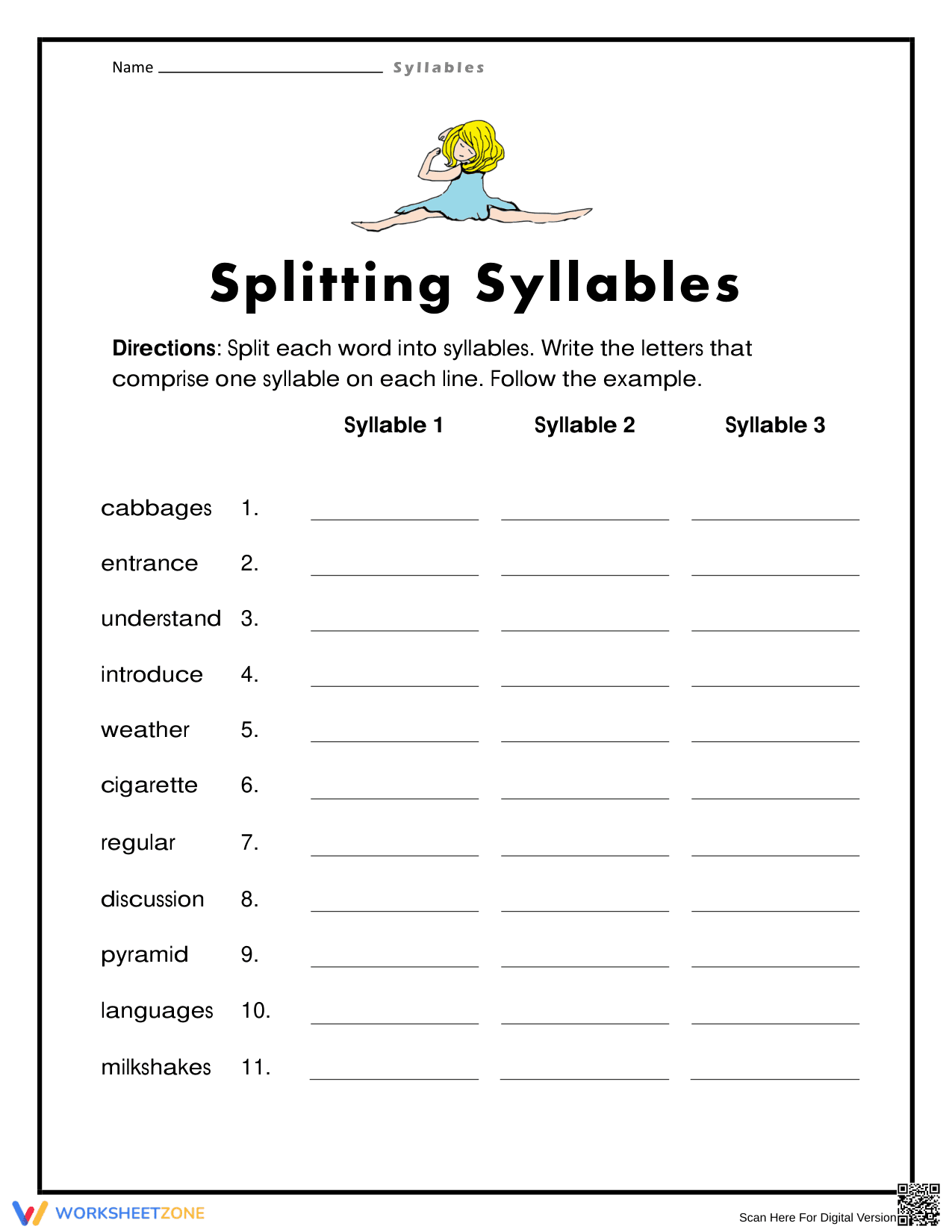

Printable Splitting Syllables Worksheet | Grade 2 Phonics

Paste this activity's link or code into your existing LMS (Google Classroom, Canvas, Teams, Schoology, Moodle, etc.).
Students can open and work on the activity right away, with no student login required.
You'll still be able to track student progress and results from your teacher account.
This Grade 2 phonics worksheet helps students master the art of syllable division by breaking down multisyllabic words into manageable components. By practicing with everyday vocabulary, learners strengthen their decoding skills and improve reading fluency. This essential resource provides immediate practice in segmenting words, which is a foundational step for spelling and advanced reading proficiency.
At a Glance
- Grade: 2 · Subject: ELA - Phonics
- Standard:
CCSS.ELA-LITERACY.RF.2.3.C— Decode regularly spelled two-syllable words following basic patterns and identifying syllable boundaries- Skill Focus: Syllable Division & Segmentation
- Format: 1 page · 11 problems · Answer key included · PDF
- Best For: Independent literacy centers and homework practice
- Time: 15–20 minutes
The worksheet features a clean layout with 11 selected multisyllabic words like "cabbages" and "entrance." Each word has three lines for students to write syllables. The single-page format includes a name header and a helpful illustration to maintain student focus. A full answer key is included to facilitate quick and easy grading.
Skill Progression
- Guided Practice: Starts with familiar two-syllable words and visual support to help students recognize natural word claps.
- Supported Practice: Introduces three-syllable words requiring students to isolate vowel clusters and consonant patterns.
- Independent Practice: Challenges learners to segment complex words like "languages" without scaffolds, fostering total mastery.
This progression ensures students master the entire syllabication process effectively using the I Do, We Do, You Do model.
Standards Alignment
The primary focus is CCSS.ELA-LITERACY.RF.2.3.C, which requires students to decode regularly spelled two-syllable words. This task directly supports the identification of syllable boundaries and vowel patterns. Additionally, it touches upon CCSS.ELA-LITERACY.L.2.2.E by encouraging accurate spelling through phonetic analysis. Both standard codes can be copied directly into lesson plans, IEP goals, or district curriculum mapping tools.
How to Use It
Use this worksheet during the "You Do" phase of a direct instruction lesson on phonics. It serves as an excellent formative assessment to check if students can apply syllable rules to new vocabulary. Alternatively, assign it as a quiet morning work activity or a specialized homework task. Teachers should observe whether students are clapping out the words or using vowel-spotting strategies during completion.
Who It's For
This tool is designed for second-grade students but is also appropriate for first graders ready for a challenge or older students requiring remedial support. It is particularly effective for English Language Learners who benefit from visual segmentation of long words. Pair this with a physical anchor chart for a complete instructional experience.
Aligned to CCSS.ELA-LITERACY.RF.2.3.C, this syllable division resource targets the vital phonological skill of word segmentation. Research by Fisher & Frey (2014) emphasizes that "clapping out" syllables and physically writing boundaries creates a multi-sensory bridge between auditory perception and written decoding. By breaking words like "milkshakes" and "understand" into discrete units, students reduce the cognitive load required to read complex texts, leading to improved fluency scores. Educational analysts at RAND AIRS 2024 have noted that structured practice in syllabication is one of the highest-leverage interventions for Grade 2 literacy, as it directly impacts a student's ability to tackle grade-level informational texts. This worksheet provides the exact repetition needed to move from labored decoding to automatic recognition. It is an essential component of any evidence-based phonics curriculum, ensuring that every learner develops the tools to navigate multisyllabic vocabulary with confidence and precision.


