


























Views
Downloads

Printable Syllable Game Worksheet | Grade 2-3 ELA
Paste this activity's link or code into your existing LMS (Google Classroom, Canvas, Teams, Schoology, Moodle, etc.).
Students can open and work on the activity right away, with no student login required.
You'll still be able to track student progress and results from your teacher account.
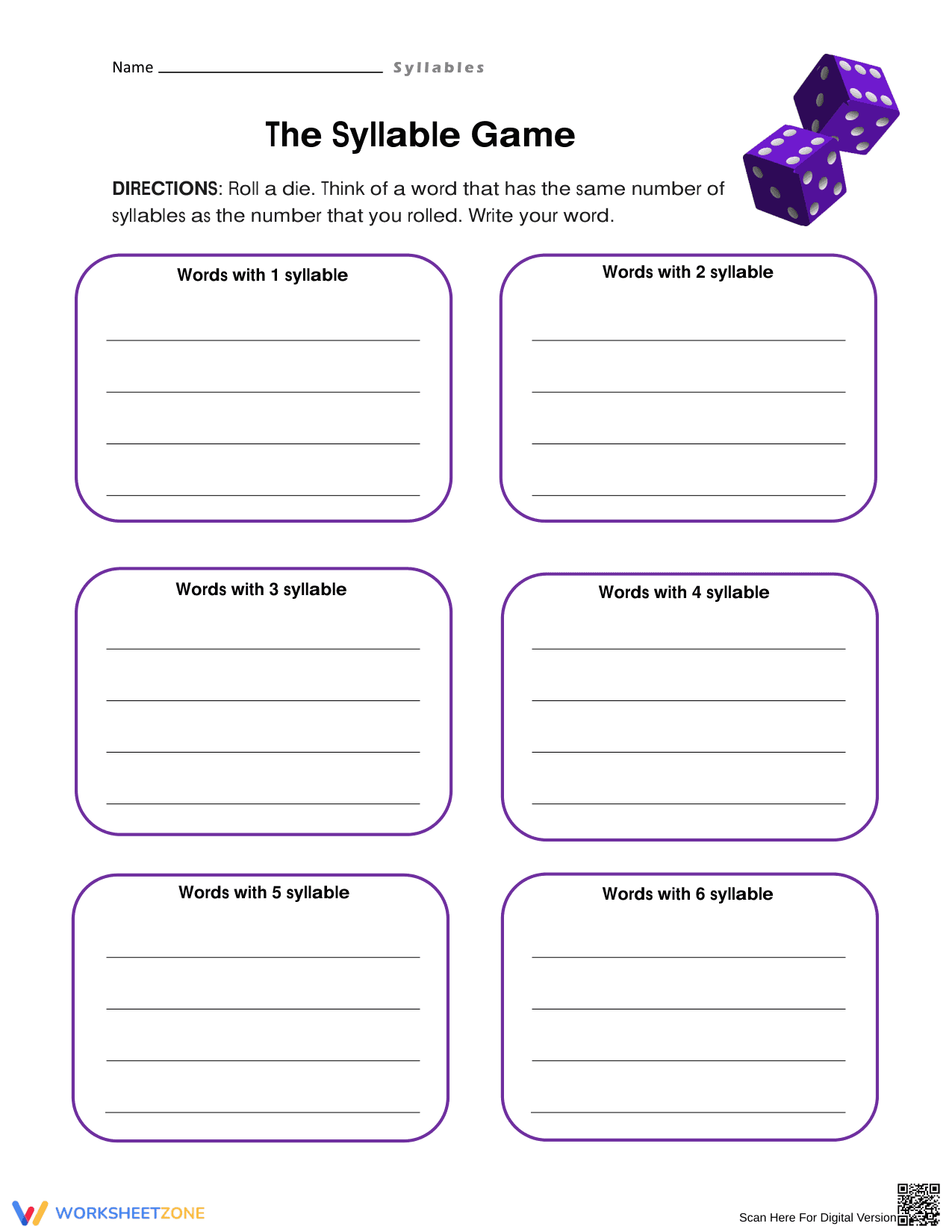
This Syllable Game worksheet provides Grade 2 and Grade 3 students with a dynamic, interactive way to practice phonics and word analysis. By combining a dice game with vocabulary generation, students actively categorize words by their syllable counts, from simple one-syllable terms to complex six-syllable words, reinforcing essential reading foundational skills through high engagement.
At a Glance
- Grade: 2-3 · Subject: English Language Arts
- Standard:
CCSS.ELA-LITERACY.RF.2.3— Categorize words by syllable count using a dice-rolling mechanic to build phonological awareness- Skill Focus: Syllable identification and categorization
- Format: 1 page · 18 word slots · Game-based · PDF
- Best For: Phonics centers and small group rotations
- Time: 15–20 minutes
What's Inside
This single-page PDF features an intuitive game board divided into six distinct sections, each dedicated to words with one to six syllables. The worksheet includes clear, student-friendly directions and a high-contrast design optimized for printing. Students have three dedicated lines per syllable count, allowing for 18 unique word entries, all facilitated by a simple dice-roll mechanic that keeps the activity unpredictable and fun.
Zero-Prep Workflow
Implementing this activity requires zero teacher preparation beyond basic printing. Step 1: Print the single-page PDF (30 seconds). Step 2: Distribute the worksheets and provide each student or pair with a standard six-sided die (1 minute). Step 3: Review the completed word lists as a whole class or in small groups to verify syllable accuracy (5 minutes). This "print-and-play" structure makes it an ideal choice for transition periods or emergency substitute plans.
Standards Alignment
The primary standard addressed is CCSS.ELA-LITERACY.RF.2.3, which focuses on decoding regularly spelled words and applying grade-level phonics and word analysis skills. Specifically, this worksheet supports sub-skills related to multisyllabic word recognition and the ability to identify complex syllable patterns. This standard code can be copied directly into lesson plans, IEP goals, or district curriculum mapping tools to ensure instructional compliance.
How to Use It
Use this worksheet as a formative assessment during a phonics unit to observe how quickly students can retrieve words with specific syllable lengths. Alternatively, assign it as a collaborative center activity where students check each other's work by clapping out the syllables of the words they write. Educators should look for students struggling with 4+ syllable words, which often indicates a need for deeper instruction in prefix and suffix identification.
Who It's For
This resource is designed for second and third-grade students who are moving beyond basic decoding into more advanced word analysis. It is highly effective for English Language Learners (ELLs) who benefit from the tactile reinforcement of rolling dice while practicing pronunciation. The open-ended nature of the task allows for natural differentiation, as students can choose words that match their individual vocabulary levels and interests.
Research from Fisher & Frey (2014) emphasizes that active engagement through game-like structures significantly improves the retention of phonological awareness skills compared to passive rote memorization. This Grade 2-3 English Language Arts worksheet directly addresses CCSS.ELA-LITERACY.RF.2.3 by requiring students to actively retrieve and categorize words based on their syllable counts. According to the RAND AIRS 2024 literacy report, early mastery of multisyllabic word structures is a primary predictor of reading fluency and comprehension in upper elementary grades. By utilizing a "roll and write" mechanic, this resource provides the high-repetition, low-stress environment necessary for students to build confidence in their phonics abilities. The integration of 18 total slots across six syllable categories ensures that students encounter a wide breadth of word structures, facilitating the gradual release of responsibility from guided practice to independent mastery. This methodology aligns with evidence-based practices for foundational reading instruction.


