




























1 / 2
0
Views
0
Downloads


0.0
0
Save
0 Likes
Share
VCCV Syllable Patterns Practice Worksheet
0 Views
0 Downloads

Paste this activity's link or code into your existing LMS (Google Classroom, Canvas, Teams, Schoology, Moodle, etc.).
Students can open and work on the activity right away, with no student login required.
You'll still be able to track student progress and results from your teacher account.
Information
Description
What It Is:
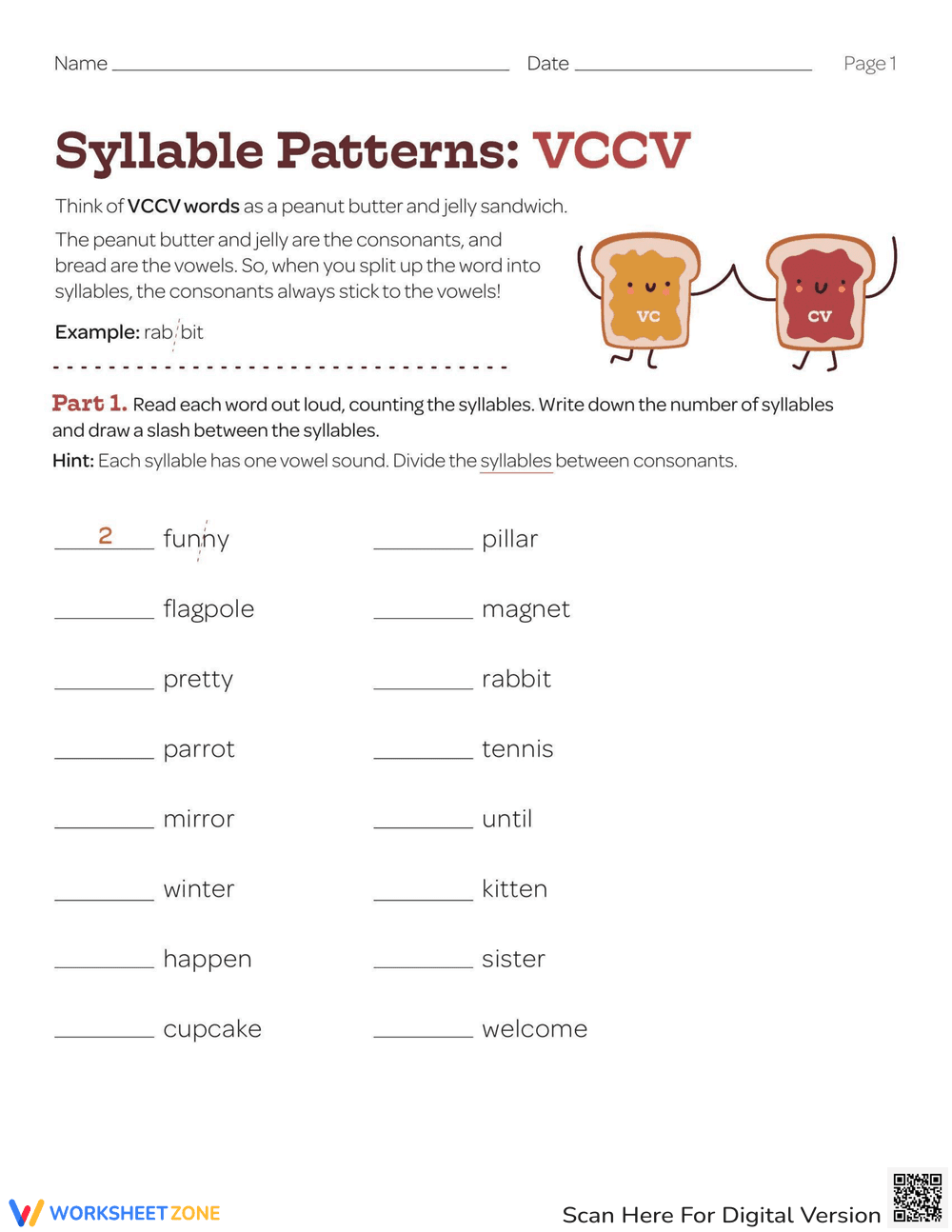
This is a worksheet focused on syllable patterns, specifically VCCV (vowel-consonant-consonant-vowel) words. It uses a peanut butter and jelly sandwich analogy to explain how consonants stick to vowels when dividing words into syllables. The worksheet requires students to read words, count the number of syllables, write the number of syllables on the line, and draw a slash to divide the syllables. The words include examples like 'funny,' 'pillar,' 'flagpole,' 'magnet,' 'pretty,' 'rabbit,' 'parrot,' 'tennis,' 'mirror,' 'until,' 'winter,' 'kitten,' 'happen,' 'sister,' 'cupcake,' and 'welcome.'
Grade Level Suitability:
This worksheet is suitable for grades 2-4. It reinforces phonics skills, specifically syllable division, which is typically taught in these grades. The vocabulary is appropriate for this age range.
Why Use It:
This worksheet helps students understand and apply the rules of syllable division, particularly for VCCV patterns. It improves reading fluency, vocabulary, and phonological awareness. The visual analogy of the peanut butter and jelly sandwich makes the concept easier to grasp.
How to Use It:
First, review the explanation of VCCV syllable patterns. Then, instruct students to read each word aloud. Next, they should count the syllables in each word and write the number on the provided line. Finally, they should divide the word into syllables by drawing a slash between the consonants as instructed.
Target Users:
This worksheet is designed for elementary school students in grades 2-4 who are learning about syllable division and phonics. It can also be used for students who need extra practice with reading and spelling skills. It's also beneficial for ESL students learning English pronunciation and word structure.
This is a worksheet focused on syllable patterns, specifically VCCV (vowel-consonant-consonant-vowel) words. It uses a peanut butter and jelly sandwich analogy to explain how consonants stick to vowels when dividing words into syllables. The worksheet requires students to read words, count the number of syllables, write the number of syllables on the line, and draw a slash to divide the syllables. The words include examples like 'funny,' 'pillar,' 'flagpole,' 'magnet,' 'pretty,' 'rabbit,' 'parrot,' 'tennis,' 'mirror,' 'until,' 'winter,' 'kitten,' 'happen,' 'sister,' 'cupcake,' and 'welcome.'
Grade Level Suitability:
This worksheet is suitable for grades 2-4. It reinforces phonics skills, specifically syllable division, which is typically taught in these grades. The vocabulary is appropriate for this age range.
Why Use It:
This worksheet helps students understand and apply the rules of syllable division, particularly for VCCV patterns. It improves reading fluency, vocabulary, and phonological awareness. The visual analogy of the peanut butter and jelly sandwich makes the concept easier to grasp.
How to Use It:
First, review the explanation of VCCV syllable patterns. Then, instruct students to read each word aloud. Next, they should count the syllables in each word and write the number on the provided line. Finally, they should divide the word into syllables by drawing a slash between the consonants as instructed.
Target Users:
This worksheet is designed for elementary school students in grades 2-4 who are learning about syllable division and phonics. It can also be used for students who need extra practice with reading and spelling skills. It's also beneficial for ESL students learning English pronunciation and word structure.


