


























Views
Downloads

Syllable Counting Worksheet | Essential Grade 1-2 Phonics
Paste this activity's link or code into your existing LMS (Google Classroom, Canvas, Teams, Schoology, Moodle, etc.).
Students can open and work on the activity right away, with no student login required.
You'll still be able to track student progress and results from your teacher account.
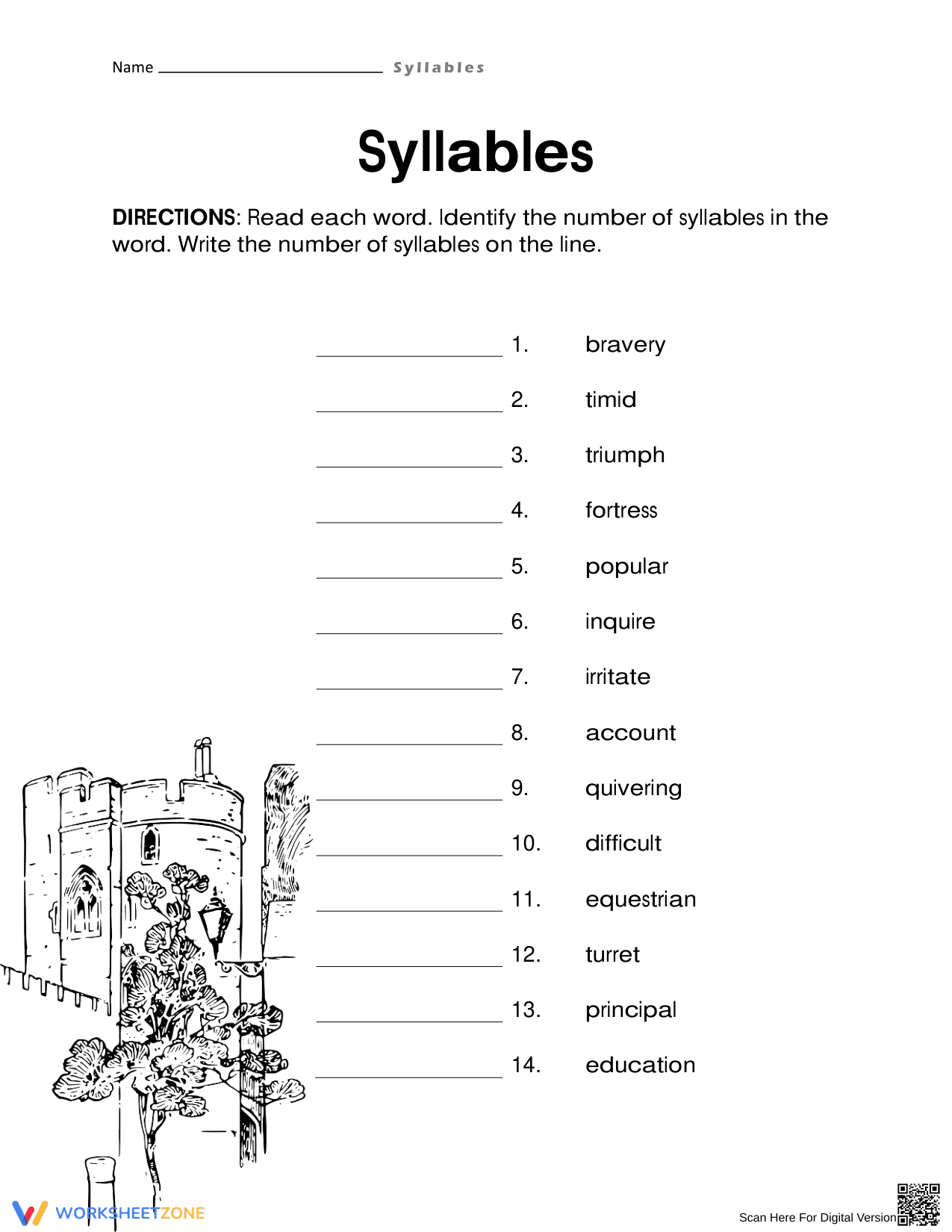
This Syllable Counting worksheet provides Grade 1 and Grade 2 students with essential practice in phonological awareness. By identifying the number of "beats" or syllables in a diverse set of words, learners strengthen their decoding and pronunciation skills. This foundational activity ensures students can segment spoken and written language effectively to improve reading fluency and spelling accuracy.
At a Glance
- Grade: 1-2 · Subject: English Language Arts
- Standard:
CCSS.ELA-LITERACY.RF.1.2— Demonstrate understanding of spoken words, syllables, and sounds- Skill Focus: Syllable Counting & Segmentation
- Format: 1 page · 14 problems · Answer key included · PDF
- Best For: Independent phonics practice and morning work
- Time: 10–15 minutes
Inside this single-page PDF, you will find 14 carefully selected words ranging from simple two-syllable terms to more complex multi-syllable vocabulary. The layout features clear numbering and designated lines for students to record their answers. Words like "bravery," "equestrian," and "education" challenge students to move beyond basic CVC patterns, while a full answer key is provided for rapid grading or student self-check.
The zero-prep workflow for this resource is designed for busy educators and substitutes. First, print the single-page document (30 seconds). Distribute the worksheets to your literacy centers or individual desks (1 minute). Review the answers using the included key (1 minute). The total teacher preparation time is under two minutes, making it perfect for supplemental instruction or emergency sub plans.
This resource is directly aligned with CCSS.ELA-LITERACY.RF.1.2, which requires students to demonstrate an understanding of spoken words, syllables, and sounds. Specifically, it supports the ability to segment words into their component beats, a precursor to advanced syllabication rules. This standard code can be copied directly into lesson plans, IEP goals, or district curriculum mapping tools.
Use this worksheet as a formative assessment after a direct instruction lesson on "clapping out" syllables. It serves as an excellent check for understanding to see if students can generalize the concept to unfamiliar or academic vocabulary. Teachers can observe students as they work; a student struggling to count the three syllables in "popular" may need additional small-group support with vowel sound recognition.
This resource is designed for first and second-grade students, but it is also effective for English Language Learners (ELLs) or students requiring reinforced phonological training. It pairs naturally with a syllable-division anchor chart to provide a balanced literacy experience that covers both auditory and visual learning modalities without extra setup.
Phonological awareness, specifically the ability to segment words into syllables, is a primary predictor of later reading success in the primary grades. According to Fisher & Frey (2014), the gradual release of responsibility model is most effective when students are provided with high-quality, independent practice opportunities like this 14-task set. Research from RAND AIRS 2024 emphasizes that structured phonics interventions that include explicit syllable identification help close the achievement gap for emerging readers. By requiring students to interact with multi-syllabic words such as "education" and "principal," this worksheet aligns with evidence-based practices that promote word-analysis skills. National assessments, including the NAEP, consistently show that students with strong phonological foundations perform better on complex comprehension tasks. This worksheet provides the repetitive, focused practice necessary for students to internalize these sounds and transfer them to their daily writing and reading.


