


























Views
Downloads

Impulse Control Pros and Cons Worksheet | Grade 10-11 Ready
Paste this activity's link or code into your existing LMS (Google Classroom, Canvas, Teams, Schoology, Moodle, etc.).
Students can open and work on the activity right away, with no student login required.
You'll still be able to track student progress and results from your teacher account.
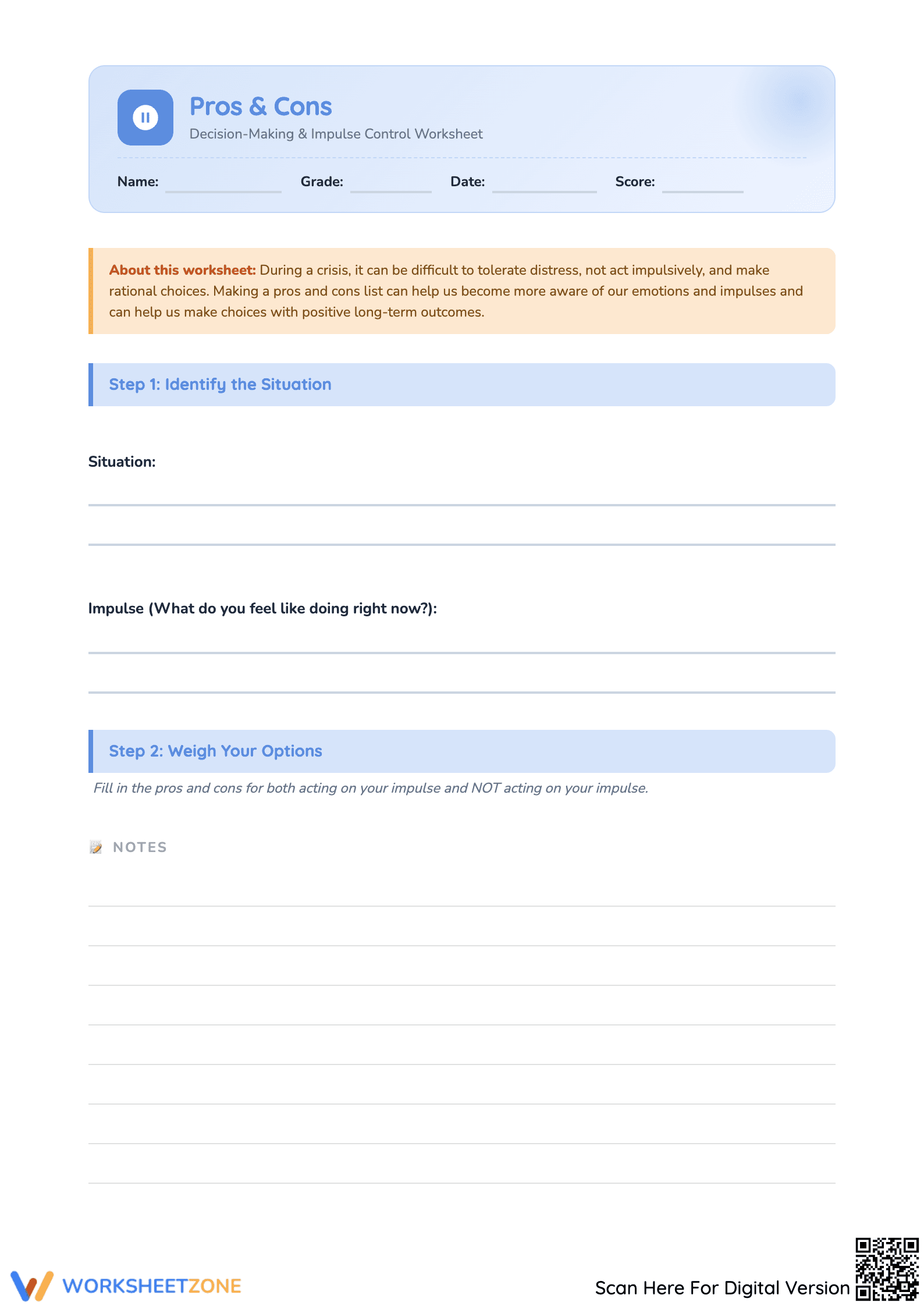
This Grade 10-11 impulse control worksheet provides a structured framework for students to evaluate high-stakes decisions during moments of distress. By weighing the pros and cons of acting on impulses versus resisting them, learners develop the emotional awareness necessary to make rational, long-term choices. It is a complete behavioral intervention tool for secondary classrooms.
At a Glance
- Grade: 10-11 · Subject: Behavior Activities
- Standard:
CCSS.ELA-LITERACY.W.11-12.1— Write arguments to support claims in an analysis of substantive topics- Skill Focus: Impulse Control & Decision Making
- Format: 4 pages · 18 problems · Answer key included · PDF
- Best For: SEL, DBT groups, and behavior intervention
- Time: 30–45 minutes
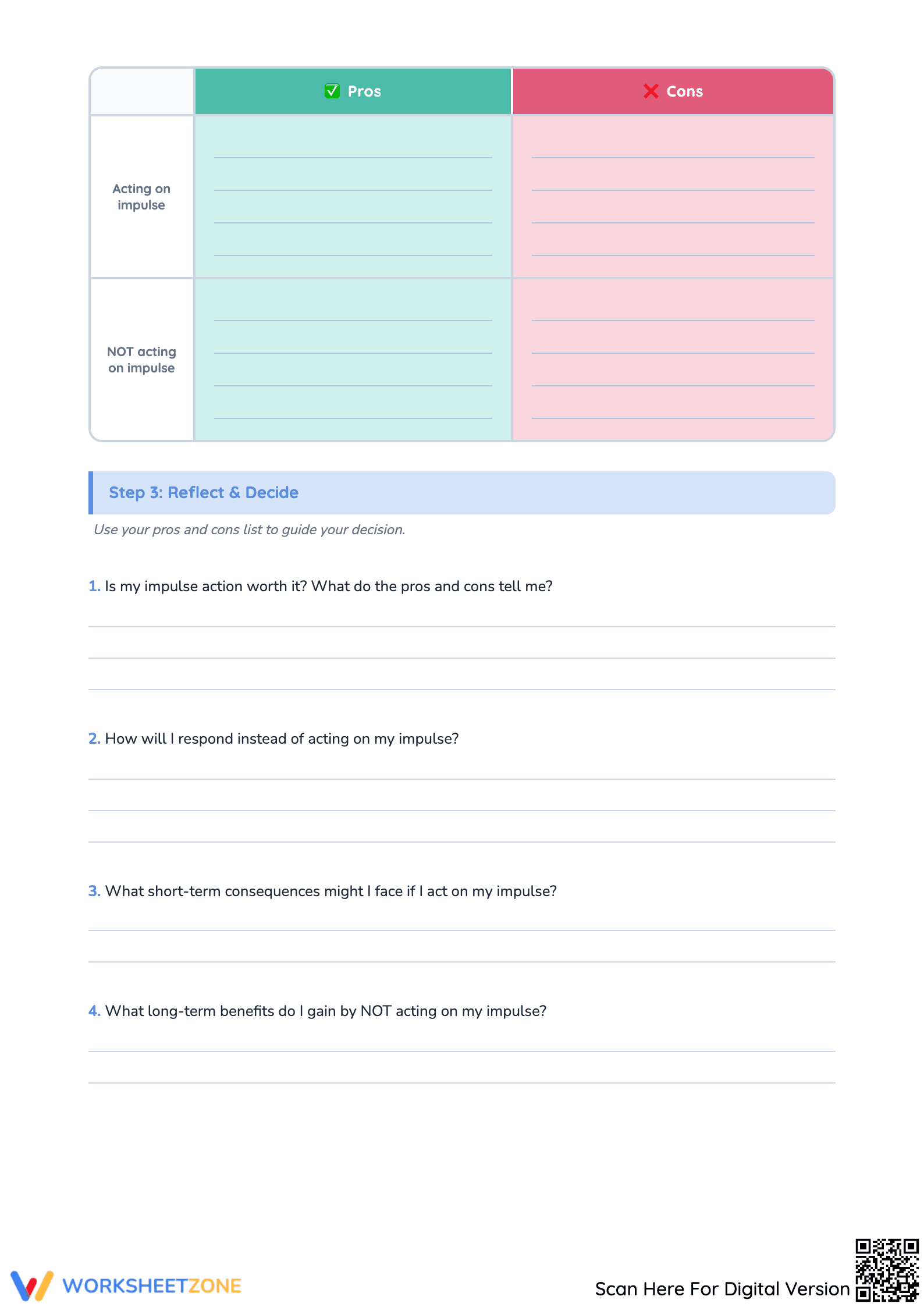
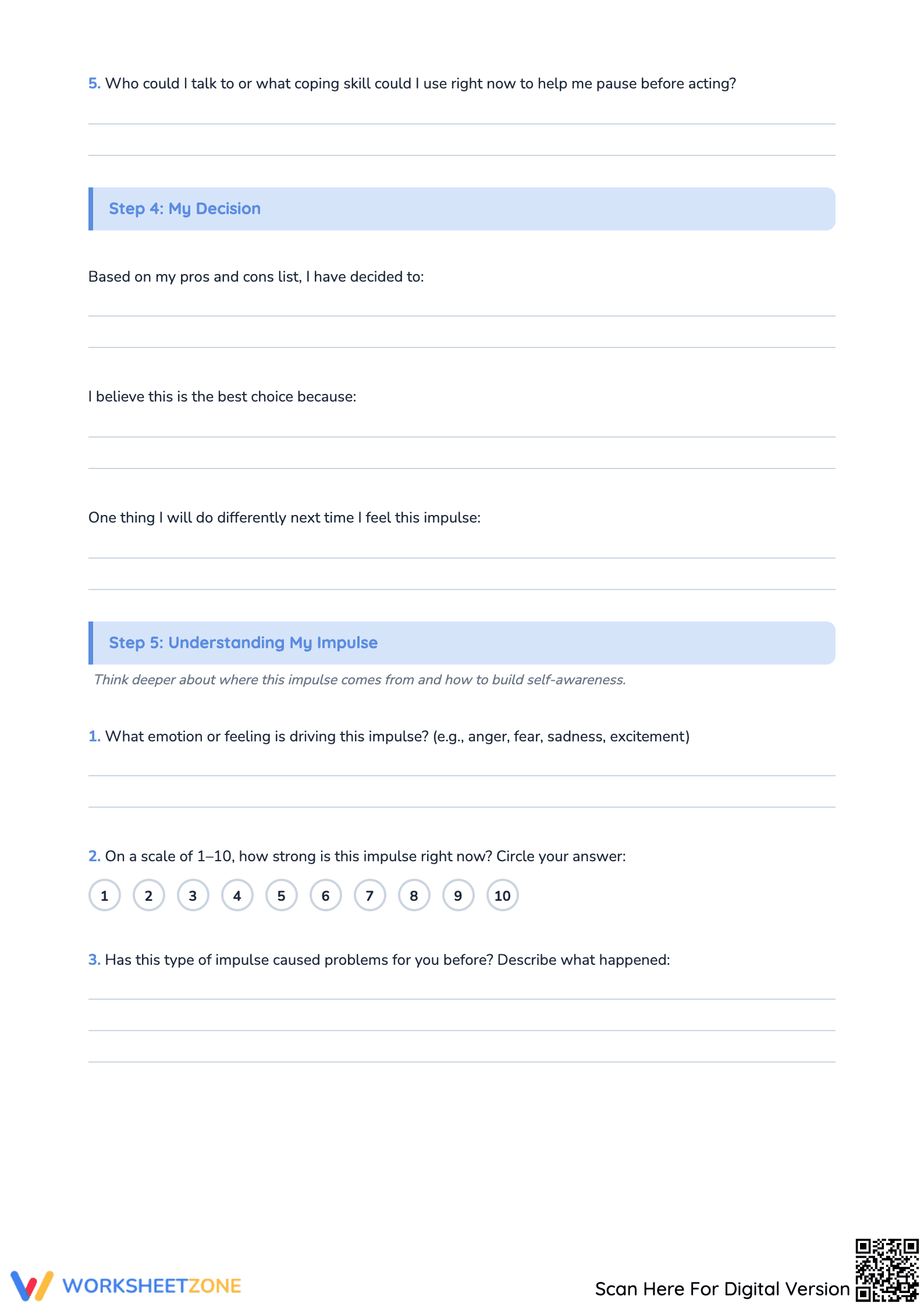
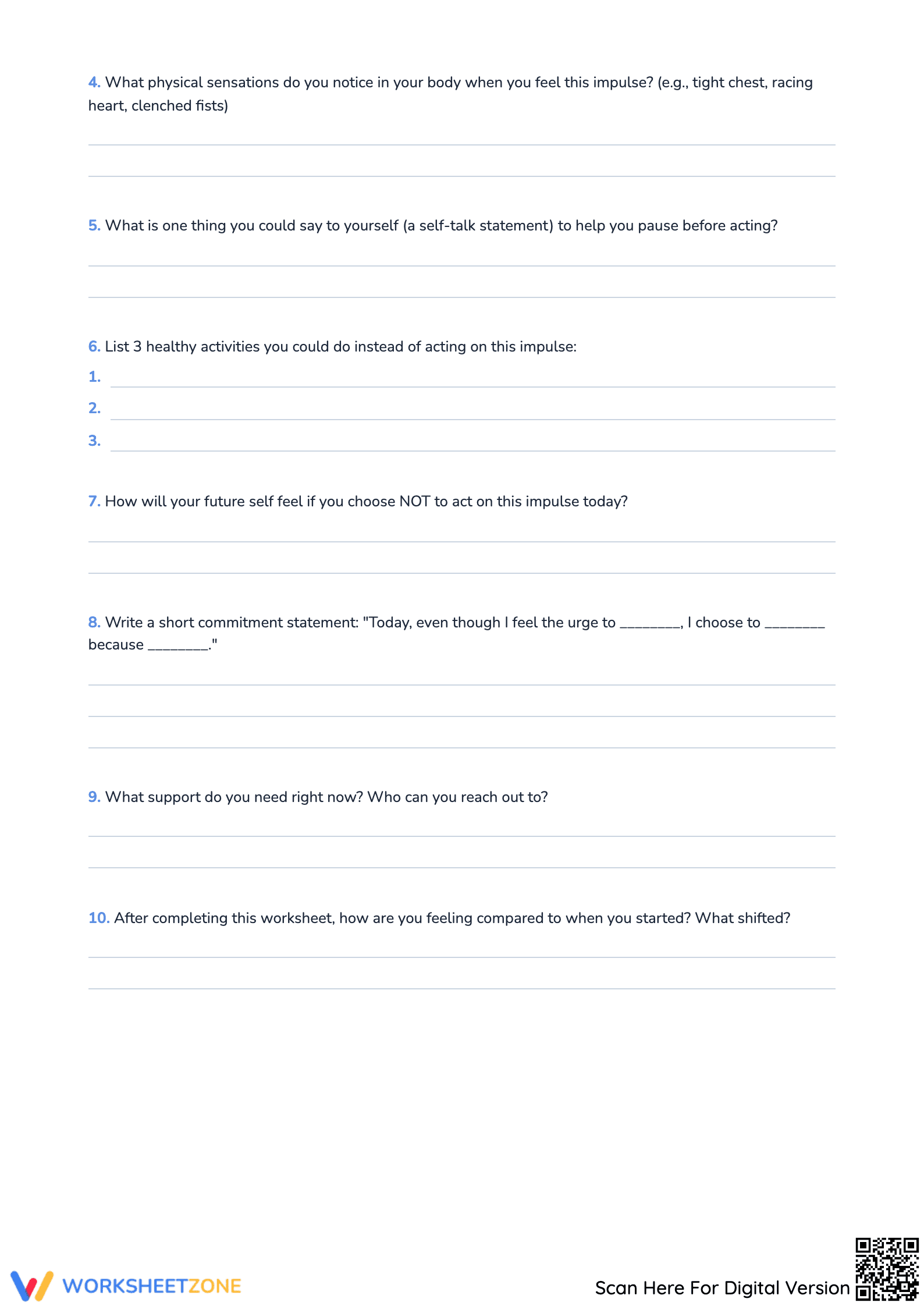
The 4-page PDF includes a comprehensive five-step workflow. It features a specialized pros and cons grid for comparing "Acting on Impulse" vs. "Not Acting on Impulse," followed by 10 deep-reflection questions. The layout provides ample writing space for situation identification, emotional scaling (1-10), and physical sensation tracking, ensuring a thorough self-analysis of behavioral triggers and outcomes.
The workflow is designed for immediate implementation in high-pressure environments. First, print the 4-page packet (30 seconds). Second, distribute to the student during a calm-down period or scheduled SEL block (1 minute). Third, review the completed reflection and commitment statement to assess student readiness (1 minute). Total teacher preparation time is under 3 minutes, making it an ideal resource for unexpected behavioral incidents or sub plans.
This resource aligns with `CCSS.ELA-LITERACY.W.11-12.1`, which requires students to write arguments to support claims using valid reasoning and relevant evidence. By analyzing the "pros and cons" of their own behavior, students practice the logical structuring of arguments and the evaluation of consequences. Both standard codes can be copied directly into lesson plans, IEP goals, or district curriculum mapping tools.
Assign this worksheet during a Tier 2 behavior intervention or as part of a Dialectical Behavior Therapy (DBT) skills group. It is most effective when used after a student has experienced a "near-miss" impulsive event but has returned to a baseline emotional state. Use the 1-10 impulse strength scale as a formative assessment to track emotional regulation progress over multiple sessions. Completion typically takes 30 to 45 minutes.
This tool is specifically designed for high school students in Grades 10 and 11 who struggle with emotional regulation or executive functioning. It serves as an excellent companion to a "Wise Mind" anchor chart or a direct instruction lesson on distress tolerance. It is also highly effective for students with IEP goals related to self-regulation and social-emotional learning in a general education or resource setting.
The use of structured pros-and-cons lists for impulse control is a cornerstone of evidence-based behavioral interventions. According to Fisher & Frey (2014), providing students with scaffolds for metacognitive reflection—such as the 18 specific prompts included here—significantly improves their ability to internalize self-regulation strategies. This worksheet addresses the CCSS.ELA-LITERACY.W.11-12.1 standard by requiring students to analyze substantive personal topics through a logical lens. By documenting physical sensations and emotional drivers, students move from reactive behavior to proactive decision-making. Research from the RAND AIRS 2024 report suggests that consistent use of written reflection tools in secondary education correlates with higher rates of successful conflict resolution. This 4-page printable serves as a standalone summary of the student's current emotional state and future commitment, making it an essential artifact for progress monitoring and behavioral data collection in high school settings.


