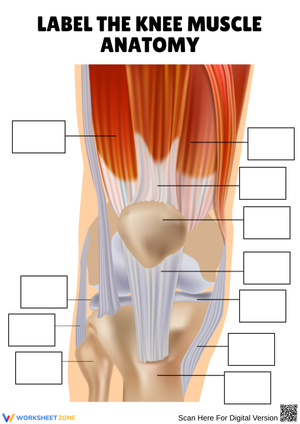
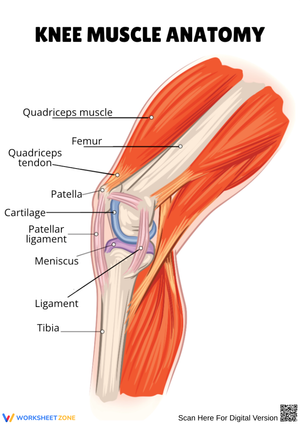
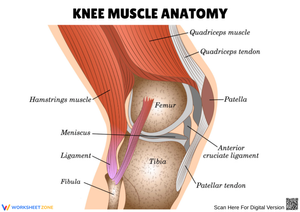
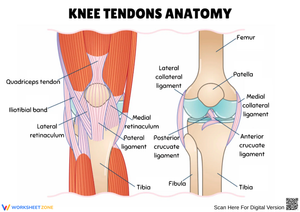
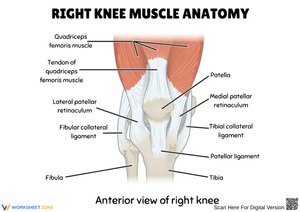
10th Grade Knee Muscle Worksheets for Anatomy Class
These 10th grade knee muscle worksheets give anatomy and biology teachers a focused entry point into one of the musculoskeletal system's most teachable joints. The knee draws on several muscle groups working in coordinated opposition — not a single prime mover — which makes it an unusually strong topic for demonstrating how muscles operate in antagonist pairs. Each worksheet moves students through identification, function matching, and short applied reasoning, without requiring lab equipment or a full dissection setup.
The Specific Skills These Worksheets Target
The content centers on three muscle groups and two connective tissue types that every grade 10 anatomy student should be able to name, locate, and explain. The quadriceps sit on the anterior thigh and drive knee extension — the straightening action students can feel when they push up from a squat. The hamstrings run along the posterior thigh and are the primary flexors, bending the knee during walking and stair climbing. The gastrocnemius deserves specific attention because it crosses both the knee and ankle joints, contributing to knee flexion while also enabling plantar flexion below. That dual-joint role is one of the clearest examples available in secondary anatomy instruction of how a single muscle can participate in more than one movement pattern at the same time.
Beyond the muscle groups themselves, each worksheet asks students to distinguish tendons and ligaments as structures with fundamentally different roles. Tendons transmit the pulling force a contracting muscle generates and connect that muscle to bone. Ligaments connect bone to bone and contribute to joint stability rather than motion. Students who cannot sort these two tissue types will consistently misread injury descriptions and stumble on any movement-analysis question that appears later in the unit.
Where Student Understanding Typically Breaks Down
Three predictable errors appear in student work on this topic. First, students routinely label the quadriceps correctly on a diagram and then match them to flexion on the function chart — they know where the muscle sits but have not connected location to action. A worksheet that sequences labeling before function matching surfaces this immediately: if a student marks the anterior thigh correctly and still selects flexion, the problem is conceptual rather than a simple memory failure about anatomical location.
Second, tendon-ligament confusion is nearly universal at this level. Students who can define both terms in isolation will still write "the ligament contracts to pull the lower leg forward" on a short-answer response, because the definition has not transferred to applied reasoning. Worksheets that ask students to sort sample scenarios — "holds the femur and tibia together at the joint" versus "attaches the quadriceps to the tibial tuberosity" — force the distinction in context, which is where it needs to hold.
Third, many students treat flexion and extension as vocabulary to memorize rather than descriptions of visible motion. When a worksheet includes a scenario question such as "explain what happens at the knee when you stand up from a seated position," students who have only memorized definitions write "extension occurs," while students with real understanding name which muscle group contracts, what that muscle pulls on, and why the antagonist group must simultaneously relax. The gap between those two responses is exactly what a well-structured worksheet reveals — and gives the teacher something concrete to address before the unit assessment.
Fitting These Worksheets Into Your Anatomy Unit
The most efficient classroom approach is a three-part lesson running about 30 minutes. Open with a body-awareness observation: ask students to place one hand on the front of the thigh and one on the back, then slowly extend and flex the knee from a seated position. They can feel the anterior muscles firm during extension and the posterior muscles firm during flexion — no equipment needed. That 90-second activity gives students a physical reference that makes every label they place on the worksheet feel grounded in something they actually noticed rather than a term they are copying from a board.
Move directly into independent completion for the labeling section, where individual responses reveal immediately where students are placing structures. Shift to partner work for the function chart and vocabulary section, which tends to generate productive disagreement when students debate whether the gastrocnemius belongs on the flexor or extensor side. Collect the applied scenario question as a written exit check — taken at the door — so you have a formative read before the next session.
For Monday warm-ups or Friday review blocks, 10th grade knee muscle worksheets also work well as standalone 15-minute activities, particularly the week before a musculoskeletal unit assessment. The combination of diagram labeling and movement reasoning gives students practice on both the identification and application question types that appear most often on unit quizzes.
Meeting Different Readiness Levels With the Same Content
These worksheets adjust cleanly across readiness levels because the core content — three muscle groups, two connective tissue types, and their roles in knee movement — stays constant while the amount of built-in support increases or decreases depending on the class.
- Students needing extra support benefit from a word bank covering all structure names and action terms, partially labeled diagram arrows, and sentence frames on short-answer questions. A frame like "The _______ muscle contracts to cause _______ at the knee because _______" reduces the writing demand without reducing the conceptual requirement — students still have to understand the content to fill it in accurately.
- On-level students complete the full worksheet as written: labeling, function matching, vocabulary definitions, and one scenario response. This version works well as independent practice after direct instruction or as a review activity before a quiz.
- Students ready for greater challenge work with the word bank removed, a second scenario involving a hamstring strain, and a question asking them to explain why an injury to one muscle in an antagonist pair limits motion for the opposing action. That last question requires understanding how muscle pairs function together — not just what each does individually — and reliably separates students who have memorized facts from those who have internalized the functional logic.
Teachers can also vary the product. Some students complete the written worksheet while others turn the same content into an annotated diagram or a concept map connecting each muscle to its joint action and antagonist partner. The content stays the same; the path to demonstrating understanding becomes more flexible.
Standard Alignment
10th grade knee muscle worksheets align most directly to NGSS HS-LS1-2, which calls on students to develop and use models to illustrate how interacting systems within multicellular organisms provide specific functions. The knee joint is a strong model for this standard because it requires students to account for multiple tissue types — muscle, connective tissue, and bone — operating in coordination rather than isolation. In classroom terms, the standard asks students to explain how a structure enables a function, which is precisely the reasoning demanded by the movement-analysis questions on each worksheet. Simply identifying the quadriceps as "the front thigh muscle" does not satisfy HS-LS1-2; explaining that the quadriceps contract and pull on the patellar tendon to extend the lower leg does.
Frequently Asked Questions
Which muscle groups should 10th grade students know for the knee?
The three groups most relevant at this level are the quadriceps, hamstrings, and gastrocnemius. Quadriceps drive extension; hamstrings drive flexion; the gastrocnemius crosses both the knee and ankle joints, assisting with knee flexion while also controlling ankle motion. Students should also be able to distinguish tendons from ligaments — not to name every individual structure, but to explain the different functional role each tissue type plays within the joint system.
How long does completing one of these worksheets take in class?
Most classes finish the full set of tasks — labeling, matching, vocabulary, and one scenario question — in 20 to 25 minutes when the worksheet follows direct instruction. If it is used to introduce the topic rather than as practice after teaching, plan for 30 to 35 minutes and expect questions during the function-matching section. The scenario question at the end typically takes students 5 to 8 minutes on its own.
Can these worksheets be used in a general biology class rather than a dedicated anatomy course?
Yes. The content maps directly onto structure-function relationships in the human body, which most 10th grade biology courses address within the organ systems unit. 10th grade knee muscle worksheets work particularly well as a focused case study within a broader musculoskeletal section, since the knee involves multiple tissue types and movement patterns students can observe without any equipment.
What should I do when students label the diagram correctly but get function questions wrong?
This is one of the most consistent patterns at this level, and it points to a specific gap: students have memorized location but not action. A quick targeted response — asking students to physically perform the movement and name which muscle group they feel contracting — typically closes that gap faster than re-reading a textbook definition. A second pass through the function chart following that activity usually resolves the confusion before the next class period.
Clear All