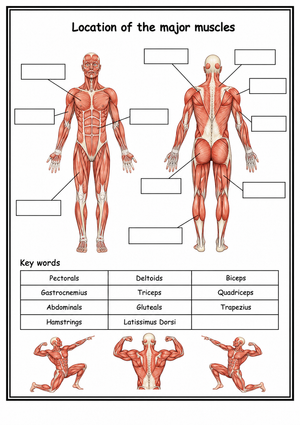
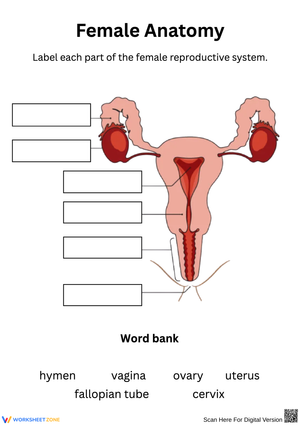
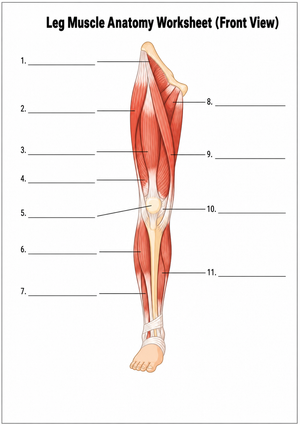
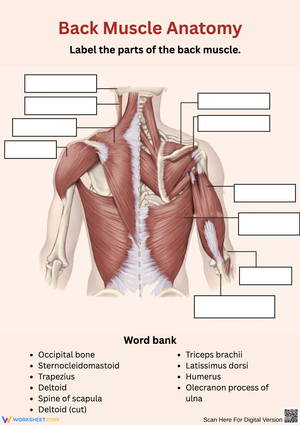
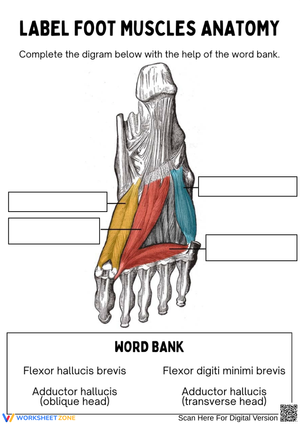
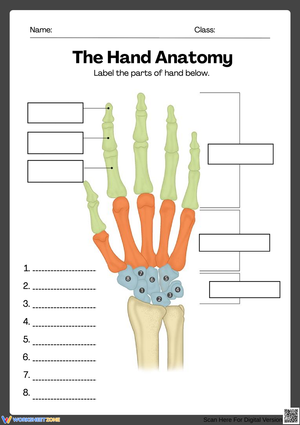
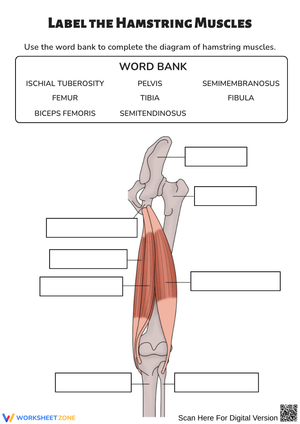
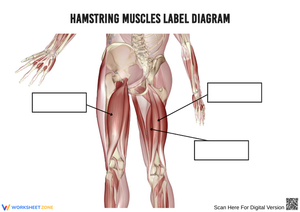
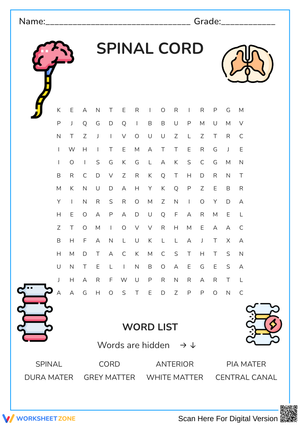
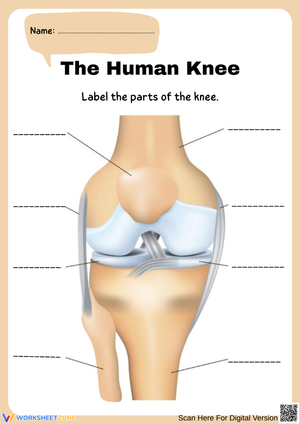
Human anatomy printable worksheets for 10th grade give biology teachers a focused set of diagramming, labeling, and systems-analysis activities built around the body systems at the center of NGSS-aligned biology. Each worksheet targets a specific anatomical focus — pulmonary circuit mechanics, nephron filtration sequence, reflex arc pathway — so individual resources drop into existing unit plans without restructuring the lesson sequence. The set carries students from structural identification toward the functional reasoning that shows up on end-of-unit assessments and state biology exams.
Body Systems and Skills Each Worksheet Targets
Six major systems form the core of the set: circulatory, respiratory, nervous, endocrine, digestive, and excretory. The task types vary across systems rather than repeating the same format throughout.
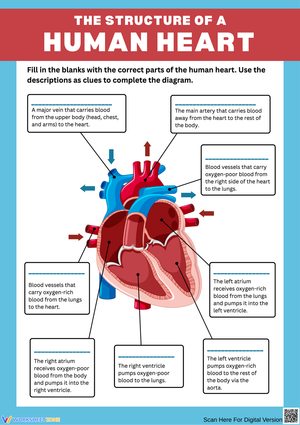
- Circulatory and respiratory: Students trace pulmonary and systemic circuits, label the four heart chambers and major vessels, and annotate alveolar structure — identifying exactly where oxygen crosses into capillary blood and carbon dioxide moves the opposite direction.
- Nervous system: Worksheets have students map reflex arc pathways step by step, label the divisions of the CNS and PNS, and annotate a motor neuron diagram indicating the direction of signal travel.
- Endocrine system: Students identify the major glands, map hormone-to-target relationships, and work through a negative feedback diagram for blood glucose regulation — tracing the insulin and glucagon responses that follow a post-meal blood sugar rise.
- Digestive system: Labeling covers the GI tract from oral cavity through large intestine, with a focused section on the accessory organs — pancreas, liver, gallbladder — and their enzymatic contributions.
- Excretory system: A nephron cross-section requires students to trace filtrate from the glomerulus through the loop of Henle to the collecting duct, annotating what is reabsorbed at each segment.
Several worksheets push past identification into application. Why is the left ventricular wall thicker than the right? What happens to renal filtration rate when systemic blood pressure drops? Those questions put anatomical vocabulary to work rather than leaving it as inert terminology.
Standard Alignment
NGSS HS-LS1-2 asks students to develop and use models illustrating the hierarchical organization of interacting systems within multicellular organisms. In classroom terms, that means students should be able to explain how cells form tissues, tissues form organs, and organs form systems that depend on one another to maintain function. The labeling and annotation activities across this set build exactly that explanatory capacity — a student who traces oxygenated blood from the left ventricle through the aorta and explains why that path differs from the pulmonary circuit is meeting HS-LS1-2 at the performance level, not the recall level. Teachers can use worksheet completion as formative evidence of the modeling expectations embedded in the standard.
Frequent Student Errors Worth Watching For
The most persistent error in 10th grade circulatory work is directional confusion. Students correctly label the right atrium and right ventricle, then draw blood flowing directly from the right ventricle to the aorta — bypassing the lungs entirely. The mistake persists after instruction because students mentally collapse "right side pumps blood" with "blood leaves the heart toward the body." Worksheets that require students to annotate why deoxygenated blood travels into the pulmonary artery force that distinction into the open before it hardens into a test-day error.
In reflex arc work, students frequently reverse signal direction — drawing the impulse traveling from motor neuron back toward the sensory receptor. Worksheets that ask students to number each step in sequence (sensory receptor → afferent neuron → spinal cord → efferent neuron → effector) catch this more reliably than simple label-the-diagram tasks, because students must commit to an order rather than place terms wherever they look plausible.
For the nephron, the trouble spot is the loop of Henle. Many students label the descending and ascending limbs identically, without distinguishing their different permeabilities to water and solutes. Pairing the structural diagram with a small table where students specify what crosses the membrane at each section surfaces this gap immediately — usually mid-worksheet, while there is still time to address it in the same class period.
How to Build These Worksheets Into Your Lesson Plans
The strongest entry point is using each worksheet as a pre-lab primer the day before a dissection or anatomy model activity. Students arrive familiar with the structural names they'll encounter, so lab time goes to observation and questioning rather than basic orientation — a meaningful difference in a 50-minute period.
As bell-ringers, the worksheets work particularly well at the start of a new system unit. A three-minute labeling warm-up tells you immediately who has been reviewing outside class and who hasn't, before any direct instruction begins. That early read shapes how much you slow down for the first lesson.
Blind labeling is the most reliable formative tool near the end of each system unit. Strip the word bank entirely, hand students a blank diagram, and ask them to label each structure and add a one-sentence function note. Students who succeed have genuinely internalized the material. Students who struggle show you exactly where recall breaks down — before the summative assessment, which is when that information is actually useful.
Human anatomy printable worksheets for 10th grade also fit naturally into late-semester review stations once students have covered all six systems. Set up six stations, one per system, with a different worksheet at each. Students rotate on a 10-minute timer. The format keeps review from collapsing into passive re-reading and surfaces cross-system connections — students notice that both the nervous and endocrine systems participate in the response to low blood sugar, which is exactly the integrated thinking HS-LS1-2 expects.
Adjusting the Set for Different Student Levels
For students who need additional support, provide a partially completed diagram rather than a full word bank. A partially filled diagram gives spatial anchors — ten or twelve structures already placed — without removing the cognitive work of completing the model. That is meaningfully different from matching terms from a list, which students can do without fully understanding where a structure sits in relation to its neighbors.
Human anatomy printable worksheets for 10th grade are arranged as individual resources rather than a locked sequence, which makes it straightforward to hold a student at one system until their work shows readiness to move forward. A student still struggling with the pulmonary circuit has no business moving on to autonomic nervous system regulation yet. The format accommodates that kind of pacing without awkward workarounds.
For students working above grade level, remove the word bank and add open-ended application questions: What would happen to urine concentration if the loop of Henle were significantly shortened? How would a blocked coronary artery affect electrical conduction through the ventricles? Those questions require applying anatomical knowledge to novel problems — closer in cognitive demand to what AP Biology and advanced coursework require than anything a standard labeling task can ask.
Frequently Asked Questions
Do these worksheets hold up as substitute teacher plans?
Yes. Each worksheet is self-contained — the diagram, any reference key, and the task instructions are all included. A substitute doesn't need to explain the lesson; students have everything they need to work independently. Assigning one system per class period gives students 40 to 50 minutes of productive review without live instruction.
Which worksheets work better as classwork versus homework?
Most of the set works fine for independent home completion. The pathway-tracing worksheets — pulmonary circuit, reflex arc, nephron filtration sequence — are the exception. Those benefit from class time where students can ask questions before they commit to wrong answers. Assigning them as solo homework before any guided practice tends to produce confidently incorrect work that takes longer to correct than if the misconception had been caught in the room.
Can these be paired with dissection labs?
Many teachers use each worksheet as a pre-dissection activity so students arrive at the lab already familiar with the structural names they'll encounter. Individual worksheets also work as lab reference sheets during the dissection itself, or as post-lab reflection tasks where students reconcile what they observed with what the printed diagram shows.
How do these resources support students in biology courses without lab access?
In courses without regular dissection, these worksheets become a primary hands-on engagement with anatomical structure. Pairing each worksheet with a freely available 3D reference — Innerbody is one teachers commonly use — gives students a way to perceive the spatial depth that a flat diagram compresses, without requiring any specialized equipment.












 Interactive Worksheet Maker
 Quiz Maker
 Word Search Maker
 Crossword Puzzle Maker
 Word Scramble Generator
 Sentence Scramble Generator
 Handwriting Worksheet Generator
 Name Tracing Generator
 Fill In The Blank Generator