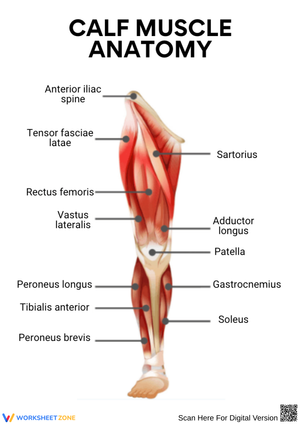
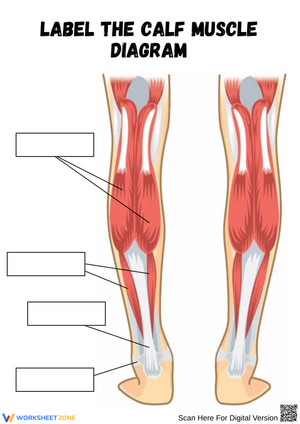
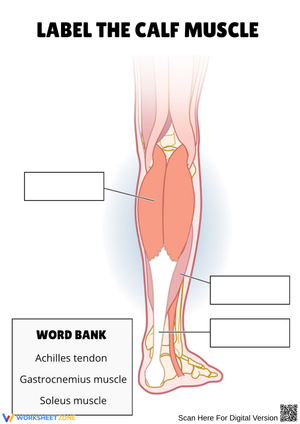
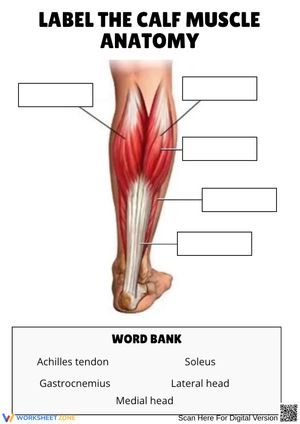
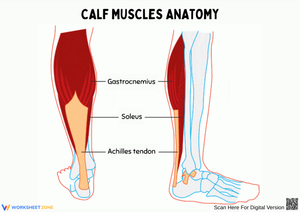
10th grade calf muscle printable worksheets give anatomy teachers a focused set of resources for one of the most consistently misunderstood regions in the muscular system unit: the posterior compartment of the lower leg. Each worksheet targets a distinct layer of understanding — from identifying the two heads of the gastrocnemius on a blank diagram to explaining, in writing, why one calf muscle crosses the knee when the other does not. The set covers gastrocnemius, soleus, and plantaris anatomy alongside the Achilles tendon and its insertion at the calcaneus.
Skills Covered Across the Set
Each worksheet addresses a separate type of anatomical reasoning rather than repeating the same labeling format throughout. Here is what students work through:
- Posterior lower leg labeling diagrams — students identify and place the medial and lateral heads of the gastrocnemius, the soleus lying deep to it, the slender plantaris, and the Achilles tendon descending to the calcaneus.
- Origins and insertions fill-in-the-blank — students write out the femoral condyle origins of the gastrocnemius, distinguish them from the tibia-and-fibula origin of the soleus, and name the shared calcaneal insertion.
- Matching activities — muscle names are paired with their specific function, structural depth (superficial or deep), or joint involvement; useful as a five-minute warm-up or an exit ticket.
- Short-answer biomechanics prompts — students explain what happens in the posterior compartment during a walking stride or how knee position changes the mechanical contribution of the gastrocnemius versus the soleus.
- Vocabulary review exercises — students work with terms like plantarflexion, posterior compartment, calcaneus, and origin and insertion across several question formats, reinforcing both spelling and meaning.
Errors to Address Before the Unit Exam
The two-joint function of the gastrocnemius catches more students than almost any other detail in this unit. Because it originates on the femoral condyles — above the knee — it contributes to both knee flexion and ankle plantarflexion. Students who learn "gastrocnemius equals plantarflexion" and stop there will miss the knee flexion component entirely. A clean diagnostic: ask students which calf muscle works harder during a seated heel raise. Students who understand the two-joint relationship will explain that the gastrocnemius is relatively slack with the knee bent, shifting the load to the soleus — a distinction the biomechanics worksheets ask them to reason through directly.
A second reliable error involves origin direction. Students expect leg muscles to originate on leg bones, so placing the gastrocnemius origin on the femur reads as counterintuitive. On fill-in-the-blank worksheets, a meaningful portion of students will reverse origin and insertion for this muscle until they have seen the diagram multiple times and internalized why the femur attachment makes anatomical sense. The soleus presents the opposite problem: because it originates on both the tibia and fibula, students often write only one bone and leave the other blank.
How These Worksheets Fit Into the Muscular System Unit
The labeling worksheets belong early in the lesson sequence, during initial exposure. Projecting a posterior leg image while students complete a blank diagram in real time keeps the activity anchored to something visual and immediate. 10th grade calf muscle printable worksheets also work well at classroom stations: laminating the labeling diagrams and providing dry-erase markers lets small groups label the same worksheet repeatedly — testing each other, wiping it clean, and going again — without consuming paper. Three rotations through that activity tends to produce noticeably more accurate recall than a single sit-down completion.
The biomechanics short-answer worksheets are better placed mid-unit or at the close of a lab day where students have already felt the difference between seated and standing heel raises with their own bodies. Pairing that kinesthetic experience with a written explanation — describe what changes in the posterior compartment when the knee moves from extended to flexed — produces stronger written responses than assigning the same question at the unit's start. Return to the blank labeling worksheet as a bell-ringer one week after the initial lesson. Students who labeled structures accurately with prompts during class often cannot retrieve the femoral condyle origin from memory — which is exactly the gap worth surfacing before the exam.
Standard Alignment
These worksheets align with NGSS HS-LS1-2, which asks students to reason from the structures of organisms to the functions those structures enable. At the high school level, that standard applies directly to tasks like explaining why the gastrocnemius, by crossing the knee joint, changes its mechanical contribution depending on leg position — not simply "what does this muscle do" but "why does the architecture of this muscle produce that function." Many state anatomy and physiology frameworks for grades 9 and 10 also require students to identify major muscles by origin, insertion, and movement. This set addresses those requirements for the posterior lower leg specifically.
Adjusting the Set for a Range of Learners
For students who are still building anatomical vocabulary, adding a word bank to the labeling worksheet shifts the cognitive demand from retrieval to recognition and spatial placement. That adjustment works well during the first week of the unit. Once students demonstrate accurate placement with a word bank, running the same worksheet without it — a week later, as a spaced retrieval task — reveals who has consolidated the terminology and who needs another pass before the unit exam.
10th grade calf muscle printable worksheets extend effectively in the other direction. Students who finish the labeling and matching tasks quickly benefit from the biomechanics prompts, which require synthesizing structure and movement rather than recalling names. A practical extension: ask those students to sketch the posterior compartment from memory, label all major structures, and annotate which muscles are active versus mechanically slack during a seated heel raise. That three-part task goes well beyond standard diagram work. For classes with ELL students, the matching worksheets — pairing muscle names with short functional descriptions — reduce language processing demands while keeping the anatomical content intact.
Frequently Asked Questions
Do these worksheets include answer keys?
Each worksheet comes with a corresponding answer key. Labeling diagram keys show correct structure placement with leader lines. The short-answer biomechanics worksheets include a sample response alongside a note on the conceptual elements worth looking for when evaluating student explanations — particularly whether students distinguish between the gastrocnemius and soleus based on joint involvement rather than just naming them.
What prior knowledge do students need before using these worksheets?
Students should already be comfortable with basic anatomical directional terms — superficial, deep, posterior, anterior — before starting the labeling worksheets. The set does not reteach those terms. Students who encounter that directional language for the first time on the diagram itself tend to spend cognitive effort on orientation rather than on muscle placement, which undermines the purpose of the activity. A brief review beforehand prevents that problem.
Can these worksheets substitute for a textbook lab on the muscular system?
They do not replace a hands-on lab or a full textbook chapter. They work best running alongside those materials — as structured practice that gives students multiple passes at posterior lower leg anatomy in different formats. 10th grade calf muscle printable worksheets fill the gap between initial instruction and summative assessment, putting the gastrocnemius, soleus, and Achilles tendon in front of students often enough — and in varied enough formats — that the details actually carry into the exam.