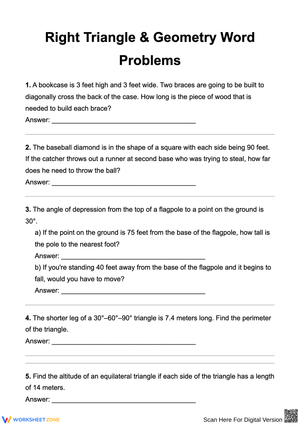
These triangles printable worksheets for 10th grade address the three content shifts that consistently cause difficulty in high school geometry: moving from measuring to formal justification, applying similarity ratios across multi-step diagrams, and building fluency with right triangle trigonometry before those skills appear on state assessments. Each worksheet targets a discrete concept, so teachers can assign exactly what a lesson needs without working around problems that don't fit. The set spans congruence proofs through two-column format, similarity with proportional side problems, trigonometric ratios, and the 45-45-90 and 30-60-90 rules — the complete range of triangle geometry from the first unit through the final exam.
Skills and Content Each Worksheet Targets
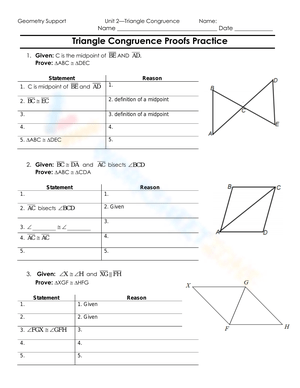
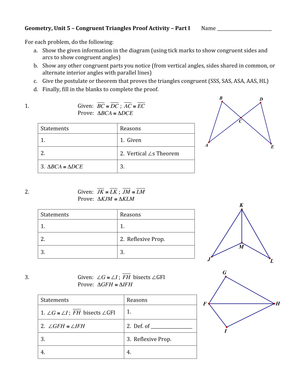
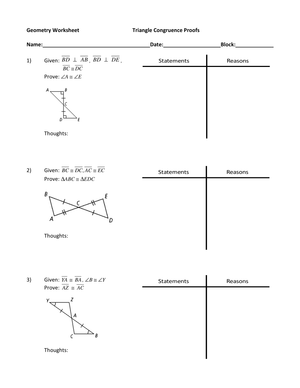
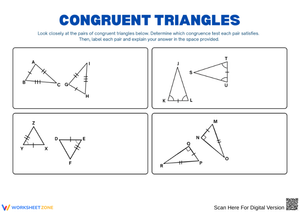
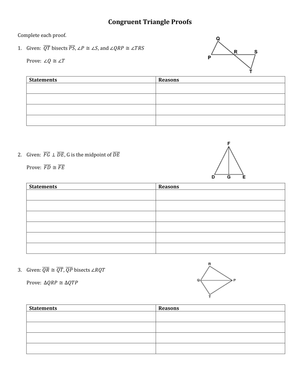
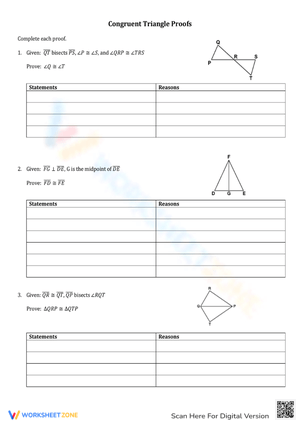
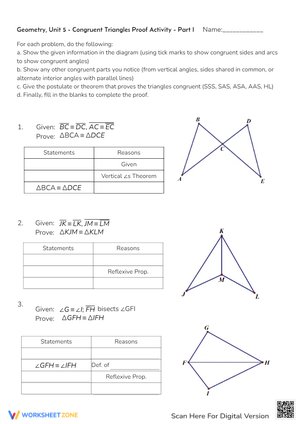
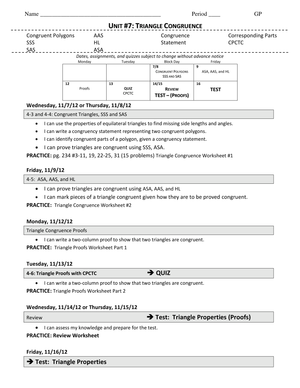
Congruence is the entry point. Students work with all five criteria — SSS, SAS, ASA, AAS, and Hypotenuse-Leg — identifying which postulate or theorem applies to a given diagram, marking sides and angles with tick marks and arc symbols, and writing the triangle correspondence statement in the correct order. From there, worksheets move into two-column proofs, starting with single-step justifications and building toward multi-step arguments where students must identify the given information, name transformation properties, and cite the correct postulate in the reason column.
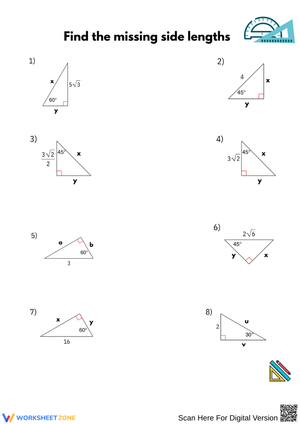
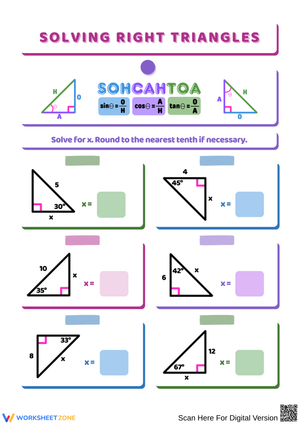
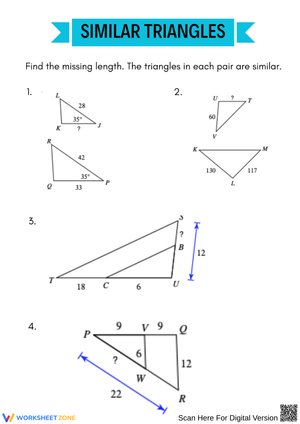
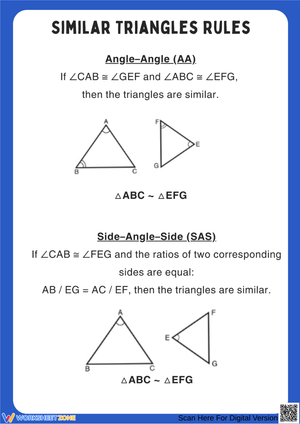
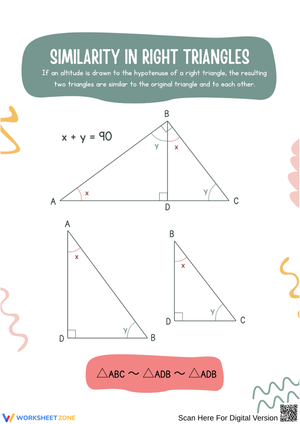
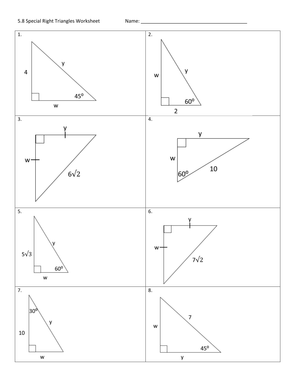
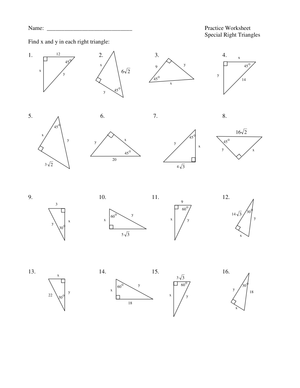
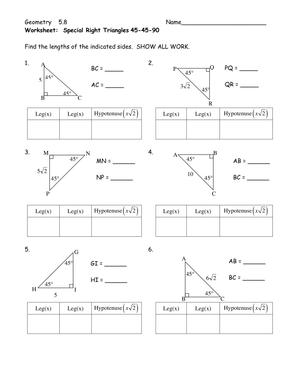
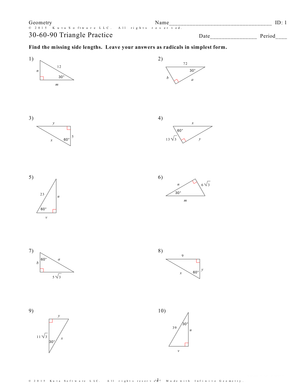
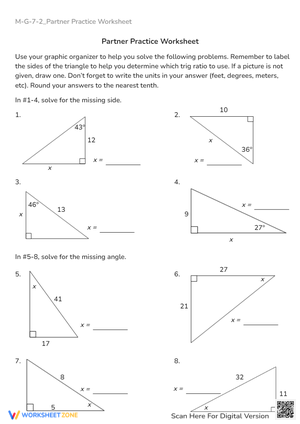
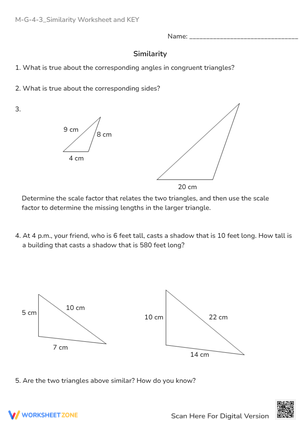
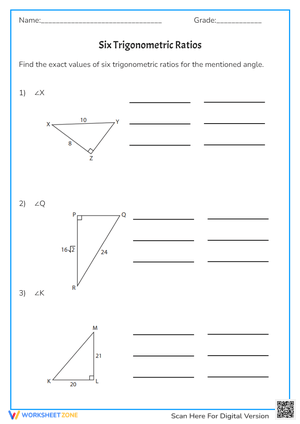
Similarity worksheets cover the AA, SSS, and SAS similarity theorems and ask students to set up and solve proportions for missing side lengths. Several worksheets in this cluster feature parallel lines cutting through triangles — exactly the configuration that generates Triangle Proportionality Theorem problems on most unit tests. Right triangle trigonometry worksheets have students set up sine, cosine, and tangent ratios, solve for unknown sides, and find missing angles using inverse trig functions. The special right triangle worksheets treat 45-45-90 and 30-60-90 separately before combining them in mixed-format drills.
Mistakes Students Make That These Worksheets Help You Catch
The SSS/SAS confusion surfaces on nearly every congruence assessment. Students count three congruent parts in a diagram and reach for SSS, even when one of those parts is an included angle — which makes SAS the correct postulate. The underlying issue is that students pattern-match on quantity (three marks) rather than reading the diagram for position. Worksheets that ask students to classify each congruent element as a side or an angle before selecting a postulate interrupt that shortcut and build the habit of reading position first.
In proof work, students reliably apply the Reflexive Property when two triangles share a side but consistently omit it when two triangles share an angle. Overlapping triangle diagrams — the configurations where two triangles share a vertex angle — generate this omission almost universally. A worksheet presenting only shared-angle configurations, where students must supply the reflexive step for an angle rather than a segment, closes this gap more efficiently than a general re-teaching of the property.
The 30-60-90 error is specific enough to anticipate: when the given value is the hypotenuse, students correctly divide by 2 to find the short leg, then multiply the hypotenuse by √3 instead of the short leg. For a hypotenuse of 10, the correct long leg is 5√3, but students routinely write 10√3. Worksheets that require students to assign the variable x to the short leg first — before doing any arithmetic — interrupt this error because the multiplication step then involves x, not the hypotenuse value.
Standard Alignment
The congruence proof worksheets align with CCSS.HSG-CO.B.7 and HSG-CO.B.8, which ask students to use the definition of congruence in terms of rigid motions and apply triangle congruence criteria to prove relationships. Similarity worksheets address HSG-SRT.A.2 through HSG-SRT.A.3, covering similarity correspondences, the AA criterion, and proportional relationships between triangle parts. The trigonometry worksheets align with HSG-SRT.C.6 through HSG-SRT.C.8, progressing from understanding why sine and cosine ratios are properties of angles rather than side lengths, to applying inverse trig functions, to solving applied right triangle problems using both trig ratios and the Pythagorean Theorem.
In the arc of a 10th grade geometry course, these standards sit between the rigid motion and congruence units earlier in the year and the circles and coordinate geometry units that follow. The trigonometry standards specifically lay groundwork that precalculus revisits with the unit circle — which means errors left unaddressed at this stage tend to reappear a year later in a different context, compounded by new material.
How to Build These Worksheets Into Your Lesson Plans
The proof worksheets work best assigned during the same class period that a new postulate is introduced, not as homework the following night. Students who sleep on a new proof structure tend to merge it with prior arguments, particularly in the early weeks when SSS, SAS, and ASA proofs look structurally similar. Using a fill-in-the-reason version of a two-column proof during the independent practice phase of the same lesson — before students leave — captures the logical structure while it is still fresh. The triangles printable worksheets for 10th grade in this cluster are organized so congruence proofs, similarity proofs, and trig applications each form a self-contained sequence, which means teachers can pull exactly the worksheets a class needs without working around irrelevant content.
Trig ratio worksheets divide naturally into two lesson types: setup and calculation. Using the non-calculator version first — where students set up a ratio and leave it as a fraction — surfaces whether students understand the relationship between a reference angle and its opposite and adjacent sides before the calculator obscures the thinking. The calculator version then becomes its own lesson focused on proper inverse function input and rounding conventions. Trying to address both setup and calculation mechanics in the same session overloads most students and leaves the conceptual error invisible.
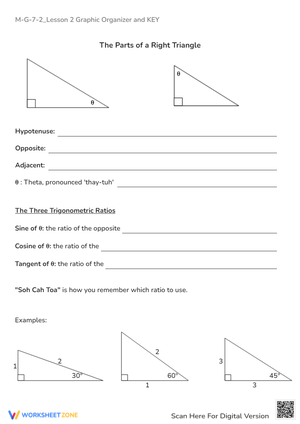
Special right triangle worksheets fit the warm-up slot during the week they are introduced, then work well as a spaced retrieval activity two or three weeks later when students are deep in trigonometry. Revisiting the 30-60-90 and 45-45-90 rules after students have learned SOH CAH TOA surfaces a meaningful comparison: students who verify a special right triangle result against a calculator answer are reasoning mathematically, not just checking arithmetic.
Adjusting These Worksheets for Different Student Levels
Students who are behind in algebraic manipulation — specifically solving equations with radicals or multi-term fractions — struggle disproportionately on similarity and trig worksheets even when they understand the geometry. For those students, worksheets where the proportion or ratio is already set up and the work begins at the solving step separate the geometry skill from the algebra skill. This allows teachers to assess each independently and identify where the actual instruction gap is, rather than assuming both areas need re-teaching simultaneously.
Students who have algebra fluency but remain uncertain about which trig ratio applies to a given right triangle benefit from worksheets that include pre-labeled diagrams — opposite, adjacent, and hypotenuse already marked relative to the reference angle — so they can focus on selecting and applying the ratio without the added demand of labeling. Students working above level get meaningful extension from the triangles printable worksheets for 10th grade that involve applied modeling: finding the height of a structure using an angle of elevation, or determining a missing segment in a nested similarity diagram where two or more theorems apply in sequence.
Frequently Asked Questions
Do the answer keys for proof worksheets show complete statement-reason pairs, or just the final conclusion?
Answer keys for proof worksheets list every statement-reason pair in sequence. For proofs where students commonly use equivalent but differently worded justifications — "definition of midpoint" versus "a midpoint divides a segment into two congruent parts," for instance — the key notes which alternate phrasings are acceptable. This prevents the grading ambiguity that two-column proofs create when a class hasn't settled on standard language for common justifications.
Should special right triangle worksheets come before or after the main trig ratio worksheets in my unit sequence?
Special right triangles work better introduced before SOH CAH TOA, not after. When students encounter the 45-45-90 and 30-60-90 relationships first, they arrive at trig ratios already understanding that certain angles produce fixed side-length relationships — which makes the definition of sine and cosine feel less arbitrary. Teachers who introduce trig first and special right triangles second often find that students treat them as unrelated topics and fail to connect them during cumulative assessments.
Are these worksheets appropriate for intervention students who are not currently enrolled in a 10th grade geometry course?
The triangles printable worksheets for 10th grade are built around the CCSS HSG-CO and HSG-SRT standards, so they assume students have prior exposure to triangle classification, angle sum relationships, and basic algebraic solving. An interventionist working with a student who missed foundational triangle content can use the congruence identification worksheets — which ask students to mark diagrams and name postulates without writing full proofs — as re-entry points before moving into the formal proof sequence.













 Interactive Worksheet Maker
 Quiz Maker
 Word Search Maker
 Crossword Puzzle Maker
 Word Scramble Generator
 Sentence Scramble Generator
 Handwriting Worksheet Generator
 Name Tracing Generator
 Fill In The Blank Generator