


























Views
Downloads


Interior Angle in a Triangle: Essential Grade 9-11 Worksheet
Paste this activity's link or code into your existing LMS (Google Classroom, Canvas, Teams, Schoology, Moodle, etc.).
Students can open and work on the activity right away, with no student login required.
You'll still be able to track student progress and results from your teacher account.
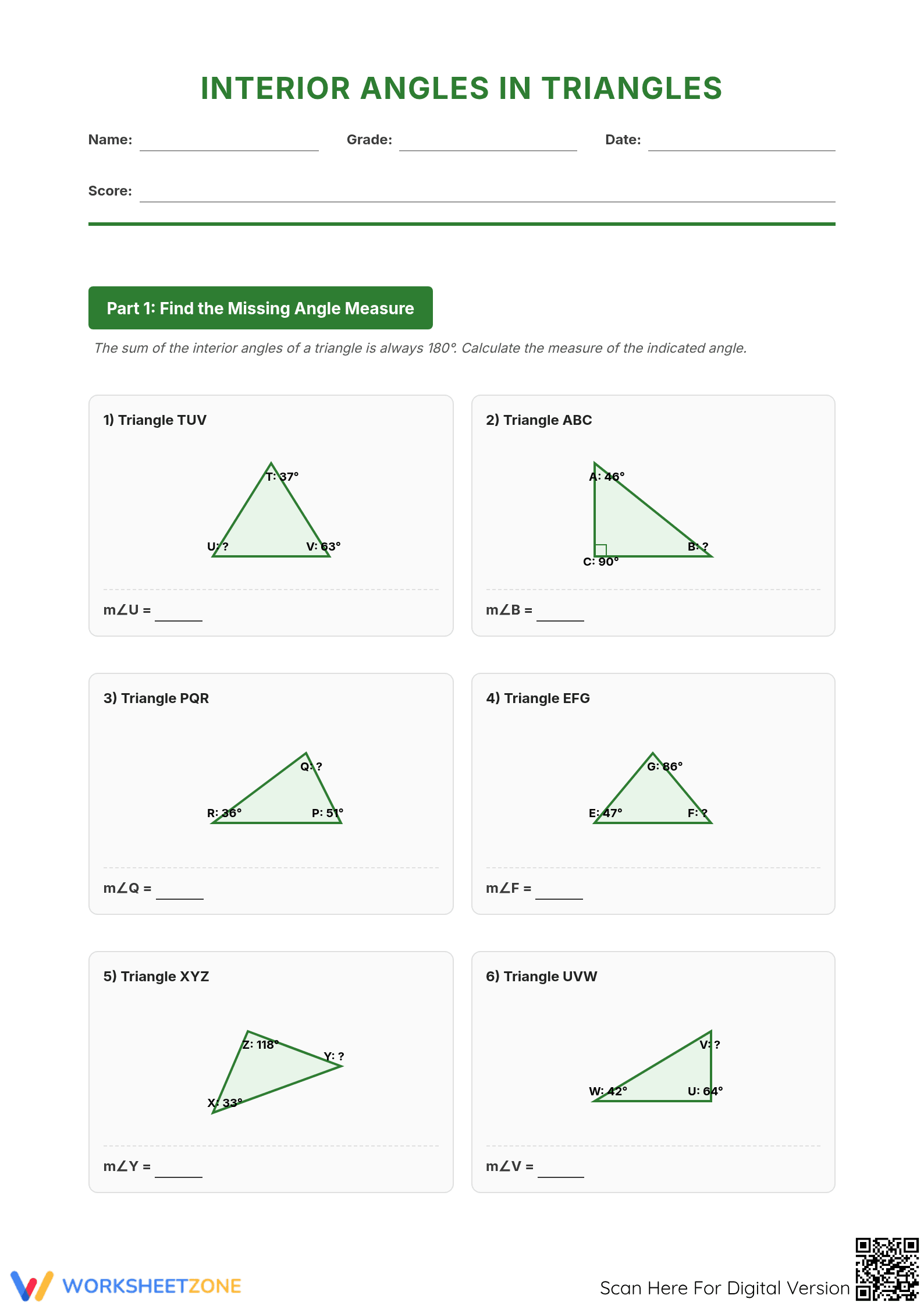
Mastering the interior angles of a triangle is foundational in high school geometry. This comprehensive worksheet provides students with 20 rigorous problems designed to solidify their understanding of the Triangle Sum Theorem. From direct measure calculations to complex algebraic applications, learners will develop the spatial reasoning skills necessary for geometric proofs and real-world problem-solving.
At a Glance
- Grade: 9–11 · Subject: Math (Geometry)
- Standard:
HSG-CO.C.10— Prove and apply the theorem that the sum of interior angles is 180 degrees.- Skill Focus: Triangle Interior Angle Sum
- Format: 4 pages · 20 problems · Answer key included · PDF
- Best For: High school geometry practice.
- Time: 40–50 minutes
What's Inside
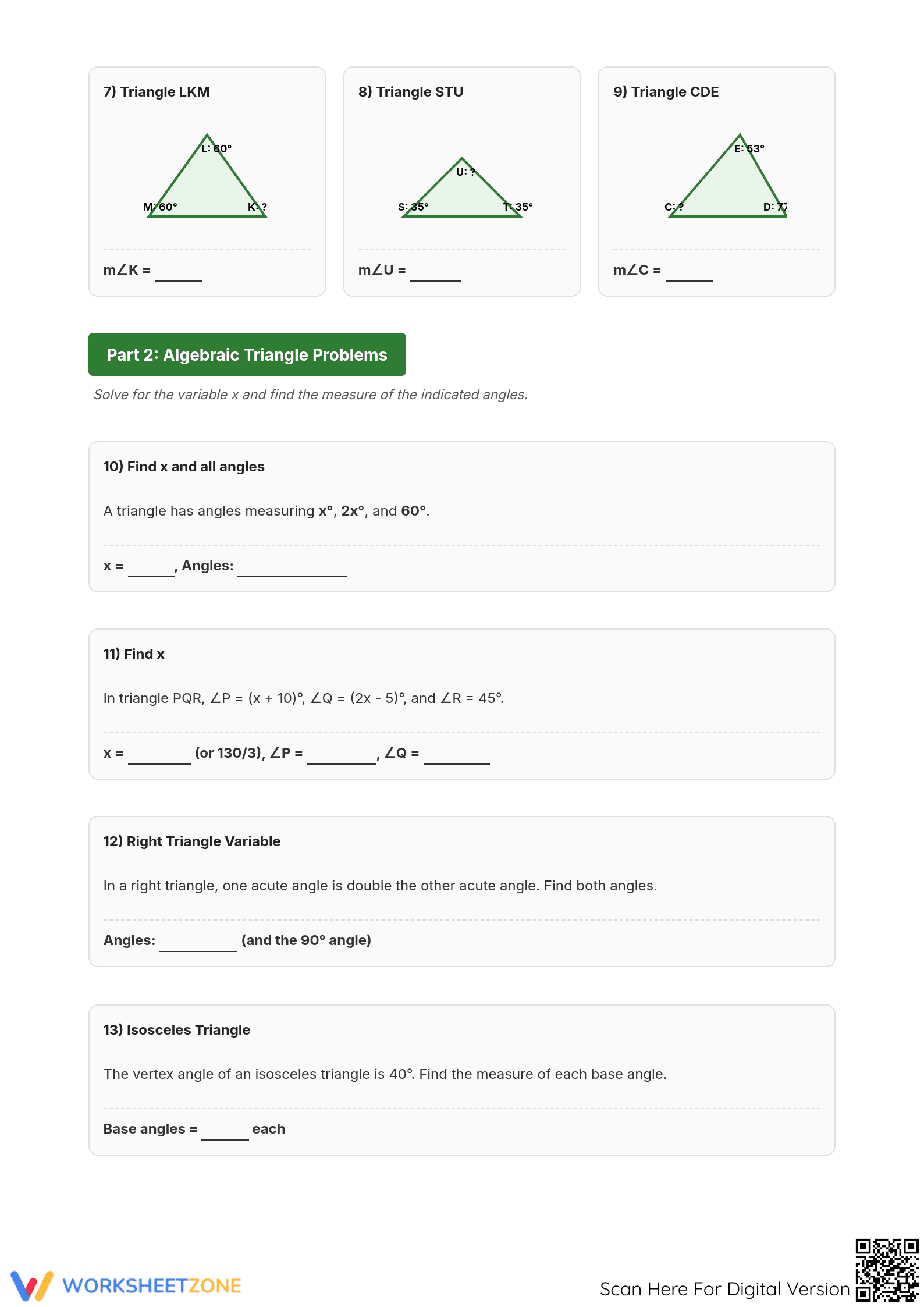
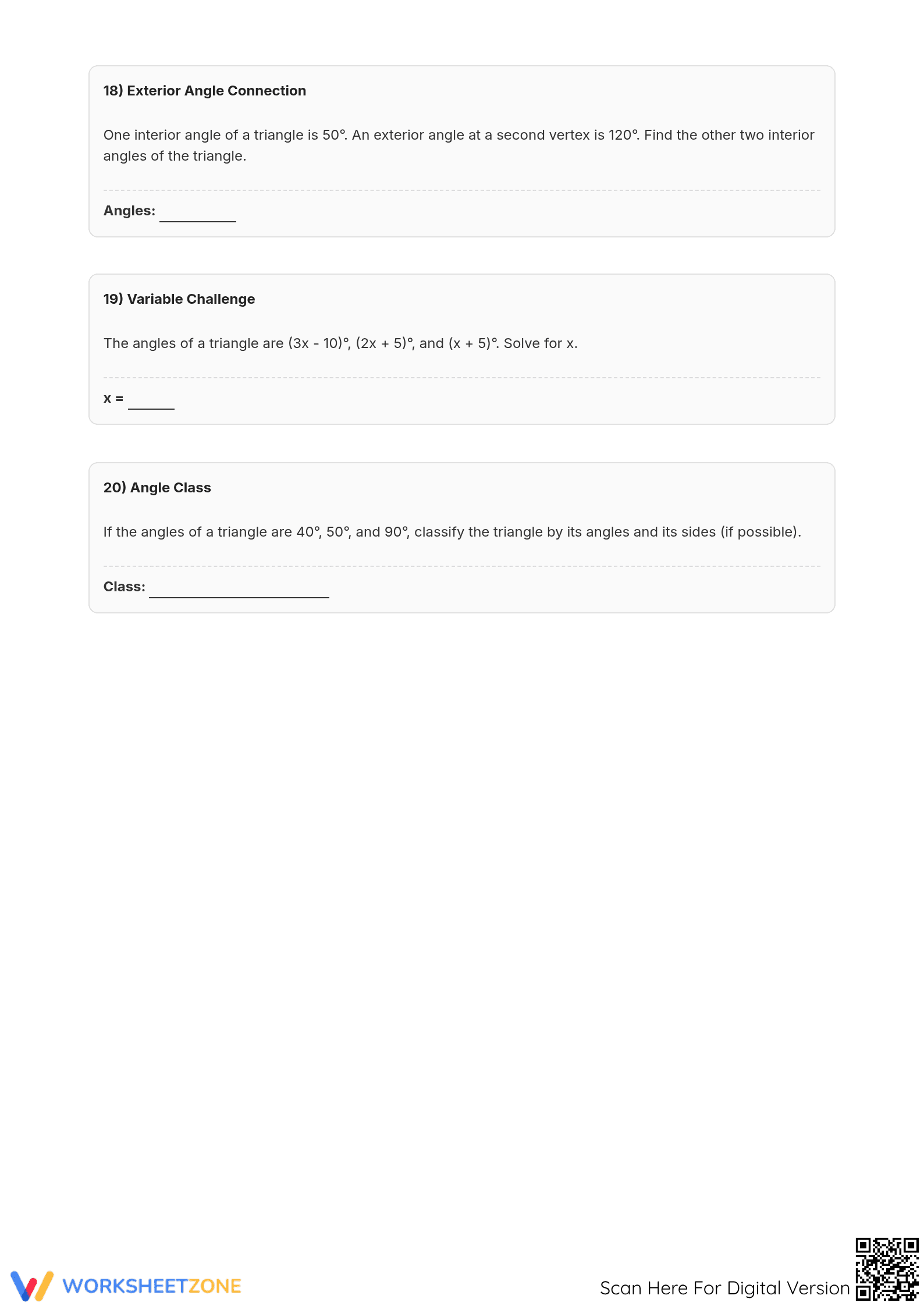
This extensive four-page packet contains a sequence of tasks with nine direct-measure triangle problems, four algebraic solve-for-x scenarios involving linear expressions, and three high-interest word problems. The resource concludes with a dedicated challenge section featuring overlapping triangles and exterior angle connections. A complete answer key is provided, mirroring the worksheet's structure for effortless verification.
Zero-Prep Workflow
The zero-prep workflow for this resource is designed for maximum efficiency:
- Print (1 minute): Print all 4 pages for each student or select specific sections for targeted practice.
- Distribute (1 minute): Hand out to students for individual or collaborative work.
- Review (5 minutes): Use the included detailed answer key for rapid grading.
Total teacher prep time is under 2 minutes, ideal for sub plans.
Standards Alignment
This worksheet is aligned to HSG-CO.C.10: "Prove theorems about triangles. Theorems include: measures of interior angles of a triangle sum to 180°." It also supports 8.G.A.5 for students needing foundational review. Both standard codes can be copied directly into lesson plans, IEP goals, or district curriculum mapping tools.
How to Use It
This resource is best utilized as an independent practice set following a direct instruction lesson on the Triangle Sum Theorem. Teachers can use the first page as a guided session before assigning the algebraic and application sections for independent mastery. For formative assessment, observe students working on the overlapping triangle problem to identify misconceptions regarding shared vertices.
Who It's For
Designed for Grades 9 through 11, this worksheet is tailored for geometry students needing to bridge gaps between basic angle sums and algebraic geometry. It provides essential support for students on IEPs through its clear visual formatting, while offering extension opportunities for advanced learners via the Part 4 challenge questions and architectural application problems.
This worksheet aligns with CCSS.MATH.CONTENT.HSG-CO.C.10, focusing on the fundamental geometric principle that the interior angles of any triangle sum to 180 degrees. According to EdReports (2024), high-quality instructional materials in geometry must bridge the gap between procedural fluency and conceptual application. This resource achieves that by transitioning from simple numerical calculations to complex algebraic equations and real-world architectural scenarios. By requiring students to solve for variables and apply angle properties to overlapping figures, the worksheet reinforces the rigorous demands of college and career readiness standards. Research from ScienceDirect TpT Analysis highlights that structured practice with diverse problem types—ranging from direct computation to word problems—significantly enhances long-term retention of geometric theorems. Educators can confidently utilize this 20-task set to provide the necessary scaffolding for mastery, ensuring students develop the analytical skills required for advanced trigonometry and higher-level mathematical reasoning in subsequent courses.


