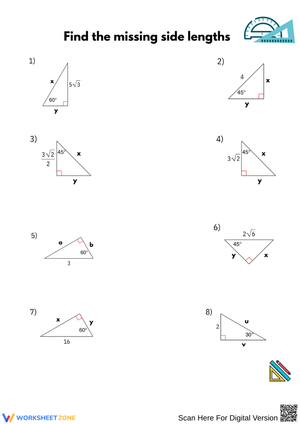
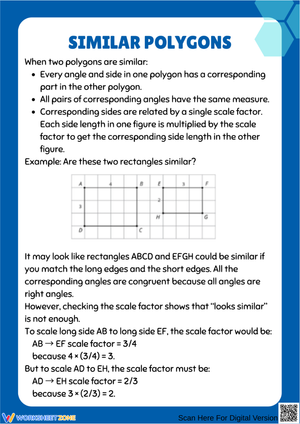
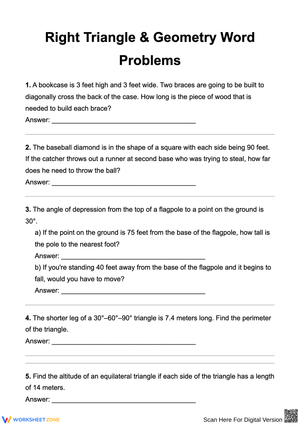
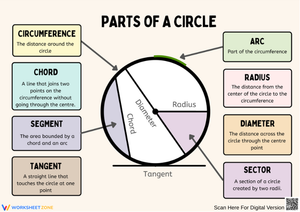
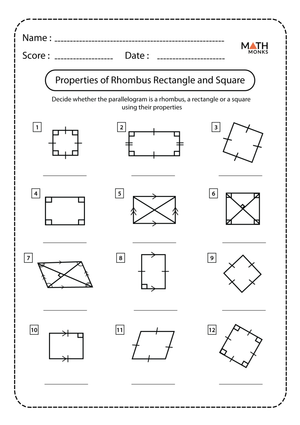
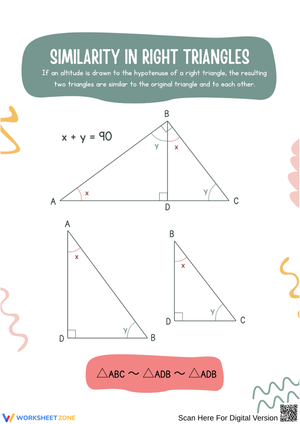
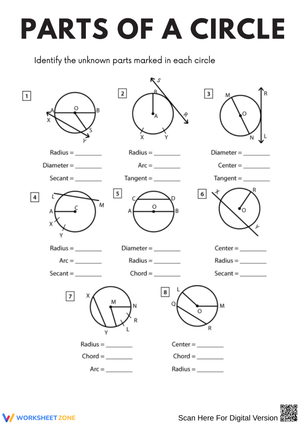
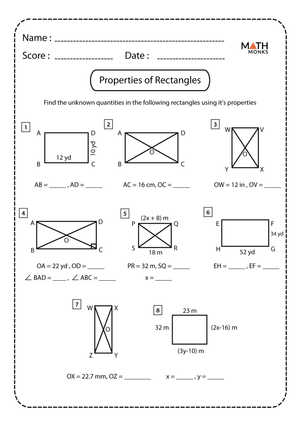
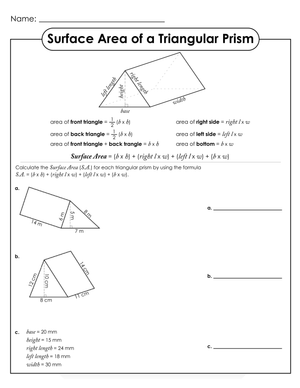
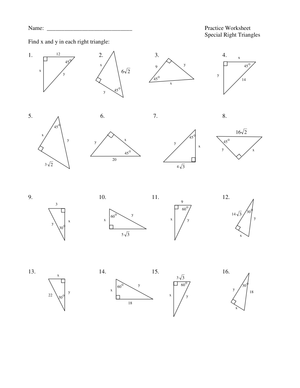
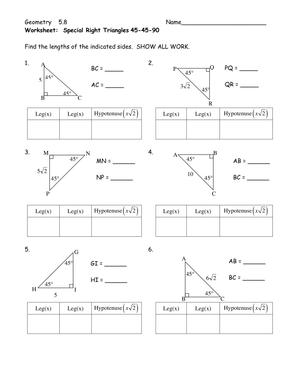
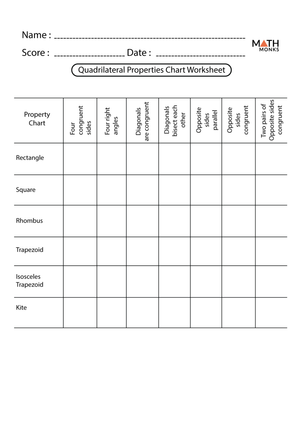
These 2d shapes printable worksheets for 10th grade address the exact transition point that defines high school geometry: the moment students stop identifying a rhombus by sight and start proving it algebraically using slope and the distance formula. Each worksheet targets a specific skill cluster — coordinate classification of quadrilaterals, composite area with irrational results, perimeter on the coordinate plane — so a teacher can assign what the class actually needs rather than working through an undifferentiated review.
The Specific Skills Targeted
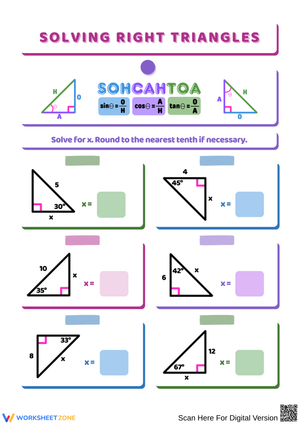
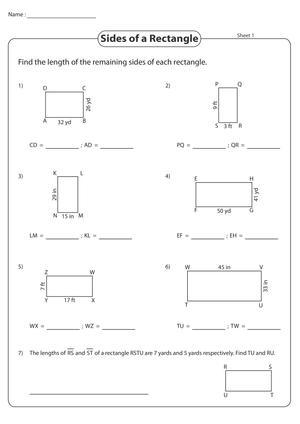
The core practice centers on analytic geometry — using coordinates to verify geometric relationships rather than measuring with a ruler. Students compute perimeters of polygons on the coordinate plane by applying the distance formula to each side and summing the resulting lengths. Area problems at this level frequently require decomposing composite figures: a hexagonal floor plan broken into triangles and rectangles, with the student calculating each region before assembling the total. Several worksheets integrate the apothem formula for regular polygons, which means students are calling on trigonometric ratios alongside familiar area procedures — a deliberate combination that mirrors what standardized assessments expect.
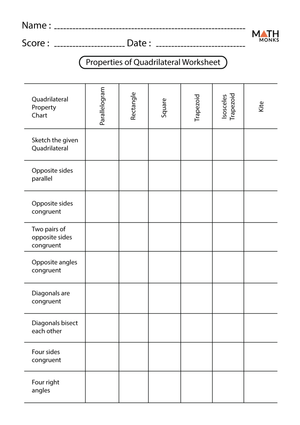
Classification tasks require students to use slope to identify parallel and perpendicular sides, and the distance formula to confirm side-length equality. A typical prompt gives four coordinate pairs and asks whether they define a square, rectangle, rhombus, or general parallelogram — with written justification required. The distinction between a rectangle and a square is where students tend to linger, because proving it demands both a slope argument and an equal-lengths argument; missing one invalidates the classification.
Mistakes Students Make That These Worksheets Help You Catch
The most persistent error in coordinate geometry at this level is sign mishandling inside the distance formula. A student who correctly writes √[(x₂ − x₁)² + (y₂ − y₁)²] will still flip the subtraction order on one coordinate pair — computing (−3 − 5) correctly while writing (2 − (−4)) as (2 − 4) — and then square the wrong value. Because squaring masks the negative, the error produces a plausible number and students almost never catch it themselves. Having them sketch the segment on a coordinate grid and estimate the distance by eye before calculating catches this error more reliably than any algebraic reminder written on the board.
A second pattern surfaces in composite area problems: students add the area of the outer polygon and the inner cutout rather than subtracting. They see two region calculations on the page and combine them. The fix is to have students annotate the figure before computing — drawing arrows that explicitly mark what gets removed — so the subtraction structure is visible before any numbers appear.
Standard Alignment
The coordinate perimeter and area worksheets align directly with HSG-GPE.B.7, which requires students to use coordinates to compute perimeters of polygons and areas of triangles and rectangles. In a typical Grade 10 pacing guide, this standard lands midway through the analytic geometry unit — after students have drilled slope and distance in isolation but before circle equations arrive. These worksheets work well at that consolidation point, pulling together algebraic tools into problems where the geometric purpose is explicit and every step of the work is shown.
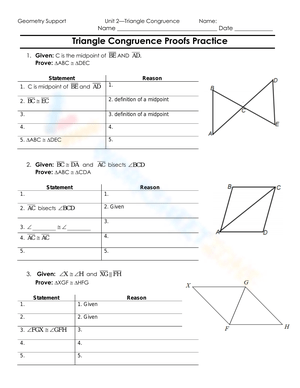
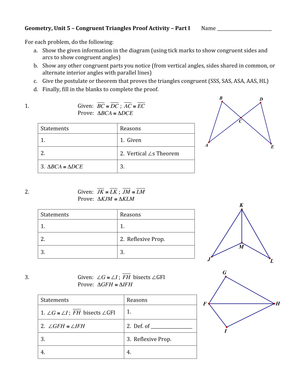
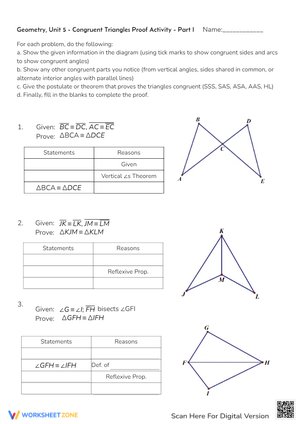
Classification and proof tasks connect to HSG-CO.C.11, which asks students to prove properties of parallelograms and other quadrilaterals. Coordinate methods count as one valid proof strategy at this level, and the worksheets give students structured practice constructing and writing out that kind of argument — not just arriving at an answer but justifying each algebraic step in geometric terms.
Smart Ways to Work These Worksheets Into Your Week
These 2d shapes printable worksheets for 10th grade run most efficiently after direct instruction, not during it. A 25-minute window — the back half of a 50-minute period — is realistic for one coordinate classification problem and one composite area problem; pushing through more than that produces rushed answers that aren't carefully checked. When I've used them as a warm-up, I limit the prompt to a single polygon with one clear question rather than a multi-part task, because students arriving from the hallway aren't yet at the level of focus that a written proof requires.
For collaborative work, assign different groups coordinate sets that all produce the same polygon type — four different sets of vertices that each define a rhombus, for instance. Every group should reach the same classification but by a different number path. The comparison discussion surfaces quickly whether students understand the underlying geometric argument or are pattern-matching their own specific values.
Adjusting These Worksheets for a Range of Learners
Students still shaky on the distance formula benefit from problems where the segment is axis-aligned — both endpoints share the same y-value, so horizontal distance reduces to subtraction with no radical needed. Once they can classify a rectangle using only horizontal and vertical measurements, reintroduce the diagonal. That progression is not a reduction in rigor; it builds algebraic fluency in a controlled sequence before the geometric demand increases. Pairing a coordinate grid overlay with a labeled formula reference sheet also reduces the working-memory load enough that students who struggle with the algebra can still engage with the geometric reasoning, which is the actual learning target.
For students who move through coordinate proofs quickly, replacing numerical coordinates with variables changes the task without requiring new materials. Give a quadrilateral with vertices at (0, 0), (a, 0), (a + b, c), and (b, c) and ask for a general proof that the figure is always a parallelogram regardless of the values of a, b, and c. The 2d shapes printable worksheets for 10th grade in this set accommodate that substitution without any additional preparation — one penciled change converts a computational exercise into an algebraic proof task that genuinely stretches advanced learners.
Frequently Asked Questions
How do these worksheets differ from 8th grade geometry materials?
Eighth grade focuses on identifying properties of 2D shapes and applying area and perimeter formulas to given measurements. Grade 10 shifts the task entirely: students derive measurements from coordinates rather than reading them off a figure, and they construct written justifications for every classification. The presence of irrational results, multi-step composite problems, and proof requirements reflects a different level of algebraic fluency and logical precision than earlier geometry work demands.
Do students need a graphing calculator to complete these worksheets?
Most problems are designed for pencil-and-paper work. Students leave answers in exact form — simplified radicals, expressions involving π — when the problem calls for it, and use a basic scientific calculator for decimal approximations when required. Graphing calculators are not assumed. For timed practice or quiz preparation, 2d shapes printable worksheets for 10th grade that include pre-printed coordinate grids save setup time and keep student attention on the mathematics rather than on drawing and scaling axes from scratch.
Can these be assigned as homework without prior in-class instruction?
Not for the proof-based classification tasks. Students who encounter a coordinate classification problem without having watched a teacher work through at least one complete example will calculate something — usually a slope or a distance — and stop there, without connecting the result to the geometric property it is supposed to verify. Use these worksheets after direct instruction for proof tasks. Perimeter on the coordinate plane is more manageable as a standalone assignment once students have the distance formula established and have seen at least one worked example of its application.













 Interactive Worksheet Maker
 Quiz Maker
 Word Search Maker
 Crossword Puzzle Maker
 Word Scramble Generator
 Sentence Scramble Generator
 Handwriting Worksheet Generator
 Name Tracing Generator
 Fill In The Blank Generator