10th Grade Triangle Proportionality Theorem Worksheets
10th grade triangle proportionality theorem worksheets give geometry teachers focused, diagram-centered practice for one of the more demanding reasoning moves in the similarity unit — reading a figure, identifying the parallel condition, and writing a proportion that compares the right segments to each other. The skill demands that students hold a figure's structure in mind the entire time they work, which is categorically different from routine ratio tasks.
What Each Worksheet Puts in Front of Students
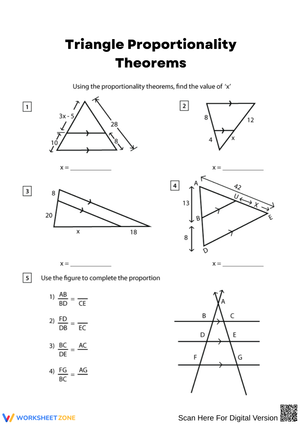
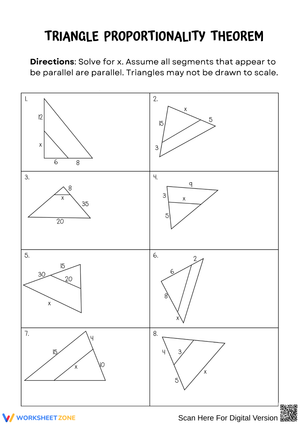
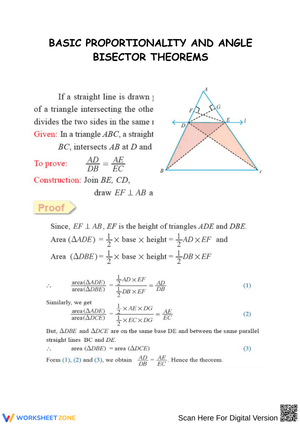
The core theorem states that a line parallel to one side of a triangle divides the other two sides proportionally. In practice, that means looking at a large triangle cut by an interior segment and recognizing which pieces go together as a ratio. Most students can recite the theorem; the breakdown happens when the diagram shows partial lengths on both sides and students must decide whether to compare part-to-part or part-to-whole. Both formulations are valid, but mixing them in a single proportion is one of the most persistent setup errors in Grade 10 geometry.
The converse gets equal treatment across the set. Where the theorem starts with a known parallel line and asks for missing lengths, the converse flips the situation: given that the side division is proportional, students must conclude that the connecting segment is parallel to the third side. That reasoning direction is categorically different, and students who only know one direction often look confident until the converse appears.
Several items connect proportional segments to similar triangles. When a parallel line cuts a triangle, it creates a smaller triangle similar to the original. Some problems resolve faster by invoking similarity; others are cleaner with a direct proportion. The set includes items that ask students to solve both ways and compare answers — a reliable method for surfacing whether students understand that the two approaches describe the same geometric relationship.
Proportion Errors Worth Catching Early
The most persistent setup mistake is pairing an upper partial segment on one side with the full length of the opposite side. A student looking at a triangle where a parallel segment creates lengths of 4 and 6 on the left might write 4/10 = 6/x if they grab the entire right side for the second ratio — even when only the upper portion belongs. The diagram looks convincing. The algebra produces an answer. The setup is wrong. Requiring students to name and label both ratios before writing any equation catches this error before it repeats across twenty problems.
10th grade triangle proportionality theorem worksheets that include diagrams where the parallel condition is absent — not just varied but genuinely missing — train students to verify the condition before applying any theorem. The error of assuming every interior segment creates proportional parts is harder to correct once established; it's easier to prevent with mixed diagram practice from the start.
There's also a quieter problem: students who execute the algebra correctly but cannot explain which segments they compared or why those are the appropriate pair. Including one justification prompt per worksheet — not an essay, just a sentence — keeps the focus on the geometry instead of the arithmetic.
Building These Worksheets Into Your Geometry Lessons
Two or three direct missing-length problems work well as a daily warm-up during the week a class first meets the theorem. After the whole-group lesson, assigning one worksheet for independent practice gives teachers a real-time look at whether students can set up the proportion without guidance. That's a better formative check than waiting for the unit quiz.
Station rotation works well here. One station handles direct computation with clearly labeled diagrams. A second station presents converse problems. A third gives students a proportion setup with a deliberate error and asks them to identify and correct it. Students rotate through all three in thirty-five to forty minutes, and teachers can position themselves at the station where the class most often struggles. The error-analysis station tends to produce productive disagreement — which is exactly the conversation worth having.
One annotation habit worth establishing early: before writing any equation, students circle matching segment pairs in two different colors — one color for the pair on the left side of the triangle, another for the pair on the right. In Grade 10, most proportion errors happen at the diagram-reading stage, not the algebra stage. The marking step slows students down in a way that actually reduces mistakes.
Adjusting the Set for Students at Different Readiness Levels
For students still shaky on proportional reasoning itself, start with worksheets where diagrams are fully labeled, the parallel condition is stated explicitly, and both ratios involve whole numbers. Removing those variables early lets students focus on the setup structure before fractions or algebraic expressions appear.
On-level students handle mixed worksheets well — some numerical, some with a variable on one side, some asking for part-to-whole comparisons alongside part-to-part. The goal at this level is accurate setup and clean algebraic work, with enough variety that students cannot rely on the same mechanical step every time.
Students ready for additional challenge benefit from 10th grade triangle proportionality theorem worksheets where expressions appear on both sides of the proportion, and where one or two items ask whether similar triangles, direct proportionality, or both can justify the answer. That last format is also solid preparation for proof-adjacent items on geometry standardized assessments.
Standard Alignment
These worksheets address CCSS.MATH.CONTENT.HSG.SRT.B.4, which calls for students to prove theorems about triangles — including the theorem that a line parallel to one side of a triangle divides the other two sides proportionally. In classroom terms, this standard sits inside the similarity cluster and typically follows angle-angle similarity and corresponding-side work. Most teachers place these worksheets after introducing similarity ratios and before moving into trigonometric ratios, using the set as the bridge that shows proportionality is a geometric property, not just an algebraic procedure.
Frequently Asked Questions
How is the Triangle Proportionality Theorem different from standard similar triangle problems?
Similar triangle problems typically ask students to compare corresponding sides across two separately identified triangles. The Triangle Proportionality Theorem focuses on what happens inside a single triangle when a parallel line cuts two of its sides — the relationship is between the partial segments created on each side, not between whole sides of two figures. Students who conflate the two end up writing proportions that mix partial side lengths with full side lengths in the same ratio.
What algebra background do students need before starting these worksheets?
Students should be comfortable setting up and solving a basic proportion, simplifying ratios, and cross-multiplying accurately. When expressions appear on both sides — for example, (x + 3)/7 = (2x)/10 — students also need to distribute and combine like terms. Teachers working with students still developing those skills can select worksheets with numerical ratios only, then introduce variable expressions once the geometric setup feels automatic.
Can these worksheets serve as review before a similarity unit test?
Yes, particularly mixed worksheets that include both the theorem and its converse alongside items that ask students to distinguish when each applies. For pre-test review, six to eight problems is enough — accurate setup and reasoning matter more than volume. Adding one item that gives a diagram and asks students to decide whether triangle proportionality, similar triangles, or neither applies catches students who are running procedures without reading the geometric conditions first.
Do these worksheets work in credit recovery or intervention settings?
10th grade triangle proportionality theorem worksheets with fully labeled diagrams and explicit parallel-line notation work well in intervention settings, where students often need to rebuild geometric reading skills alongside relearning the theorem itself. Start with the most structured worksheets in the set and move toward converse problems and open-ended justification items only after students show consistent accuracy on direct missing-length problems.
Clear All