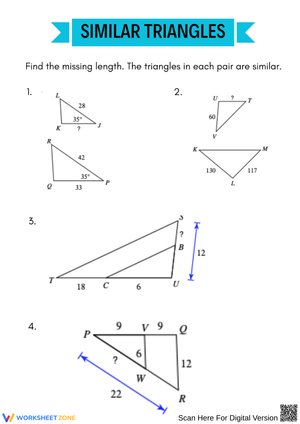
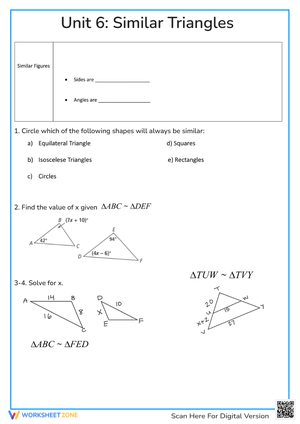
10th Grade Simialarity of Triangles Worksheets
These 10th grade simialarity of triangles worksheets give teachers a structured path through one of geometry's most layered concepts — from recognizing when two triangles qualify as similar, to naming the correct criterion with justification, to applying proportional reasoning inside nested figures and real-world measurement problems. Each worksheet in the set targets a specific layer of the skill, making it straightforward to assign them in sequence or pull individual ones to close a gap.
The Skills Each Worksheet Targets
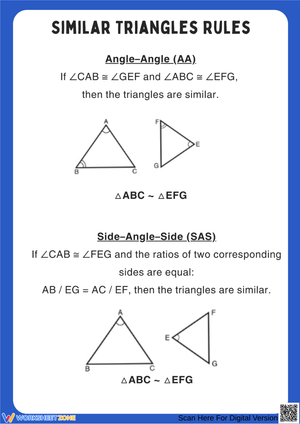
Identification comes first. Students examine a pair of triangles, assess the given information, and decide whether the triangles are similar — naming AA, SAS, or SSS as appropriate. The key habit being built here is genuine verification rather than pattern-matching. SAS similarity requires the equal angle to lie between the two pairs of proportional sides. Students who only count "two proportional sides and one equal angle" without checking position will claim SAS incorrectly, and several items are written specifically to surface that error.
After identification, students move into proportion work. They write a similarity statement with vertices in matching order, set up a ratio using corresponding sides, and solve for an unknown length. Later worksheets replace numerical side lengths with algebraic expressions, so students are solving linear equations rather than cross-multiplying known values — a natural increase in demand that keeps the same geometric concept at the center.
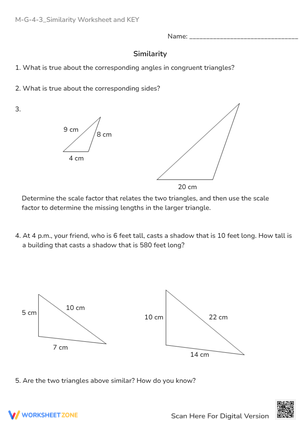
The set also addresses scale factor, perimeter, and area relationships. Students who grasp that a scale factor of 3 between two similar triangles means perimeters also scale by 3 — but areas scale by 9 — have moved past procedural proportion work. A targeted cluster of items makes that distinction explicit through direct comparison rather than through rule memorization.
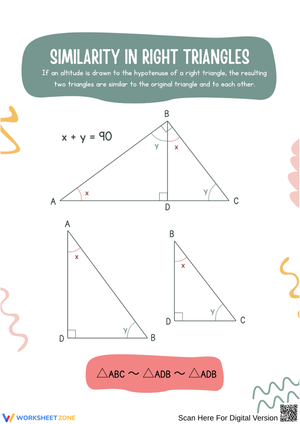
Nested diagram problems are included throughout the set. These are configurations where a segment inside a larger triangle creates a smaller similar triangle — often formed by a midsegment, a line parallel to one side, or an altitude drawn to the hypotenuse of a right triangle. Students must identify shared angles and parallel-line angle relationships to build the similarity argument, which is consistently harder than working with two separate diagrams and much closer to what assessments actually ask.
- Identification items: students determine which criterion — AA, SAS, or SSS — applies and explain why it fits
- Correspondence tasks: students write the similarity statement with vertices in matching order before setting up any ratio
- Proportion problems: students solve for missing side lengths using correctly formed ratios, including items with algebraic expressions
- Scale and area comparisons: students apply scale factor to perimeter and recognize the squared relationship for area
- Application problems: students use similar triangles in indirect measurement, shadow problems, and scale drawing contexts
Mistakes Students Make That Are Worth Anticipating
The most consequential error in this unit is writing the similarity statement with vertices out of correspondence. If triangle ABC is similar to triangle DEF, the correct proportion is AB/DE = BC/EF = AC/DF. A student who writes the similarity as ABC ~ EDF and then sets up a proportion faithfully from that wrong statement will produce incorrect answers on every calculation — and the error will be invisible if teachers only check numerical results rather than the similarity statement itself. These worksheets ask students to record the similarity statement as a separate step before any calculation begins, which makes this mistake visible and correctable.
Area scaling is a reliable stumbling block. Students who correctly identify that two similar triangles have sides in a ratio of 2 to 5 will typically say their areas are also in a ratio of 2 to 5. Explicit practice comparing actual areas — by decomposing figures on a grid or by applying the formula with known side lengths — makes the squared relationship concrete in a way that abstract rule-stating does not.
SAS similarity gets misapplied more than either of the other two criteria. The problem is that students look for any equal angle alongside two pairs of proportional sides rather than checking that the angle falls specifically between those sides in the triangle. The worksheets include near-miss items where the angle is not included, and students must write an explanation of why SAS does not apply. Refutation practice — explaining why a criterion fails — builds sharper precision than additional correct-case identification drills.
Standard Alignment
These worksheets address standards from the Common Core Geometry domain Similarity, Right Triangles, and Trigonometry. Standard G-SRT.A.2 asks students to use the definition of similarity in terms of similarity transformations to decide whether two figures are similar — several identification items require students to justify similarity claims rather than simply name them, which aligns directly with that expectation. Standard G-SRT.A.3 calls for establishing the AA criterion, which the early worksheets reinforce through repeated application with explanation. The proportion, application, and reasoning tasks in the middle and later worksheets align with G-SRT.B.5, which covers using similarity criteria to solve problems and prove relationships in geometric figures.
In most 10th grade geometry courses, triangle similarity falls after triangle congruence and before right triangle trigonometry. That placement matters because students can contrast the proportional side relationship in similarity with the equal side relationship in congruence — a comparison that sharpens both concepts. The connection to trigonometry becomes explicit once students encounter right triangle similarity and realize that the consistent side ratios in similar right triangles are exactly what the sine, cosine, and tangent ratios describe.
Fitting These Worksheets Into a Geometry Unit
Before the first identification worksheet, run a brief warm-up on the angle relationships students will need — vertical angles, alternate interior angles, corresponding angles from parallel lines, and the triangle angle-sum. Students who are uncertain about these properties will struggle to construct valid similarity arguments even when they understand what AA means. Five minutes of angle identification at the start of the lesson prevents confusion later in the same period.
During the identification and proportion worksheets, pair students and require them to agree on the similarity statement before writing any ratios. A workable routine: each partner independently marks matching angles in the diagram using tick marks or a colored pencil, then both partners compare markings before writing the statement together. Disagreements surface the visual matching problem early — before a wrong correspondence is practiced across multiple problems. Once accuracy improves, move students to independent proportion-solving work.
Exit ticket design is more consequential here than in many other geometry units. One item that asks students to name a criterion from an unmarked diagram and a second that asks them to solve for a missing side from an already-established similarity statement test two separate skills. A class that handles the second item but not the first has a geometric reasoning gap; a class that handles the first but not the second has an algebraic setup problem. When teachers choose 10th grade simialarity of triangles worksheets that keep identification and proportion work in separate items rather than folding them into single multi-step problems, the exit ticket split becomes genuinely diagnostic.
Adjusting the Work for a Range of Learners
Students who need more support should begin with diagrams where the matching angles are already marked. Remove the visual identification layer entirely at first — ask them to focus on writing the ratio and solving the equation from a given similarity statement. Once proportion mechanics are reliable, reintroduce the full identification task. This two-stage approach avoids the situation where a student fails at proportion setup not because of algebraic weakness but because an earlier correspondence error corrupted the whole problem.
For students working beyond grade level, proof-based tasks are the right extension. Instead of identifying that two triangles are similar, students construct a two-column or paragraph argument from a set of given conditions, using angle relationships and proportional reasoning to support each step. Applied problems that require selecting which measurements matter — shadow measurement, ground distance from a height using similar triangles formed by sightlines — are also effective because they reduce procedural guidance without changing the underlying geometry. The 10th grade simialarity of triangles worksheets in this set include those applied items in the later worksheets, and teachers can assign them selectively to students ready for less structured problem contexts.
Across all levels, having students physically mark equal angles with matching symbols before writing anything is one of the most transferable adjustments available. It works for students who need to slow down the visual matching step and for students who rush through diagrams. In nested triangle problems especially — where the same angle appears in both triangles because it is shared — the marking habit makes what is otherwise an abstract observation into something students can see and point to on the diagram.
Frequently Asked Questions
Are these worksheets appropriate for review, or only for initial practice during a similarity unit?
Both uses work. The identification worksheets are well-suited for initial practice after direct instruction on similarity criteria. The proportion and application worksheets function effectively as review before a unit test or as targeted intervention for students who struggled on earlier assessments. Because each worksheet focuses on a specific skill layer, teachers can pull individual ones without using the full set.
How do the worksheets handle diagrams where a smaller triangle is embedded inside a larger one?
Several worksheets include those configurations — figures with a midsegment, a line parallel to one side of a triangle, or an altitude drawn to the hypotenuse in a right triangle. These items ask students to explicitly name the shared or equal angles before writing the similarity statement. Teachers should expect students to find these harder than side-by-side diagrams, and assigning them without first reviewing the relevant angle relationships usually produces confusion rather than productive struggle.
Do any worksheets in the set include proof writing?
Yes. Proof tasks appear in the later worksheets. They are short — typically three to five steps — and ask students to complete a two-column argument given a diagram and initial conditions. These items work well for classes that have already moved through congruence proofs and are ready to apply the same logical structure to similarity. Teachers whose students have not had much proof instruction can skip those worksheets without losing access to the identification and proportion content.
What grade level are these resources written for?
These 10th grade simialarity of triangles worksheets target the standard high school geometry course, typically taken in 9th or 10th grade. Students in accelerated 8th grade math programs will find the identification and proportion work accessible. The proof-focused worksheets in the set are better matched to students who have had prior experience with geometric proof, regardless of grade.
Clear All