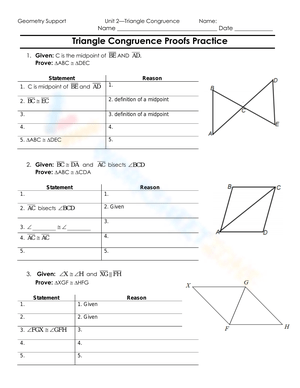
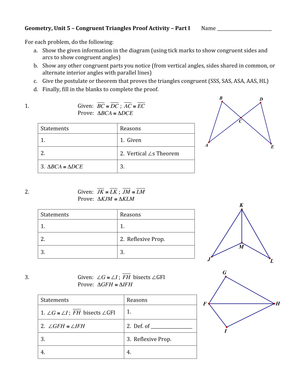
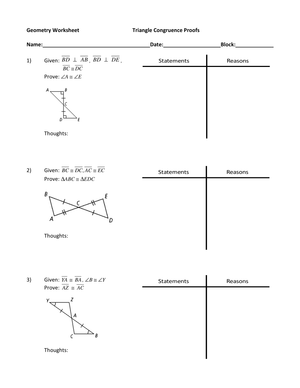
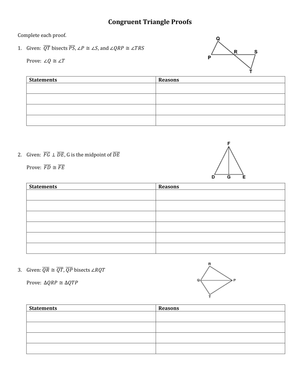
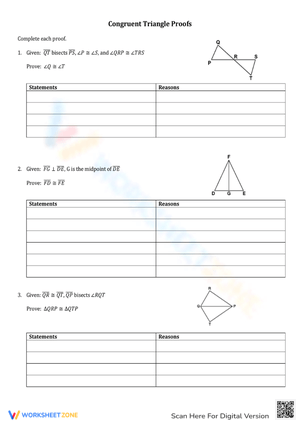
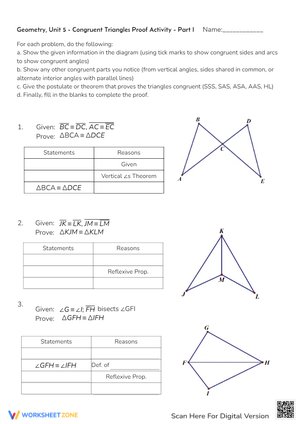
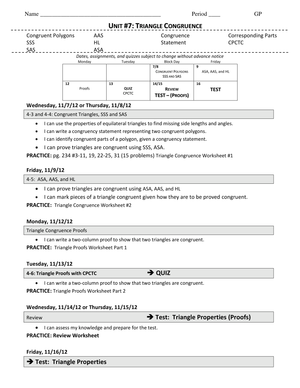
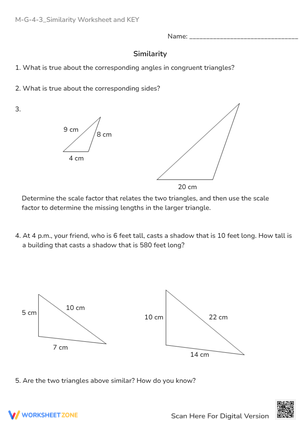
These 10th grade triangle congruence proofs printable worksheets resources give geometry teachers something they often struggle to find: proof practice that matches how students actually build reasoning, not just how they label diagrams. Each worksheet moves students through a specific piece of the proof process — marking equal parts, identifying a congruence criterion, writing a chain of statements and reasons — rather than dropping them into a blank two-column proof with no intermediate support. The set covers SSS, SAS, ASA, AAS, and HL, and deliberately includes problems where AAA and SSA appear so students have to explain why those patterns don't guarantee congruence.
The Specific Skills These Worksheets Build
Proof writing in Grade 10 geometry is several skills layered on top of each other, and students tend to get stuck at different points. Some can mark a diagram correctly but can't translate those marks into written statements. Others know SAS by name but can't locate the included angle when a figure is oriented differently than the textbook example they memorized. Each worksheet in the set isolates parts of that process so students practice each layer deliberately before combining them in a full proof.
- Identifying which congruence criterion fits the given information in a diagram
- Stating the reflexive property correctly when a side or angle is shared between two triangles
- Recognizing vertical angles and applying them as a reason within a proof chain
- Using midpoint and angle bisector definitions as intermediate steps, not just vocabulary terms
- Distinguishing between what is marked as given and what must be derived through reasoning
- Writing complete proofs in two-column, flow, and paragraph formats
- Evaluating SSA and AAA setups and articulating why neither pattern qualifies as a valid congruence test
Errors Worth Watching for When Students Write Congruence Proofs
The most common mistake at this level is not forgetting postulate names — it's applying them without checking the conditions. Students see two sides and an angle and reach for SAS. They haven't verified whether the angle is the included angle; they've matched a visual pattern. A worksheet that places SSA diagrams alongside SAS diagrams in the same problem set forces students to slow down and confirm placement before committing to a reason.
A second persistent gap is omitting the reflexive property. When two triangles share a side, students treat congruence of that segment as self-evident — they write the congruence postulate without first establishing that the shared segment equals itself. This leaves the proof with a missing step that students genuinely cannot locate on their own. Partially completed proofs where that reflexive step is blank — no statement, no reason filled in — are more effective at correcting this habit than re-explaining the property during class.
There's also a column-placement error worth naming explicitly: students write SSS or SAS in the Statements column rather than the Reasons column. They understand the logic but haven't internalized that a congruence postulate is the justification after establishing evidence, not a free-standing claim. Matching exercises that ask students to sort evidence from reasoning address this faster than lecture does.
Building These Worksheets Into a Geometry Lesson Cycle
A reliable opener for any congruence proof lesson is a five-question identification task: here is a marked diagram — which criterion applies, or is the information insufficient? That kind of warm-up surfaces confusion before students start writing proofs and tells you right away whether they are distinguishing SAS from SSA. The first few minutes of class are the most useful diagnostic window for this topic.
The sequence that holds best for a full lesson is: guided diagram-marking with the whole class, then a partially completed proof in pairs, then independent proof writing. The diagram-marking step is not decorative — it reduces errors in the written proof because students have already committed to specific pairs of congruent parts before writing a single statement. When teachers skip it and go straight to the two-column format, the work gets messier and the feedback loop takes longer.
One strategy worth building into your rotation: print the same proof problem in two versions, one with the diagram pre-marked and one from a clean figure. Students who lose traction on visual interpretation use the marked version; everyone else works from the plain diagram. The mathematical reasoning required is identical — both groups write the same proof — but the starting point differs. This avoids the familiar bottleneck where several students are still staring at the figure while the rest of the class has moved on.
For homework that follows a rough class period, assigning a single-criterion worksheet rather than a mixed set keeps the task manageable. For extension, composite figures with embedded triangles ask students to decide which triangle pair to prove congruent and why, which adds strategic thinking without requiring new materials.
Standard Alignment
These worksheets align primarily to CCSS.MATH.CONTENT.HSG.CO.B.8, which requires students to explain how the criteria for triangle congruence — ASA, SAS, and SSS — follow from the definition of congruence in terms of rigid motions. In classroom terms, this means students are not just memorizing postulate names. They are showing why corresponding parts must be equal for one triangle to map onto another through a rigid transformation. Formal proof practice is the direct instructional vehicle for that standard, which is why congruence proofs anchor most Grade 10 geometry units rather than appearing as a peripheral topic.
CCSS.MATH.CONTENT.HSG.CO.C.10 also connects here. That standard asks students to prove theorems about triangles, many of which depend on establishing triangle congruence as a prior step. These worksheets build the foundational reasoning students need before those larger proof tasks arrive in the sequence.
Adjusting These Worksheets for a Mixed-Ability Geometry Class
The reason 10th grade triangle congruence proofs printable worksheets resources lend themselves to tiered practice is that the core task — construct a valid argument that two triangles are congruent — stays constant across levels. Only the support structures change. A student who needs a word bank of acceptable reasons (reflexive property, vertical angles theorem, definition of midpoint) is still doing the same logical work; they just aren't spending cognitive energy retrieving vocabulary while also managing proof structure for the first time.
- For students who need more support: matching tasks that pair diagrams to criteria, pre-marked figures, and fill-in-the-blank proofs with statements provided and reasons left blank.
- For on-level practice: mixed-criterion identification plus complete two-column proofs from unmarked diagrams.
- For extension: composite figure problems, multi-step proofs where congruence is an intermediate conclusion rather than the final one, and tasks that ask students to compare two valid proof paths for the same triangle pair.
Rotating proof formats across the week also serves different learners without requiring entirely separate materials. Two-column proofs impose structure that helps students who get lost in open-ended writing. Flow proofs help visual thinkers see how reasons connect in sequence. Paragraph proofs push students to produce connected mathematical language without a column structure to lean on — which is exactly the kind of writing they will encounter on extended-response assessments.
Frequently Asked Questions
Do these worksheets include non-examples like SSA and AAA, or only the valid criteria?
The set includes both valid congruence criteria and deliberate non-examples. Students encounter SSA and AAA setups and must explain why those patterns are insufficient. This is where many proof errors originate — students apply a half-recognized pattern without checking whether it holds — so the non-examples are part of the core practice, not optional extension items.
What proof formats appear across the set?
Two-column proofs appear most frequently because they are the most common format on geometry assessments and the most accessible entry point for students new to formal proof writing. Flow and paragraph proof tasks are included across the set to satisfy departments that assess multiple formats and to give students practice translating their reasoning into different structures.
Are the worksheets organized by individual criterion or mixed together?
Both types are included. Some worksheets focus on one criterion — SSS only, or AAS only — so students see what that postulate requires across several different diagram orientations. Others are mixed-review worksheets where students must first determine which criterion applies before writing any proof steps. The focused worksheets work best early in a unit; the mixed ones suit review blocks and quiz preparation.
How do these resources work for intervention students who previously struggled with proofs?
In a standard Grade 10 unit, 10th grade triangle congruence proofs printable worksheets resources fit naturally into direct instruction, guided practice, and homework cycles. For intervention, the approach shifts: start with single-criterion worksheets and partially completed proofs rather than mixed practice, and move toward independent work only after students are consistently identifying the correct criterion without prompting. Assigning one postulate at a time is a more reliable path back than repeating the full unit.
Do the worksheets come with answer keys?
These 10th grade triangle congruence proofs printable worksheets resources include full answer keys, which matter most during whole-class review and for teachers using them in intervention settings without extra planning time. For supplemental terminology reference, Khan Academy's triangle congruence review and CK-12's geometry materials offer consistent vocabulary that aligns with standard Grade 10 instruction and can help resolve wording questions when departments are aligning across sections.













 Interactive Worksheet Maker
 Quiz Maker
 Word Search Maker
 Crossword Puzzle Maker
 Word Scramble Generator
 Sentence Scramble Generator
 Handwriting Worksheet Generator
 Name Tracing Generator
 Fill In The Blank Generator