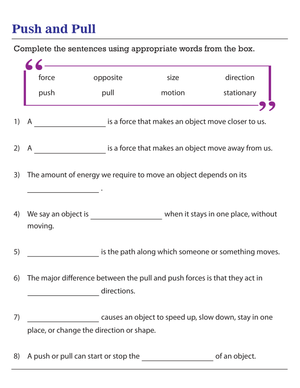
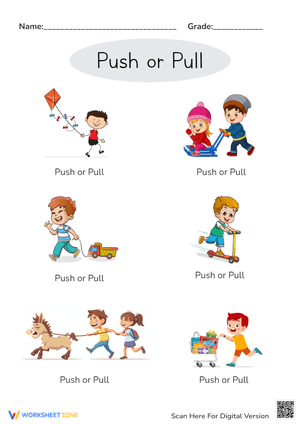
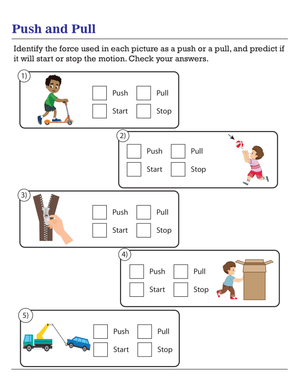
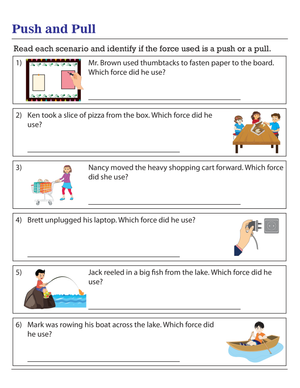
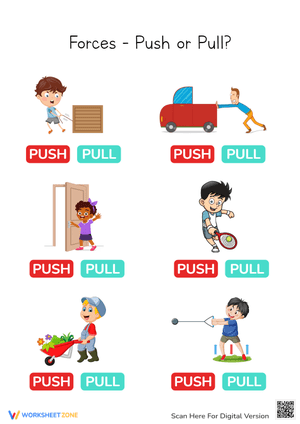
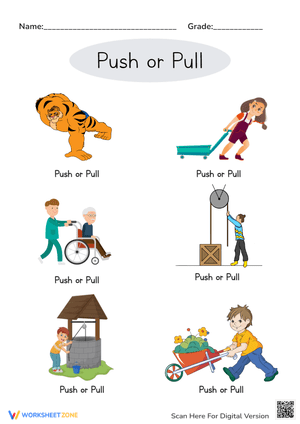
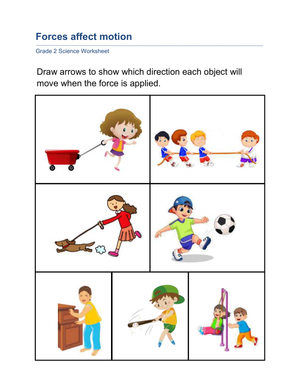
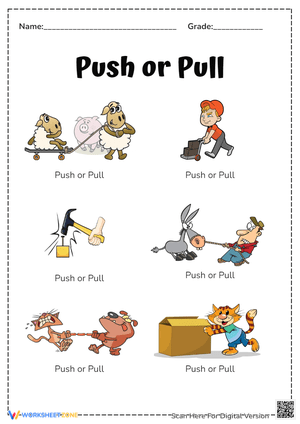
1st grade forces motion and machines printable worksheets give teachers a structured recording layer to pair with the physical demonstrations first graders need — turning the moment a student rolls a marker down a binder-ramp into a documented observation rather than a forgotten five minutes. Each worksheet targets a specific concept: sorting pushes and pulls, tracing motion patterns, or identifying simple machines in real-world contexts. The set covers enough ground to run a focused physical science unit while staying tight enough that no worksheet wastes instructional time on filler.
Skills Targeted Across the Set
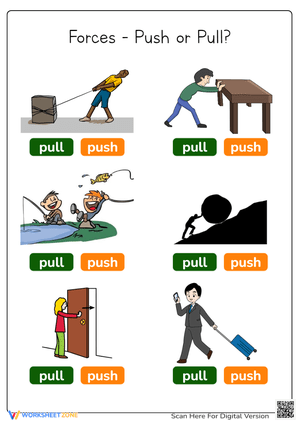
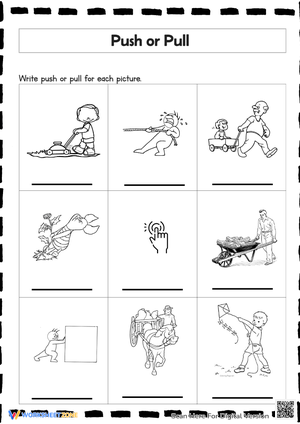
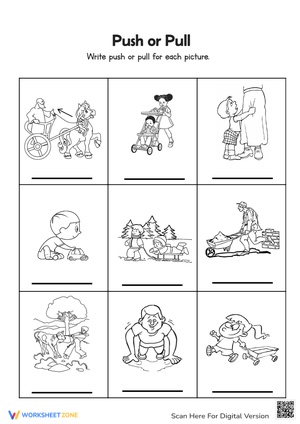
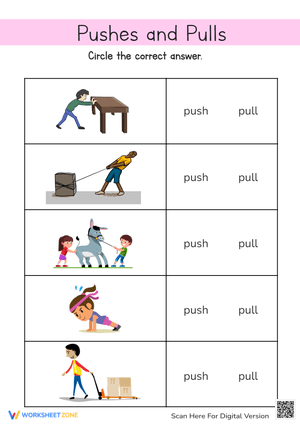
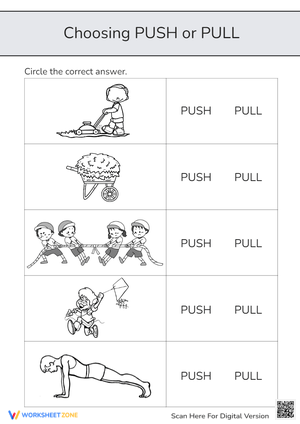
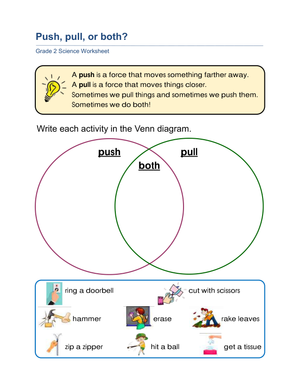
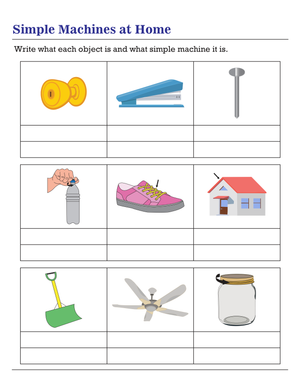
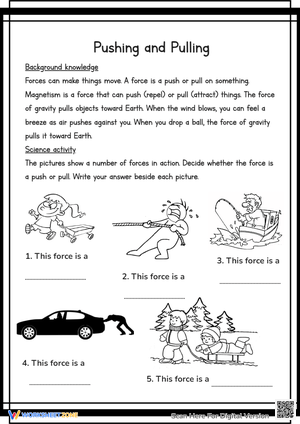
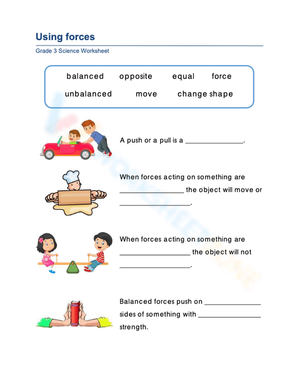
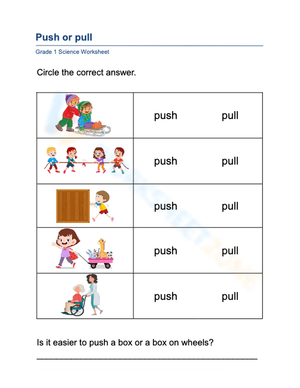
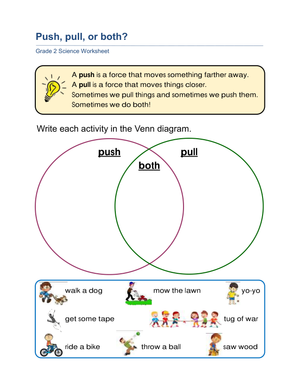
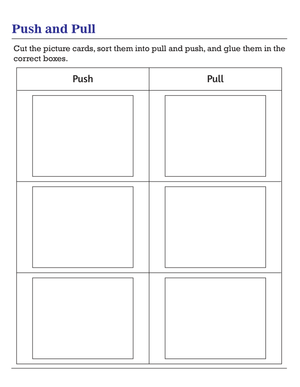
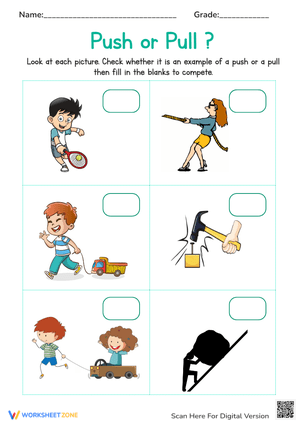
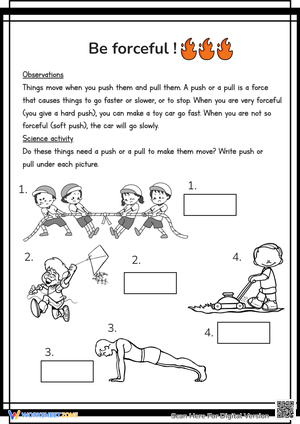
The worksheets move through three connected content areas. Pushes and pulls come first: sorting activities ask students to categorize everyday actions — dragging a sled, closing a drawer, kicking a ball — as pushes, pulls, or both. The "both" category trips students up productively; a vacuum cleaner and a yo-yo belong there, and placing them correctly shows real conceptual grip rather than pattern-matching. Motion patterns follow, with students tracing and predicting the paths objects take — straight, circular, back-and-forth, zigzag — and recording what kind of force produced each path. Simple machines close the set, with students identifying inclined planes, wheels and axles, and levers in context before matching each machine to the task it makes easier.
Why This Content Lands in First Grade
Six- and seven-year-olds arrive with years of unexamined physical intuition. They know a heavy block is harder to slide than a light one; they just cannot explain why. That gap — between felt experience and scientific vocabulary — is exactly what this content targets. The worksheets ask students to name what their bodies already know. That process of attaching precise language to lived experience is developmentally appropriate here in a way it is not in kindergarten, when gross motor control and basic object reasoning are still consolidating. The vocabulary load — force, motion, push, pull, inclined plane — stays manageable because every term anchors to a physical action the student has already performed.
Misconceptions to Watch For and Correct Early
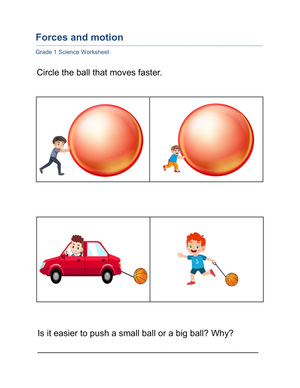
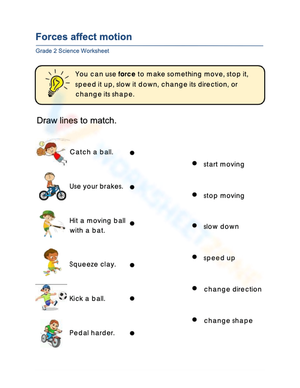
The most predictable error is conflating strength with type. Students who correctly identify "push" on simple examples will mark "hard push" and "soft push" as two different kinds of forces rather than two different intensities of the same force. A worksheet that asks students to draw arrows showing direction — not just label the action — catches this error immediately, because the arrow reveals whether the student is thinking about the force or just the effort level.
On motion-pattern exercises, students frequently describe a swinging pendulum as circular because it curves. They are tracking the shape of the arc rather than the direction of travel. Asking them to trace the path with a finger before drawing it resolves the confusion most of the time. Simple machines produce a different misconception: students exclude levers from their machine-hunt results because levers have no moving parts they associate with machinery — no motor, no wheel, nothing spinning. A seesaw does not look like a machine to a six-year-old. The worksheets address this directly by defining a machine as anything that changes the direction or amount of force required, not as something with spinning or motorized parts.
How to Work These Worksheets Into Your Science Block
The sorting and prediction worksheets earn their place at the front of a unit as informal pre-assessments. Before any direct instruction on pushes and pulls, distribute the sorting sheet and note where errors cluster. That data shapes the first lesson more usefully than any generic pacing guide. The motion-pattern tracing worksheets fit naturally into a center rotation — four students at a table with a marble track and a ramp while the rest of the class continues reading workshop, completing their observation sheets before rotating out.
The simple machines checklist works best as a walking-the-building activity, not a desk exercise. Students carry a clipboard and mark each machine they spot — the ramp at the entrance, the door hinges, the wheels on the media cart. The desk-based matching worksheet comes after, when students have a reference pool of real examples. Sequence matters here: worksheet before the walk produces guessing; worksheet after the walk produces retrieval. That difference shows clearly in the quality of written responses.
Standard Alignment
The pushes and pulls content maps to K-PS2-1 and K-PS2-2 from the Next Generation Science Standards, which target planning and conducting investigations into how force strength and direction affect object motion. Many districts address these performance expectations in first grade rather than kindergarten, particularly when paired with the engineering design strand. The simple machines content does not map to a single NGSS code at this band — it draws from state-level physical science progressions that extend K-PS2 into tool use and mechanical reasoning. Teachers using 1st grade forces motion and machines printable worksheets alongside these standards should document the pushes-and-pulls exercises as direct evidence and the simple machines exercises as supporting application work.
Differentiating the Set Across Your Classroom's Range
For students who need additional support processing the sorting tasks, pre-cut the illustrations and let them physically place pictures into categories before writing anything down. Removing the cutting step keeps the cognitive focus on classification rather than fine motor execution. For students moving ahead of the class, the prediction worksheets extend naturally: instead of predicting the path of a given object, ask them to design a path and name the force that would produce it — reversing the prompt converts a recall task into a generative one.
English language learners benefit most from the illustration-heavy exercises in the set, but the vocabulary-labeling worksheets build the academic language students need for this strand. Use a word bank and a posted visual anchor chart the first time through a labeling exercise; by the third repetition, remove the word bank entirely and treat completion as a vocabulary check. The transition from supported to independent production happens faster than most teachers expect when the physical referents are still present in the room.
Frequently Asked Questions
Are these worksheets meant to be used alongside hands-on experiments, or do they work as standalone desk activities?
Both are workable, but the worksheets produce stronger results when they follow or accompany a physical activity. A prediction sheet completed before rolling objects down a ramp gives students a stake in the outcome; the observation sheet completed after gives them something to analyze. Used only as desk work, the exercises are adequate for vocabulary review, but students miss the cause-and-effect reasoning that comes from testing a real prediction with a real object in their hands.
Which simple machines are covered — and are pulleys included?
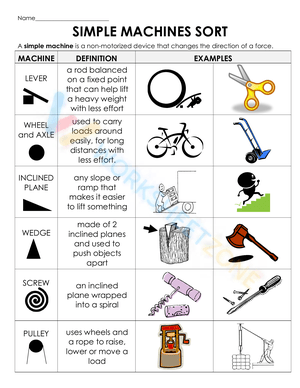
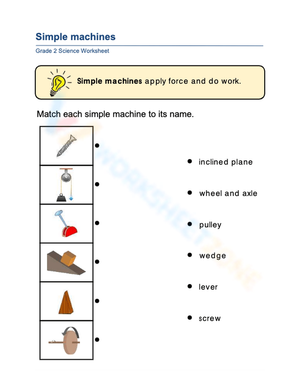
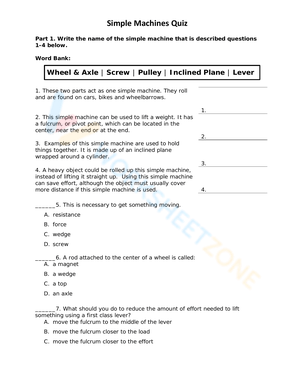
The worksheets cover inclined planes, wheels and axles, and levers — the three simple machines addressed consistently in first-grade curricula. Pulleys appear in some state standards at this level but more commonly enter the progression in grades 3 and 4; they are not included in this set. If your district scope and sequence introduces pulleys in first grade, the machine-matching format adapts easily — the same structure works with an additional row and corresponding illustrations.
How should these worksheets be used for formative assessment rather than graded work?
Use 1st grade forces motion and machines printable worksheets as exit tickets: five items, two categories, three minutes, no names required. Collect them at the door and sort the stack into three groups — solid understanding, partial, needs reteaching. That sort takes under four minutes and tells you exactly which students to pull during the next day's independent work block. Resist grading these against a key for individual scores; at this stage, class-wide patterns in the data matter more than any single student's tally.
What is the best way to explain a lever to a six-year-old who insists a seesaw is "just a board"?
Start with their hands. Have the student press one palm flat on a desk and push down on one end of a ruler balanced on an eraser — the opposite end rises. Ask: "Did you push, or did the ruler push?" That immediate feedback — their downward push produced an upward lift on the other side — is the lever concept at its most elemental. Once students feel it in their hands, the 1st grade forces motion and machines printable worksheets that ask them to label the effort, fulcrum, and load on a diagram become a naming exercise rather than an abstract one. The diagram makes sense because the experience came first.