


























Views
Downloads

Essential Forces and Motion Matching Worksheet | Grade 1
Paste this activity's link or code into your existing LMS (Google Classroom, Canvas, Teams, Schoology, Moodle, etc.).
Students can open and work on the activity right away, with no student login required.
You'll still be able to track student progress and results from your teacher account.
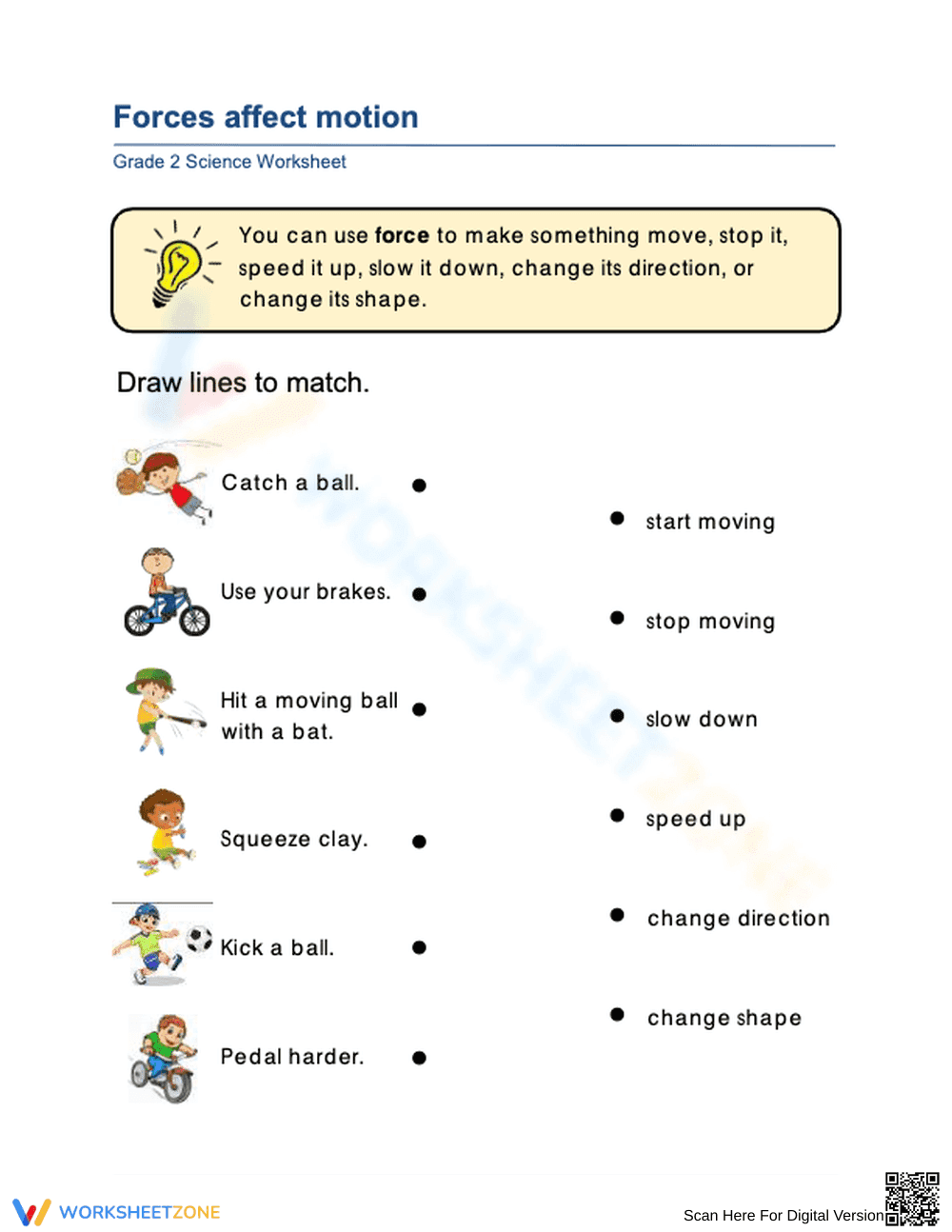
This Grade 1 Forces Affect Motion Matching worksheet helps students master fundamental physics concepts. Learners will identify six ways force changes an object's state of movement. This focused practice ensures students distinguish between starting, stopping, and changing the speed or direction of motion using real-world examples.
At a Glance
- Grade: 1 · Subject: Science
- Standard:
1-PS2-1— Analyze how pushes and pulls change the speed or direction of an object- Skill Focus: Identifying effects of force on motion
- Format: 2 pages · 6 problems · Answer key included · PDF
- Best For: Formative assessment and independent science centers
- Time: 10–15 minutes
What's Inside
This resource features six illustrated prompts that challenge students to match an action with its physical consequence. The worksheet covers starting motion, stopping motion, slowing down, and changing shape. A color answer key is included to facilitate quick grading or student self-correction, spanning two pages of total material.
Zero-Prep Workflow
Designed for immediate implementation, this classroom-ready resource requires minimal teacher intervention. Print the student handout and distribute it in under one minute. Students work independently for approximately 12 minutes to match actions to motion outcomes. The answer key allows for a rapid three-minute review, making it ideal for sub plans or quick transitions.
Standards Alignment
This worksheet is aligned to 1-PS2-1, which focuses on the investigation of how pushes and pulls affect the motion of objects. Students demonstrate mastery by accurately predicting how different forces result in specific changes to an object's speed, direction, or shape. This standard code can be copied directly into lesson plans, IEP goals, or district curriculum mapping tools.
How to Use It
Use this worksheet during the 'Explain' or 'Evaluate' phase of a 5E model. It is a perfect formative assessment after exploring pushes and pulls. Observe if students can differentiate between 'stopping' and 'slowing down,' as this indicates a deeper grasp of force magnitude. Expected completion time is 15 minutes.
Who It's For
Tailored for Grade 1, this resource also suits Kindergarten enrichment or Grade 2 review. Clear visuals support English Language Learners. It pairs naturally with physical demonstrations of toy cars to bridge the gap between abstract concepts and concrete observations.
According to RAND AIRS 2024, visual matching exercises in early science education significantly improve conceptual retention of abstract physics principles like force and inertia. This worksheet aligns with the standard 1-PS2-1, focusing on the observable effects of pushes and pulls on common objects. By connecting everyday actions—such as kicking a ball or applying bicycle brakes—to specific motion outcomes, students develop the foundational vocabulary required for higher-order mechanical reasoning. The integration of 6 distinct tasks ensures students distinguish between speed changes, directional shifts, and structural deformations. Research by Fisher & Frey (2014) emphasizes the importance of guided practice in the 'gradual release of responsibility' model, which this zero-prep resource supports through clear, illustrated prompts and a self-contained answer key. Teachers can use this assessment to gauge student understanding of how external forces dictate object behavior in a physical system before advancing to complex machines.


