


























Views
Downloads

Essential Forces and Motion Worksheet | Grade 1 Science
Paste this activity's link or code into your existing LMS (Google Classroom, Canvas, Teams, Schoology, Moodle, etc.).
Students can open and work on the activity right away, with no student login required.
You'll still be able to track student progress and results from your teacher account.
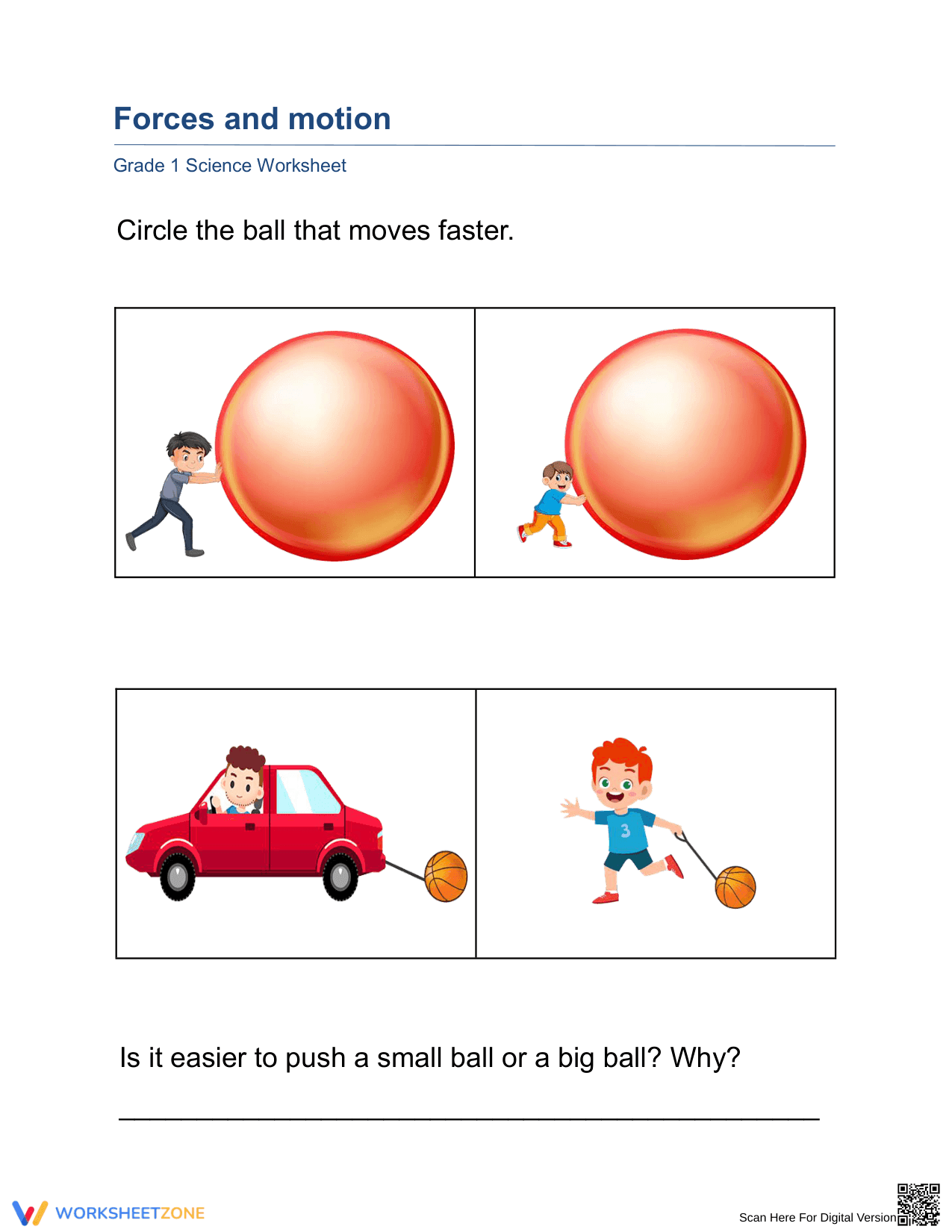
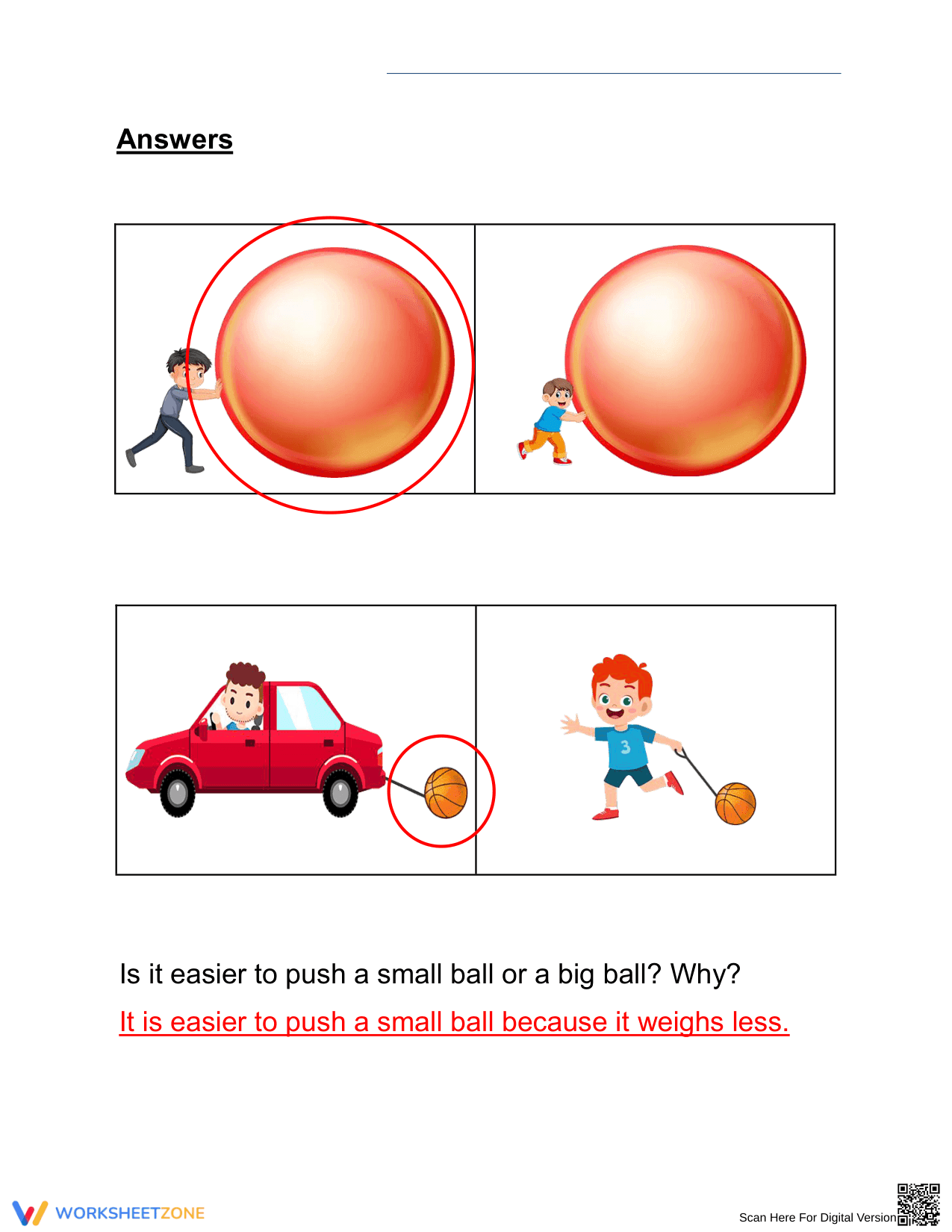
This Grade 1 Forces and Motion worksheet provides an essential introduction to physical science concepts through clear visual comparisons. Students analyze realistic scenarios to identify which objects move faster and how size influences the force required to move them. It establishes a strong foundation for future scientific reasoning and academic success.
At a Glance
- Grade: 1 · Subject: Science
- Standard:
K-PS2-1— Compare effects of different strengths of pushes and pulls on object motion- Skill Focus: Speed comparison and force application
- Format: 1 page · 2 problems · Full answer key included · PDF
- Best For: Introduction to physical science and forces
- Time: 10–15 minutes
What's Inside
The worksheet features two tasks for young learners. First, illustrations of children pushing balls help students visually discriminate between speeds. Second, an open-ended question with car and runner images prompts students to compare the effort needed to move objects of different sizes. Includes a complete answer key.
Zero-Prep Workflow
Implementing this requires zero setup. Print the single-page PDF for your class in 20 seconds. Distribute copies immediately—no prep or materials needed. Review responses using the answer key in under one minute per student. Total teacher preparation time is under two minutes, making this ideal for sub plans.
Standards Alignment
This resource is aligned to K-PS2-1, which requires students to plan and conduct an investigation to compare the effects of different strengths or different directions of pushes and pulls on the motion of an object. The worksheet specifically addresses the "strength" aspect of the standard by asking students to evaluate the difficulty of moving large versus small objects. Both standard codes can be copied directly into lesson plans, IEP goals, or district curriculum mapping tools.
How to Use It
Use this worksheet as a formative assessment after hands-on exploration. Observe if students articulate why larger objects require more force, using vocabulary like "push" and "faster." The 15-minute completion time makes it a perfect "exit ticket" to gauge understanding before moving to complex machines.
Who It's For
This material is for first-grade students but accessible for kindergarten. Visual scaffolds support English Language Learners and students with processing needs. It pairs with a classroom anchor chart depicting pushes and pulls or a short reading passage about transportation.
According to the RAND AIRS 2024 report on early childhood science education, integrating visual models with guided inquiry significantly improves a student's ability to internalize abstract physical concepts like force and acceleration. This worksheet utilizes these research-based strategies by presenting students with familiar objects—balls and cars—to bridge the gap between everyday experience and scientific terminology. By focusing on the primary standard K-PS2-1, the activities help learners understand that the strength of a push directly correlates with the resulting speed and direction of an object's motion. Research from Fisher & Frey (2014) emphasizes that such structured practice is vital for developing the domain-specific vocabulary necessary for scientific literacy. Implementing these targeted exercises ensures that young learners build the cognitive frameworks required for mastering more advanced mechanical concepts in later grades, while simultaneously fostering the critical thinking skills demanded by modern educational frameworks and standardized assessments.


