


























Views
Downloads
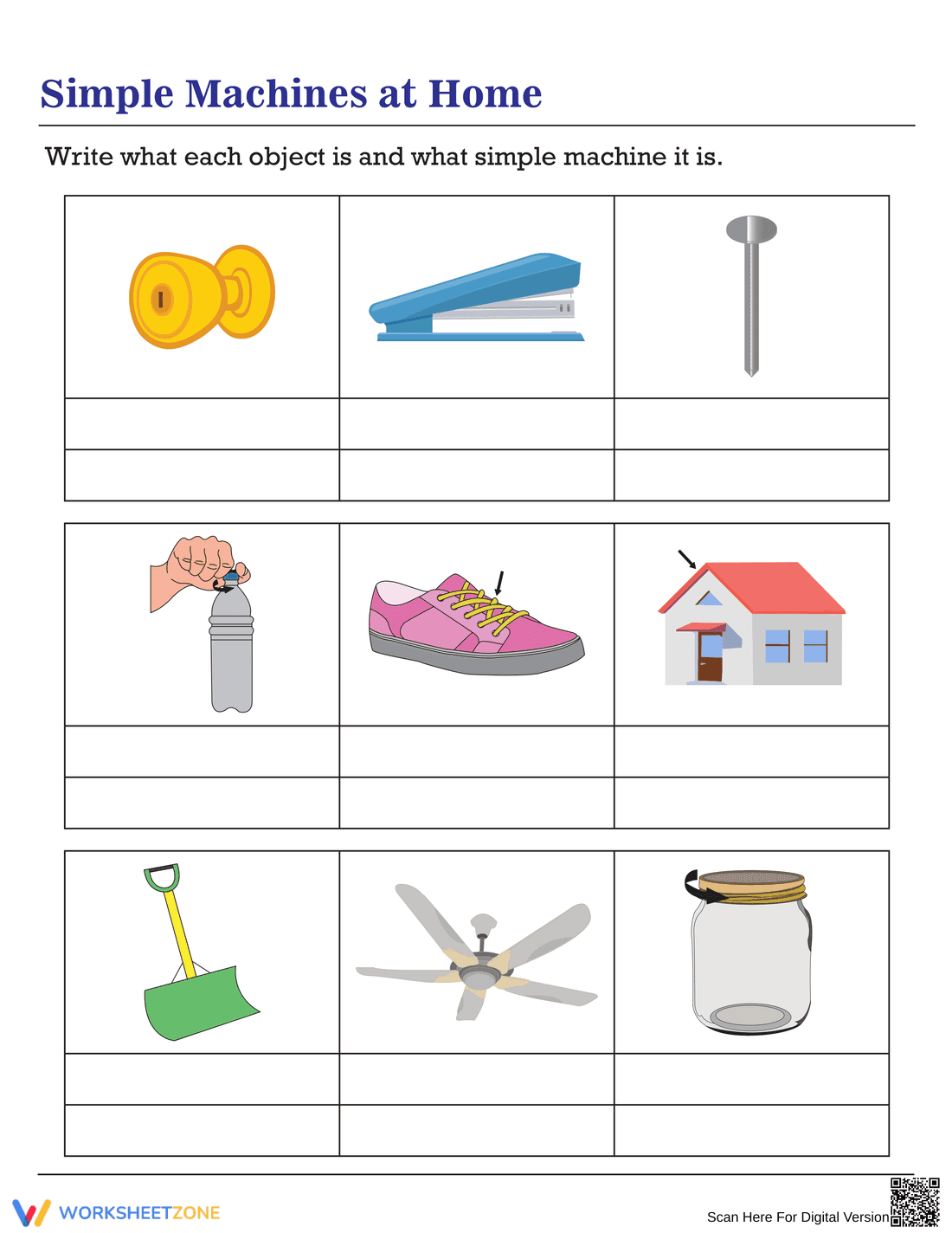

Simple Machines at Home Worksheet | Grade 1 Essential
Paste this activity's link or code into your existing LMS (Google Classroom, Canvas, Teams, Schoology, Moodle, etc.).
Students can open and work on the activity right away, with no student login required.
You'll still be able to track student progress and results from your teacher account.
This Grade 1 science worksheet helps students connect abstract physics concepts to their daily lives by identifying simple machines in household items. Students observe 9 distinct illustrations, naming the object and the mechanical principle it utilizes. This activity builds foundational knowledge in forces and motion while encouraging scientific observation in familiar environments.
At a Glance
- Grade: 1 · Subject: Science
- Standard:
K-PS2-1— Plan and conduct an investigation to compare the effects of different strengths or directions of pushes and pulls- Skill Focus: Simple machine identification
- Format: 1 page · 9 problems · Answer key included · PDF
- Best For: Independent practice or homework
- Time: 15–20 minutes
The worksheet features a clean 3x3 grid layout containing high-quality illustrations of common items like doorknobs, shovels, and jar lids. Each of the 9 tasks provides two lines for student responses: one for the name of the object and one for the specific simple machine (lever, wedge, screw, etc.). A comprehensive answer key is provided for quick grading.
This resource is designed for a zero-prep workflow. First, print the single-page PDF (30 seconds). Second, distribute to students for independent work or as a quick check for understanding (1 minute). Finally, use the included answer key to review responses as a whole class or for individual grading (under 1 minute). Total teacher preparation time is less than two minutes, making it an ideal sub plan addition.
This resource aligns with K-PS2-1, focusing on how objects move and the tools we use to change that motion. By identifying levers, pulleys, and inclined planes, students demonstrate an understanding of how simple machines facilitate work. This standard code can be copied directly into lesson plans, IEP goals, or district curriculum mapping tools.
Use this worksheet as a formative assessment after a lesson on the six simple machines. It works well as a scavenger hunt follow-up where students first find these items in the classroom. Expected completion time is 15 to 20 minutes. Observe if students can distinguish between a screw (jar lid) and a wheel and axle (doorknob) during the identification process.
This is ideal for first and second-grade students beginning their physics unit. It provides visual support for English Language Learners and students with IEPs through clear, recognizable imagery. Pair this with a hands-on simple machines kit or a classroom anchor chart for maximum instructional impact during your science block.
According to the RAND AIRS 2024 report, connecting scientific principles to real-world contexts significantly improves retention in early childhood learners. This worksheet addresses the K-PS2-1 standard by requiring students to categorize everyday objects based on their mechanical function. By identifying 9 specific examples—such as the wedge in a nail or the lever in a stapler—students move beyond rote memorization toward conceptual application. Research from Fisher & Frey (2014) emphasizes that visual non-linguistic representations, like the illustrations used here, help bridge the gap for diverse learners in science education. This resource provides a structured environment for students to practice observation skills essential for future NGSS mastery. The inclusion of a clear answer key ensures that teachers can provide immediate feedback, a critical component of the gradual release of responsibility model in primary science instruction.


