


























Views
Downloads

Essential Grade 1 Forces Worksheet: Pushes and Pulls
Paste this activity's link or code into your existing LMS (Google Classroom, Canvas, Teams, Schoology, Moodle, etc.).
Students can open and work on the activity right away, with no student login required.
You'll still be able to track student progress and results from your teacher account.
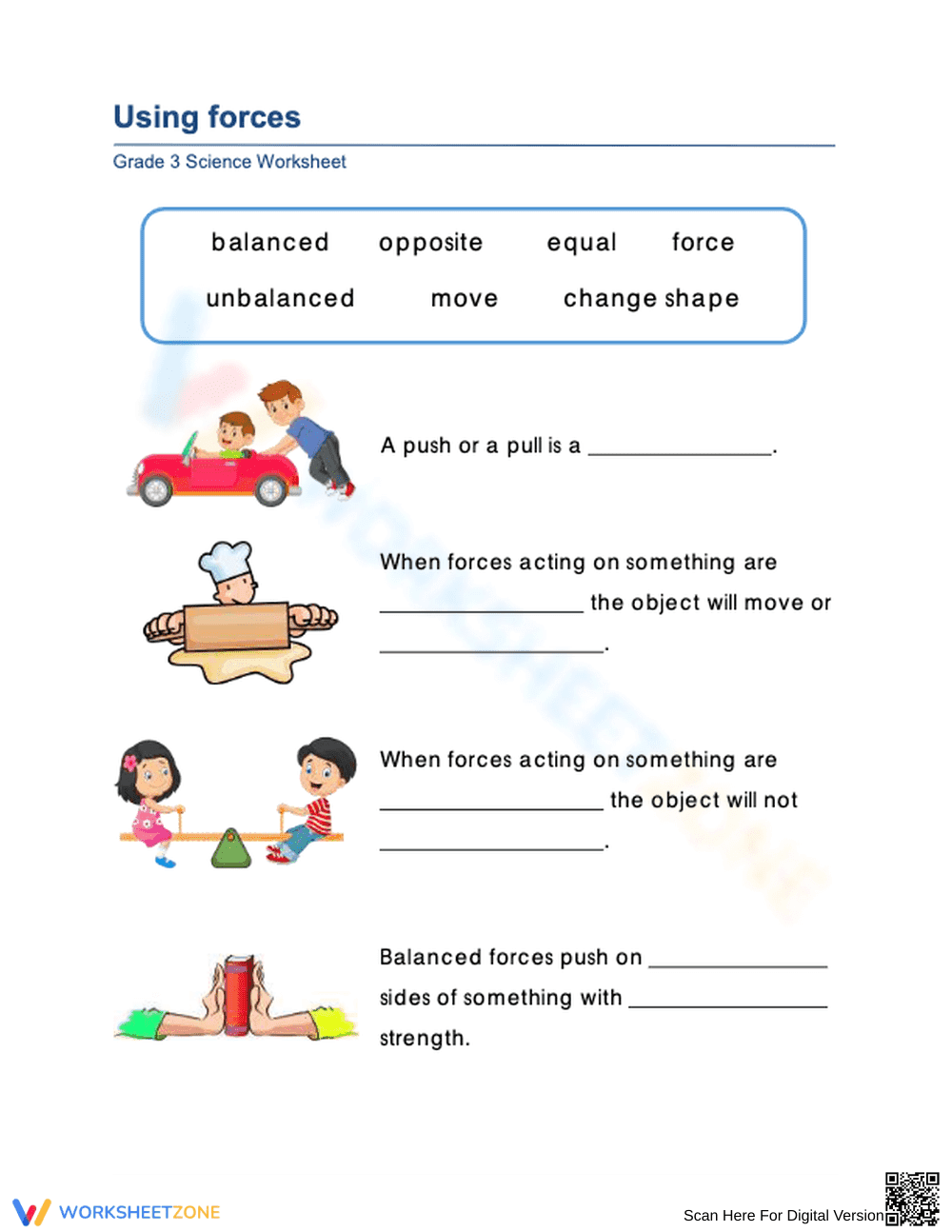
Students explore the fundamental principles of physical science by identifying how different types of forces impact the movement and shape of everyday objects. This worksheet provides a clear, structured way for young learners to distinguish between balanced and unbalanced forces. By completing these exercises, students build a solid foundation for understanding physics.
At a Glance
- Grade: 1 · Subject: Science
- Standard:
3-PS2-1— Plan and conduct an investigation to provide evidence of the effects of balanced and unbalanced forces on the motion of an object- Skill Focus: Forces and Motion
- Format: 2 pages · 7 problems · Answer key included · PDF
- Best For: Independent student practice, science centers, and quick formative assessment
- Time: 15–20 minutes
What's Inside
This two-page PDF resource includes a primary worksheet and a corresponding answer key. The page features a word bank containing seven vocabulary terms: balanced, opposite, equal, force, unbalanced, move, and change shape. Four distinct illustrated scenarios prompt students to apply these terms to real-world contexts, such as pushing a car, using a rolling pin on dough, or playing on a seesaw.
Zero-Prep Workflow
The zero-prep design allows teachers to implement this lesson in under two minutes. Step one involves printing the single-page student sheet, which takes thirty seconds. Step two is distribution, where students begin work using the provided word bank. Step three is the final review, utilizing the included answer key to provide instant feedback or facilitate a quick peer-grading session.
Standards Alignment
This resource is directly aligned to 3-PS2-1, which requires students to provide evidence of the effects of balanced and unbalanced forces on the motion of an object. It also supports K-PS2-1 regarding the comparison of pushes and pulls. Both standard codes can be copied directly into lesson plans, IEP goals, or district curriculum mapping tools.
How to Use It
Use this worksheet as a high-leverage exit ticket following a hands-on investigation with magnets or toy cars to verify student comprehension of force vocabulary. Alternatively, it serves as an excellent guided practice activity during the "We Do" phase of a direct instruction lesson on Newton's Laws of Motion. During completion, observe whether students can explain why the seesaw remains stationary.
Who It's For
This resource is designed for Grade 1 and Grade 3 students beginning their study of physical science. The visual supports and word bank make it highly accessible for English Language Learners and students with IEPs who require linguistic scaffolding. It pairs naturally with an anchor chart depicting pushes and pulls or a short informational passage about simple machines and mechanical advantage.
Research from EdReports 2024 emphasizes that high-quality science instruction must integrate specific vocabulary within observable phenomena to ensure long-term retention of physical concepts. This worksheet applies that evidence-based strategy by pairing technical terms like "unbalanced forces" with concrete visual cues such as a rolling pin deforming dough. By requiring students to select terms that describe both the cause and the effect, the activity reinforces the cognitive mapping necessary for advanced physics. Studies in science education indicate that providing structured scaffolds, such as the 7-item word bank used here, reduces cognitive load and allows students to focus on the underlying mechanics of 3-PS2-1. This approach ensures that learners are not merely memorizing definitions but are instead synthesizing information to describe how forces interact in a closed system to produce predictable physical outcomes.


