


























Views
Downloads

Printable Push, Pull, or Both? Worksheet | Grade 2 Science
Paste this activity's link or code into your existing LMS (Google Classroom, Canvas, Teams, Schoology, Moodle, etc.).
Students can open and work on the activity right away, with no student login required.
You'll still be able to track student progress and results from your teacher account.
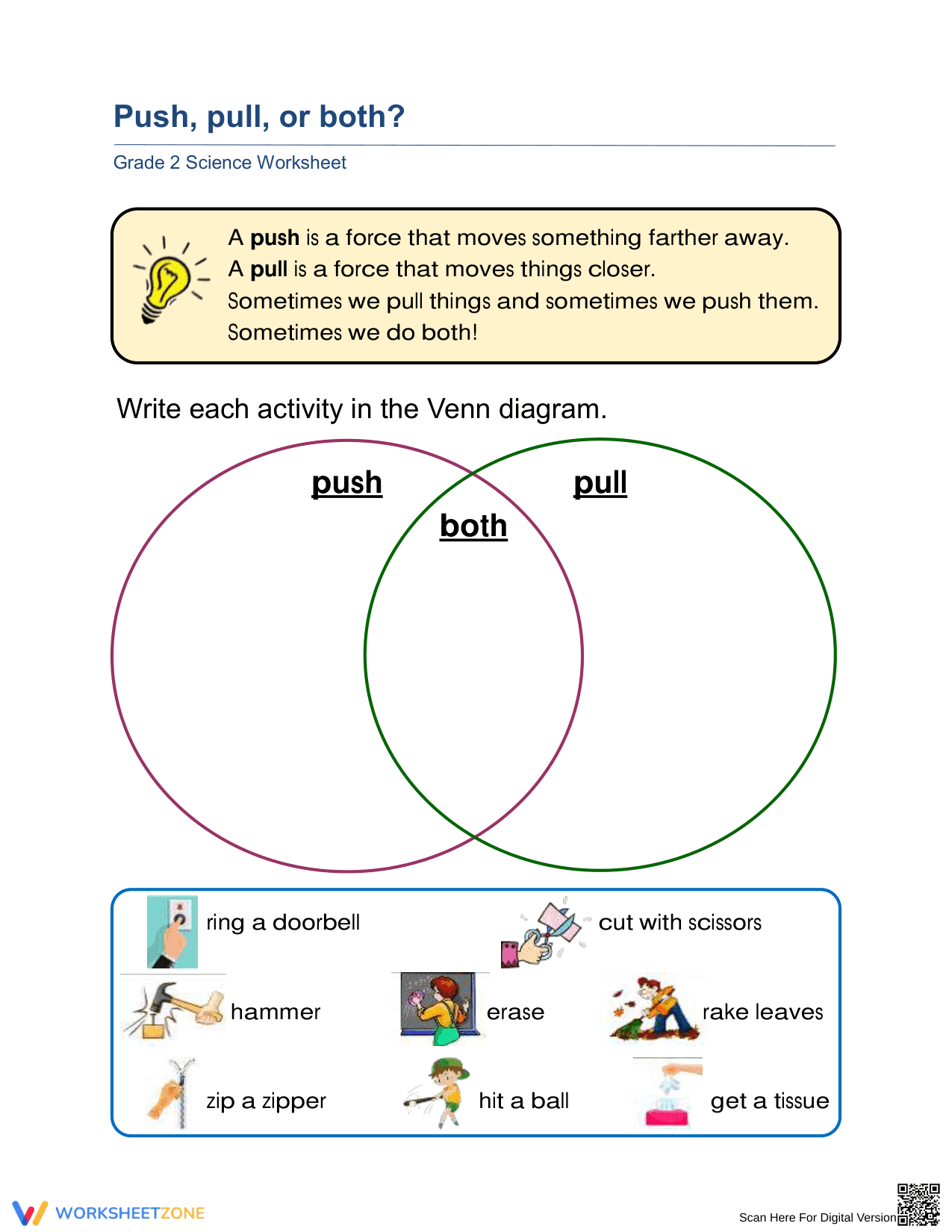
Master fundamental force concepts with this engaging Grade 2 science worksheet. Students analyze eight everyday activities—like ringing a doorbell or raking leaves—to determine if they involve a push, a pull, or both. This visual exercise builds critical thinking and observational skills necessary for understanding physical science and basic motion.
At a Glance
- Grade: 2 · Subject: Science
- Standard:
3-PS2-1— Provide evidence of the effects of balanced and unbalanced forces- Skill Focus: Identifying and categorizing push and pull forces
- Format: 1 page · 8 problems · Answer key included · PDF
- Best For: Independent practice or physical science centers
- Time: 15–20 minutes
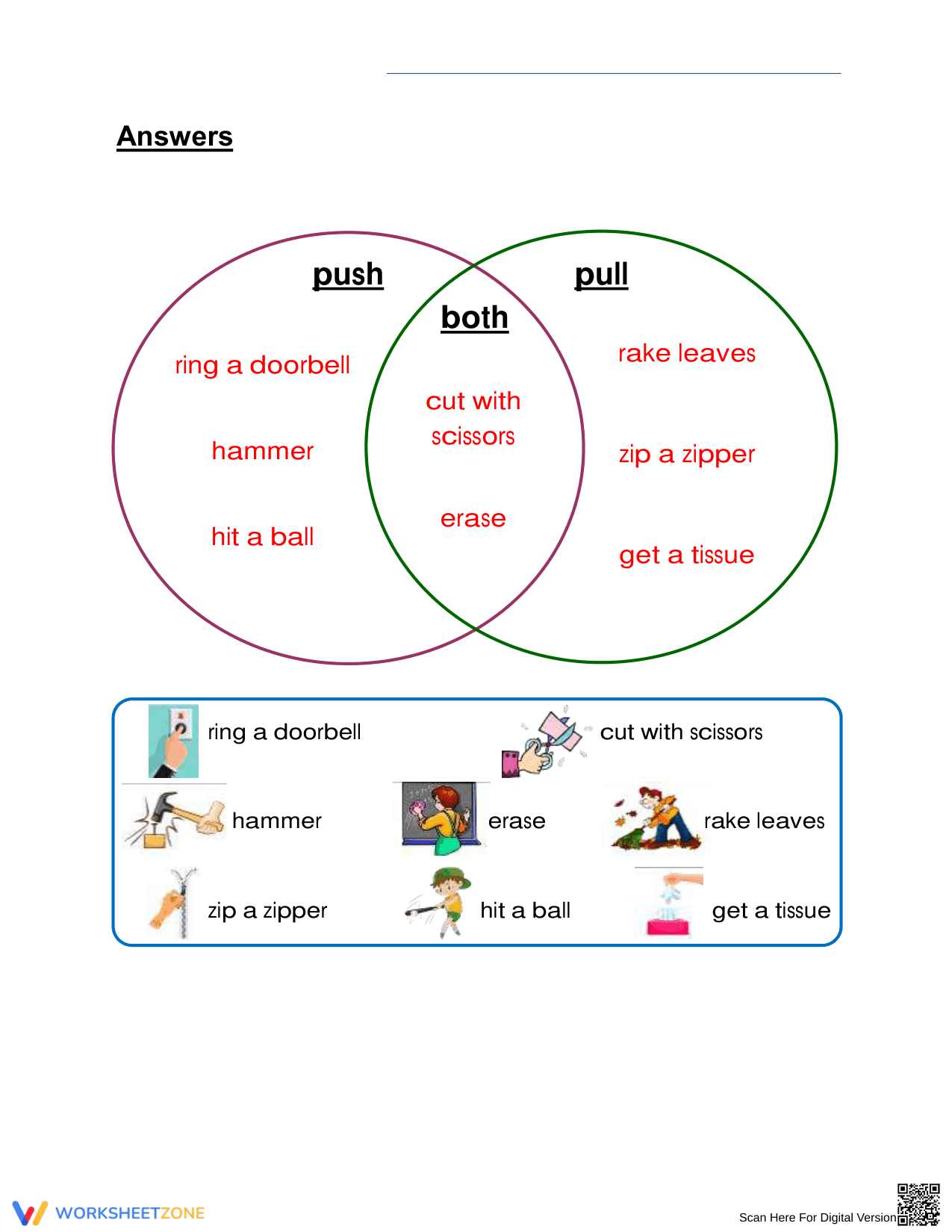
This one-page PDF features a clear Venn diagram layout for elementary learners. At the top, students find helpful definitions for 'push' and 'pull' to anchor their learning. The bottom contains a bank of eight illustrated activities, ranging from using a zipper to hitting a ball. A full answer key is provided for quick grading and immediate student feedback.
Zero-Prep Workflow
This worksheet follows a streamlined zero-prep workflow for busy educators. First, print the single-page PDF (30 seconds). Next, distribute sheets with minimal instructions needed due to the intuitive Venn diagram format (1 minute). Finally, review answers as a class or use the provided key for self-correction (5 minutes). It is a perfect addition to emergency sub-plans.
Standards Alignment
Aligned to 3-PS2-1, this resource requires students to provide evidence of the effects of forces on motion. By identifying how actions like 'cutting with scissors' require multiple force directions, students build the conceptual foundation for mechanical analysis. This standard code can be copied directly into lesson plans, IEP goals, or curriculum mapping tools.
How to Use It
Use this worksheet during the 'Explain' phase of a 5E science lesson. It serves as a bridge between concrete observations and abstract classification. Observe if students struggle with the 'both' category for formative assessment purposes. Expected completion time is 15–20 minutes, making it an ideal exit ticket or formative assessment after a hands-on lab.
Who It's For
This worksheet is for Grade 2 students but works for Grade 1 enrichment or Grade 3 review. Icons for each activity support English Language Learners (ELL) and students with reading disabilities by providing visual cues. It pairs naturally with a classroom anchor chart or an introductory reading passage about Isaac Newton’s laws of motion.
Effective science instruction in the early grades relies on the transition from observable phenomena to scientific categorization. According to RAND AIRS 2024, the use of visual organizers like Venn diagrams significantly enhances a student's ability to retain conceptual definitions of forces such as push and pull. This Grade 2 worksheet specifically targets classification, requiring learners to map real-world actions to physical science principles. By analyzing eight distinct tasks, students meet the evidence requirements of 3-PS2-1 while developing the vocabulary needed for future investigations into friction and gravity. Research from ScienceDirect TpT Analysis suggests that high-quality, print-ready materials that integrate definitions directly into the workspace reduce cognitive load and improve mastery rates among elementary learners. This resource ensures that foundational physics concepts are accessible, measurable, and aligned with national standards for scientific inquiry and physical science literacy.


