


























0
Views
0
Downloads

10.0
0
Save
0 Likes
Share
Exploring Buoyancy: A Sink or Float Worksheet
0 Views
0 Downloads
Paste this activity's link or code into your existing LMS (Google Classroom, Canvas, Teams, Schoology, Moodle, etc.).
Students can open and work on the activity right away, with no student login required.
You'll still be able to track student progress and results from your teacher account.
Information
Description
What It Is:
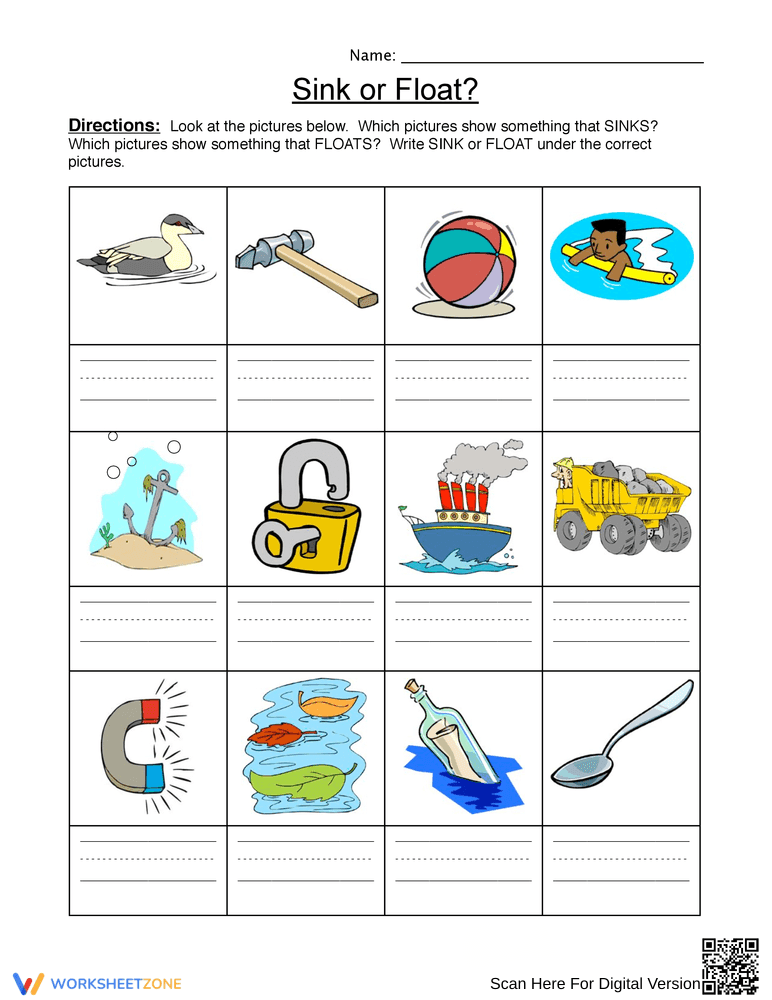
This is a science worksheet titled 'Sink or Float?'. It presents 12 different pictures, including a duck, hammer, ball, person on a surfboard, anchor, lock, ship, dump truck, magnet, leaves, bottle, and spoon. Students are instructed to determine whether each item would sink or float and write 'SINK' or 'FLOAT' under the corresponding picture.
Grade Level Suitability:
This worksheet is suitable for Kindergarten to 2nd grade. The concepts are simple and visual, making it easy for young children to understand the basic principles of buoyancy.
Why Use It:
This worksheet helps students develop their observation and prediction skills while learning about density and buoyancy. It reinforces scientific vocabulary and encourages critical thinking by requiring students to apply their knowledge to different objects.
How to Use It:
Students should look at each picture and predict whether the object will sink or float. They then write either 'SINK' or 'FLOAT' on the lines provided under each picture. This can be done individually or as a class activity.
Target Users:
This worksheet is ideal for elementary school students, particularly those in early grades (K-2), who are learning about science concepts like density, buoyancy, and properties of matter. It can also be used for homeschooling or as a supplemental activity in a classroom setting.
This is a science worksheet titled 'Sink or Float?'. It presents 12 different pictures, including a duck, hammer, ball, person on a surfboard, anchor, lock, ship, dump truck, magnet, leaves, bottle, and spoon. Students are instructed to determine whether each item would sink or float and write 'SINK' or 'FLOAT' under the corresponding picture.
Grade Level Suitability:
This worksheet is suitable for Kindergarten to 2nd grade. The concepts are simple and visual, making it easy for young children to understand the basic principles of buoyancy.
Why Use It:
This worksheet helps students develop their observation and prediction skills while learning about density and buoyancy. It reinforces scientific vocabulary and encourages critical thinking by requiring students to apply their knowledge to different objects.
How to Use It:
Students should look at each picture and predict whether the object will sink or float. They then write either 'SINK' or 'FLOAT' on the lines provided under each picture. This can be done individually or as a class activity.
Target Users:
This worksheet is ideal for elementary school students, particularly those in early grades (K-2), who are learning about science concepts like density, buoyancy, and properties of matter. It can also be used for homeschooling or as a supplemental activity in a classroom setting.


