


























Views
Downloads

Essential Grade 2 Forces & Motion: Drawing Arrows Worksheet
Paste this activity's link or code into your existing LMS (Google Classroom, Canvas, Teams, Schoology, Moodle, etc.).
Students can open and work on the activity right away, with no student login required.
You'll still be able to track student progress and results from your teacher account.
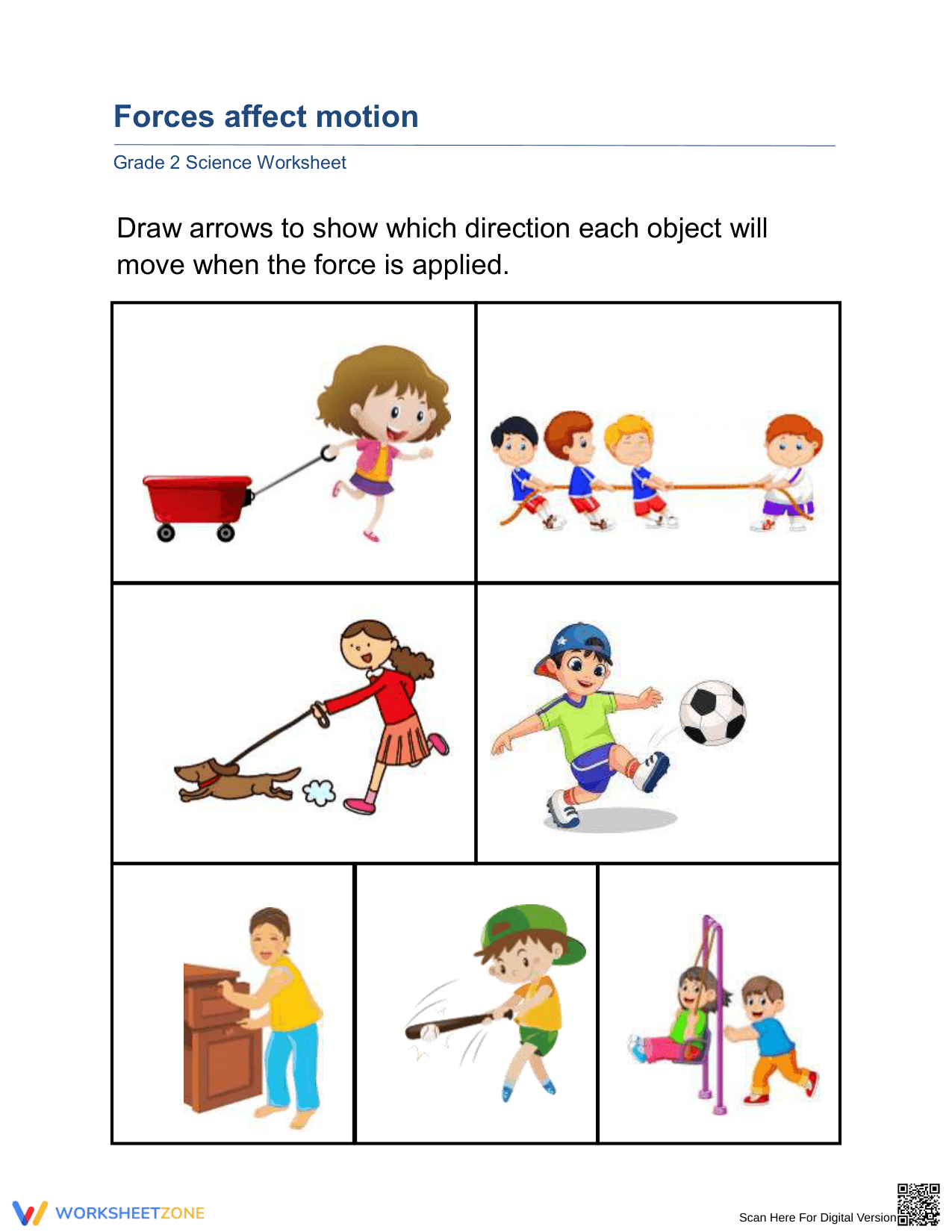
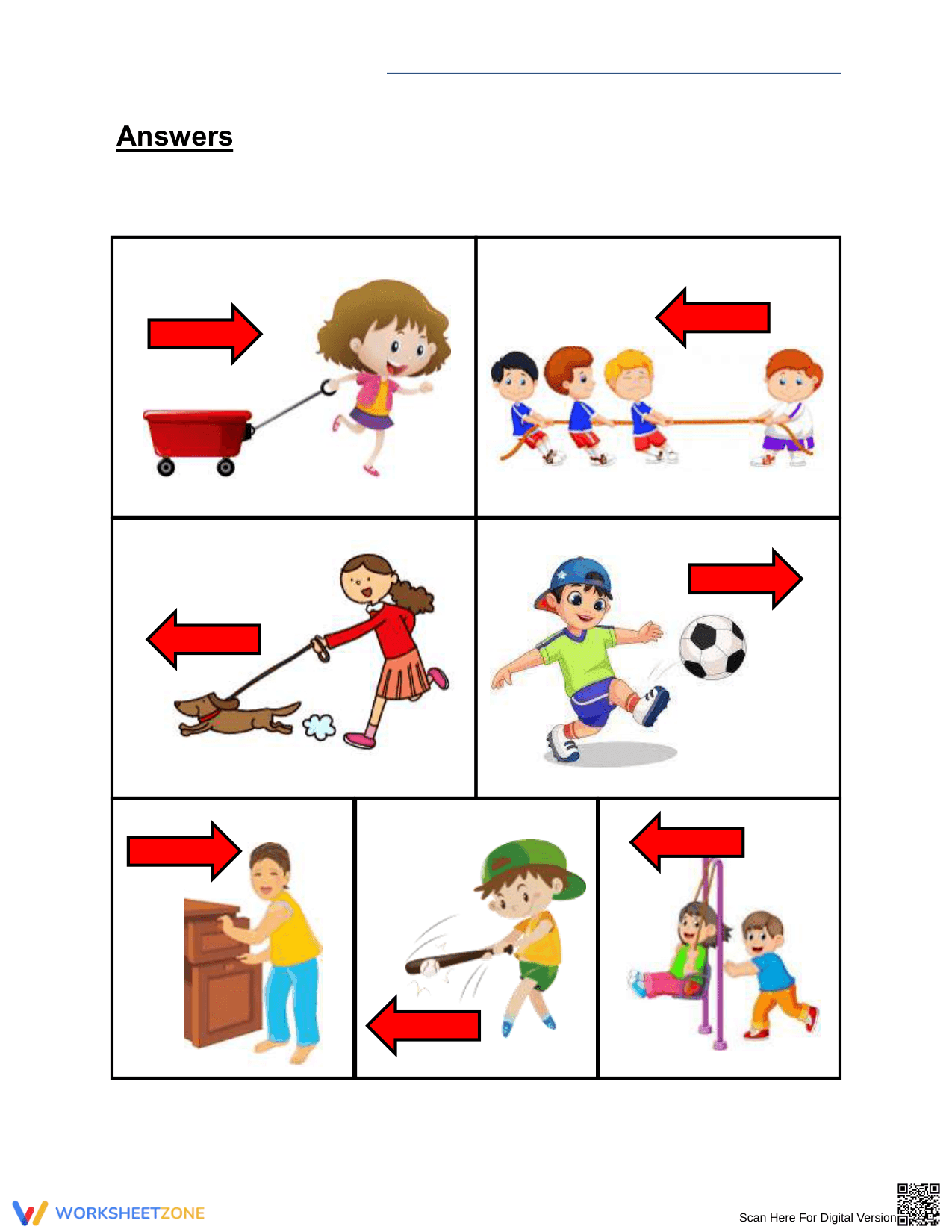
This worksheet helps students visualize how forces like pushes and pulls dictate the direction an object moves. By analyzing seven everyday scenarios, students translate physical interactions into vector-style arrows, bridging the gap between observation and scientific representation. It is an ideal tool for reinforcing basic physics concepts in the primary classroom.
At a Glance
- Grade: 2 · Subject: Science
- Standard:
3-PS2-1— Plan and conduct an investigation of the effects of forces on motion- Skill Focus: Direction of motion from pushes and pulls
- Format: 1 page · 7 problems · Answer key included · PDF
- Best For: Individual practice or formative assessment
- Time: 10–15 minutes
What's Inside
The worksheet contains seven distinct illustrations featuring relatable activities like pulling a wagon, kicking a soccer ball, and pushing a swing. Each task requires students to draw a single arrow indicating the resulting direction of motion. The clean layout and large images ensure accessibility for young learners, while the inclusion of an answer key allows for immediate feedback and self-correction.
Zero-Prep Workflow
This resource is designed for seamless, zero-prep integration. Teachers can print the single-page PDF in seconds, distribute it immediately, and conduct a full class review in under five minutes. Its intuitive design makes it an excellent choice for substitute plans, morning work, or a quick exit ticket to gauge student understanding of force dynamics.
Standards Alignment
Aligned to 3-PS2-1, which requires students to plan and conduct an investigation to provide evidence of the effects of forces on the motion of an object. By identifying the path of objects like a baseball or a sliding drawer, students demonstrate mastery of NGSS PS2.A: Forces and Motion. Both standard codes can be copied directly into lesson plans, IEP goals, or district curriculum mapping tools.
How to Use It
Use this worksheet immediately following a hands-on demonstration of pushes and pulls to solidify abstract concepts. During the activity, walk around and observe if students are drawing arrows away from the source (pushes) or toward it (pulls). This formative assessment observation tip helps identify students who may need additional scaffolding with directional vocabulary. Expected completion is 10-15 minutes.
Who It's For
This resource is tailored for second-grade students but is equally effective for Grade 1 enrichment or Grade 3 review. It supports diverse learners through visual cues and minimal text, making it accessible for English Language Learners and students with processing needs. Pair this worksheet with a simple anchor chart showing Push vs. Pull for maximum instructional impact.
Research by Fisher & Frey (2014) emphasizes that visual representations, such as drawing arrows to indicate motion, are critical for primary students to internalize foundational physics principles. This worksheet leverages that methodology by requiring students to apply the 3-PS2-1 standard to everyday observable scenarios like a child hitting a baseball or pulling a dog on a leash. By focusing on the plain-English skill of predicting directionality based on applied force, the resource ensures that young learners build a concrete conceptual foundation for later study of balanced and unbalanced forces. This instructional approach is consistent with ScienceDirect TpT Analysis findings that highlight the efficacy of structured visual practice in early elementary science education. The combination of relatable imagery and active response allows students to bridge the gap between physical experience and scientific modeling, a key requirement for achieving long-term mastery in the NGSS framework.


