


























Views
Downloads

Essential Push and Pull Venn Diagram Worksheet | Grade 2
Paste this activity's link or code into your existing LMS (Google Classroom, Canvas, Teams, Schoology, Moodle, etc.).
Students can open and work on the activity right away, with no student login required.
You'll still be able to track student progress and results from your teacher account.
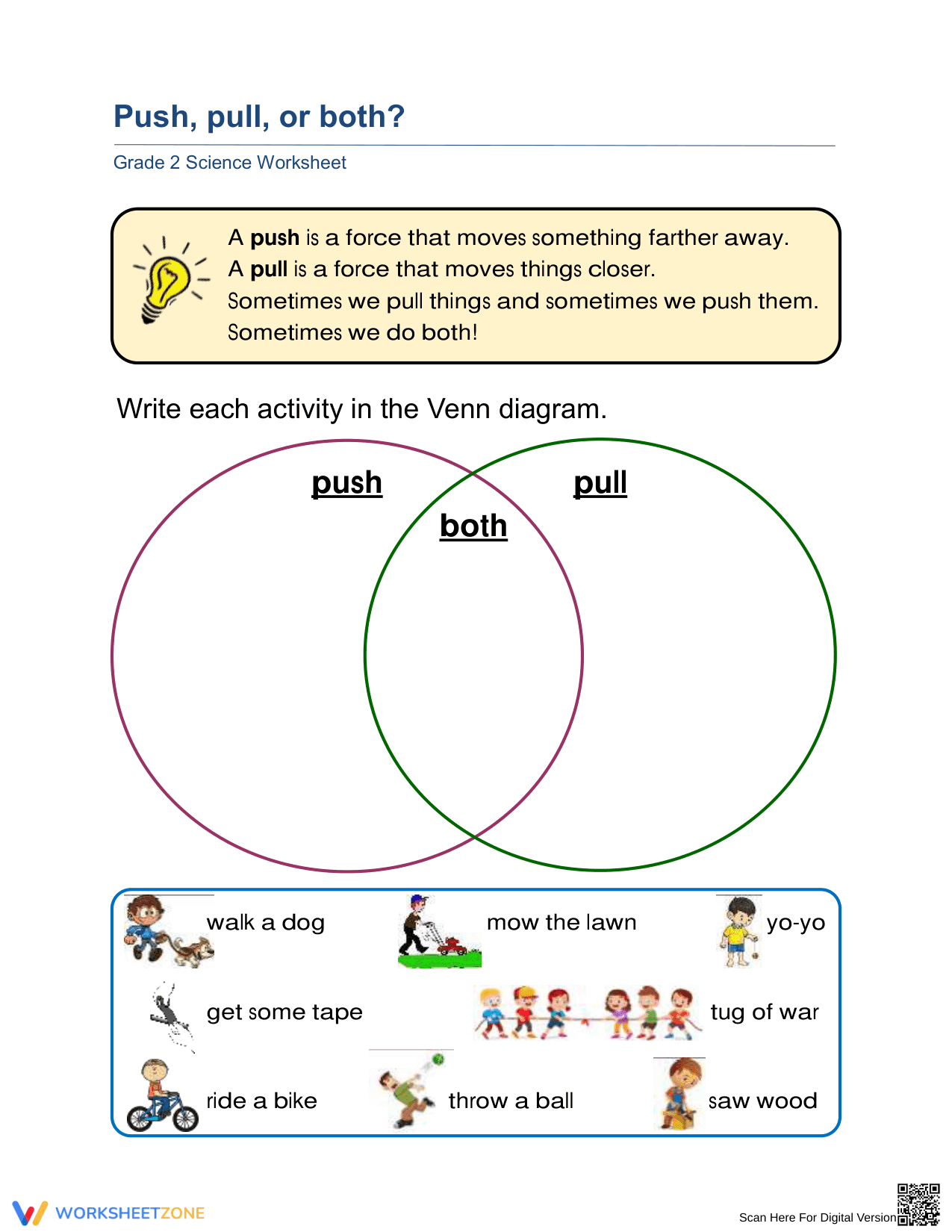
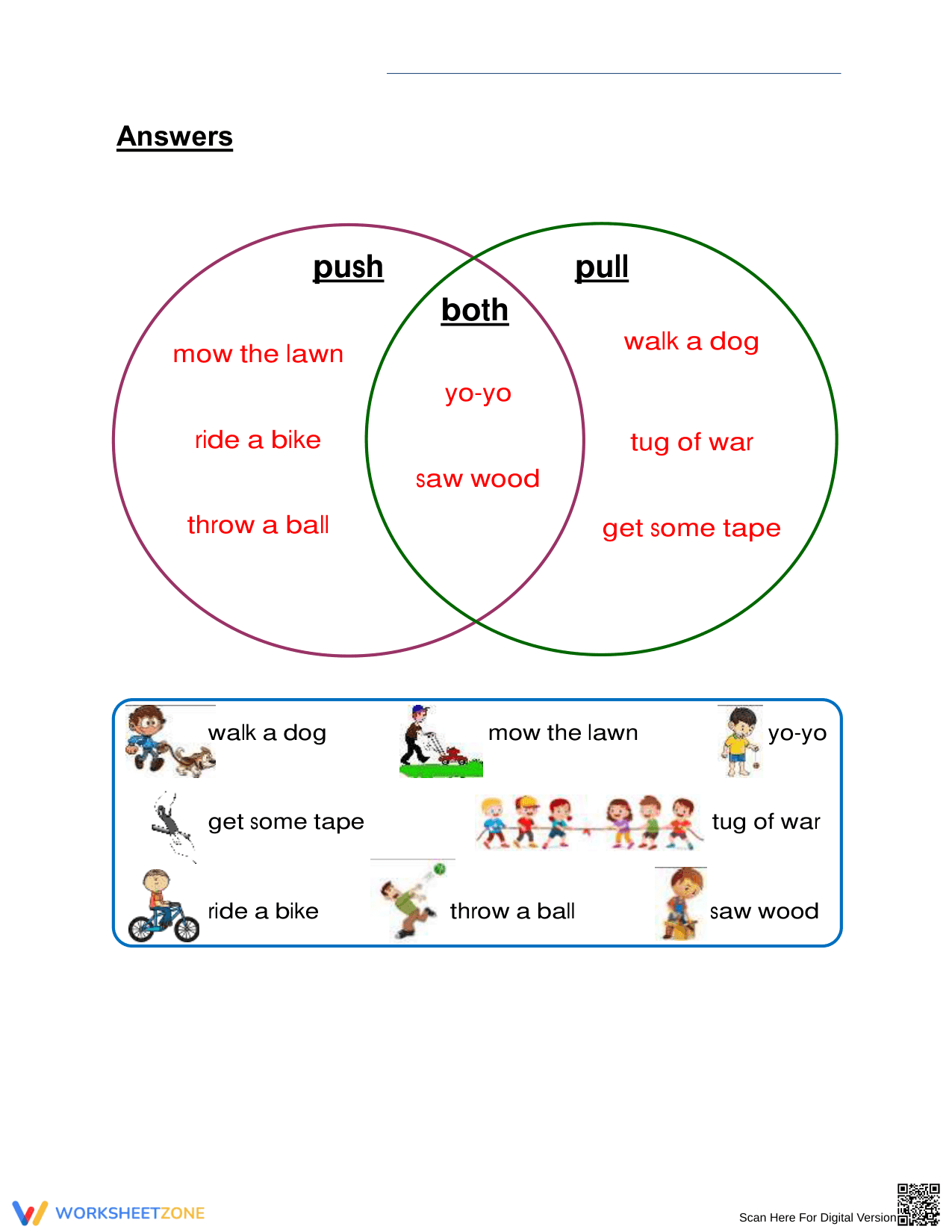
Students identify and categorize various forces in this engaging push and pull Venn diagram worksheet. By analyzing eight real-world activities like sawing wood or riding a bike, learners determine if the force applied is a push, a pull, or a combination of both. This activity clarifies foundational physics concepts through concrete, relatable examples.
At a Glance
- Grade: 2 · Subject: Science
- Standard:
K-PS2-1— Compare the effects of different directions of pushes and pulls on an object- Skill Focus: Identifying and categorizing forces
- Format: 1 page · 8 problems · Answer key included · PDF
- Best For: Introduction to forces and motion units
- Time: 15–20 minutes
What's Inside
This worksheet features a clear, interactive Venn diagram layout where students sort eight distinct illustrations and labels. Each activity—ranging from "walk a dog" to "mow the lawn"—represents a common physical interaction. The single-page PDF format includes a concise definition section at the top to anchor student understanding, along with a comprehensive answer key for quick grading.
Zero-Prep Workflow
The zero-prep design of this worksheet ensures it is ready for immediate classroom use. Implementation follows a simple three-step workflow: Print (30 seconds), Distribute (1 minute), and Review (5 minutes). Because the instructions are self-explanatory and the activities are visually supported, teachers spend under 2 minutes on preparation. This makes the resource ideal for emergency sub plans, independent centers, or a quick morning-work activity.
Standards Alignment
This resource is primarily aligned to the K-PS2-1 standard, which requires students to conduct investigations and compare the effects of different directions of pushes and pulls. It also supports higher-grade standards involving balanced and unbalanced forces. Both standard codes can be copied directly into lesson plans, IEP goals, or district curriculum mapping tools.
How to Use It
Use this worksheet during the "Explain" or "Elaborate" phase of a 5E lesson cycle. After students have explored forces through hands-on play with toys, use this Venn diagram to formalize their observations. While students work, observe if they can justify why an activity like "saw wood" belongs in the "both" category, as this reveals their depth of conceptual understanding.
Who It's For
This activity is designed for second-grade students but is also appropriate for Grade 1 and Grade 3 learners needing reinforcement of force concepts. The visual cues help differentiate for English Language Learners and students with reading difficulties. Pair this worksheet with a short video clip or a physical demonstration of the listed activities to maximize impact.
According to the RAND AIRS 2024 report on elementary science instruction, utilizing graphic organizers like Venn diagrams significantly enhances student retention of abstract physical concepts by forcing active categorization. This worksheet targets the K-PS2-1 standard by asking students to distinguish between the directional forces of pushes and pulls in everyday contexts. Research from Fisher & Frey (2014) emphasizes that "gradual release of responsibility" is most effective when students transition from anchored definitions to independent classification tasks. By identifying that some actions involve both directions, students build the prerequisite knowledge for more complex vector-based physics encountered in middle school. This 1-page resource provides a focused, evidence-based approach to mastery, ensuring students can accurately identify force interactions with high confidence. The inclusion of an answer key supports immediate feedback, a critical component for early learners as they navigate the foundational principles of motion and mechanical advantage.


