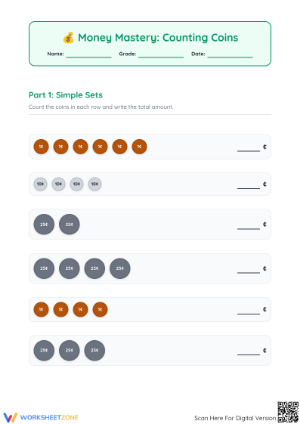
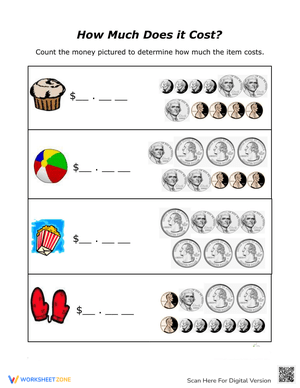
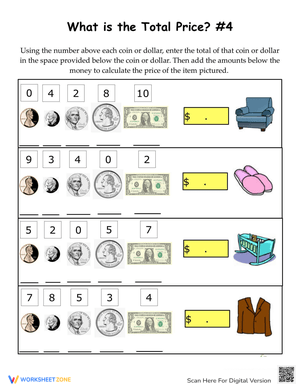
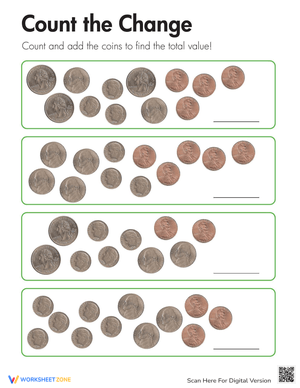
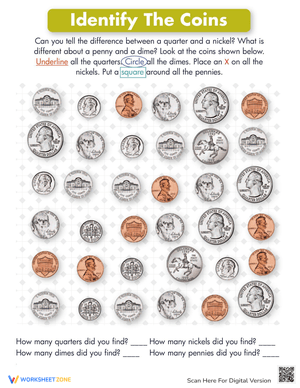
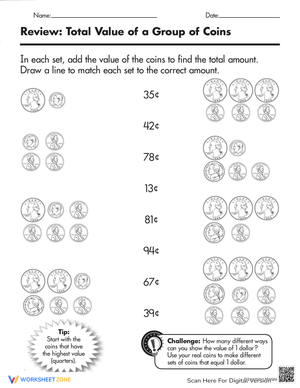
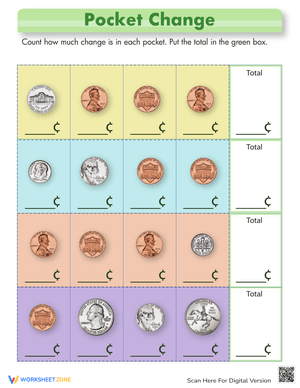
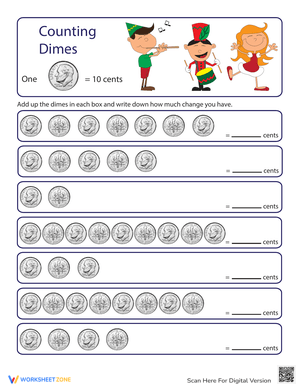
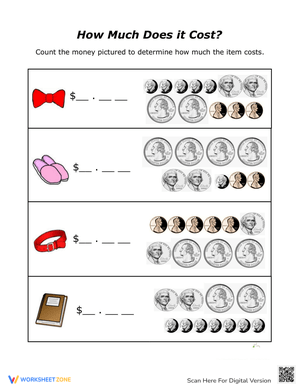
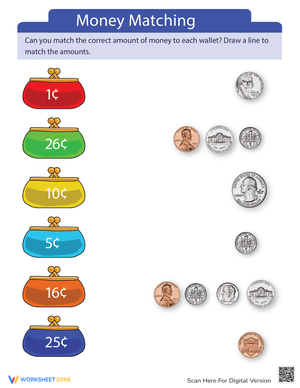
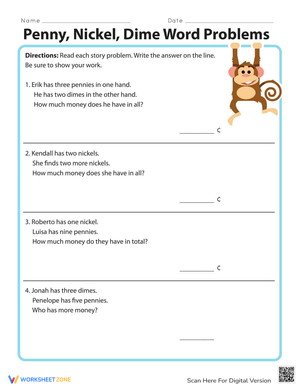
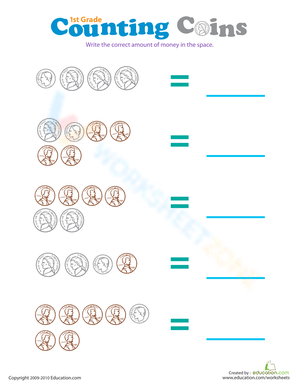
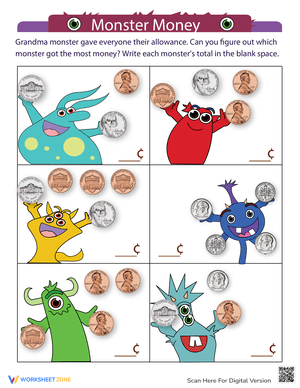
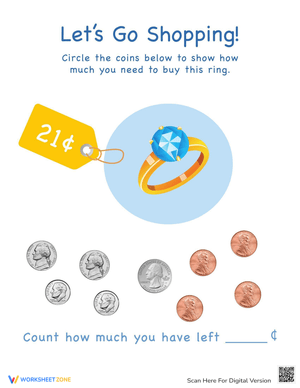
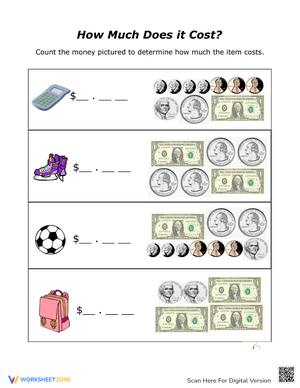
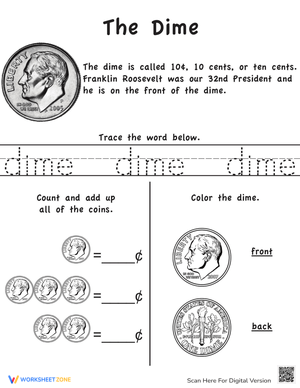
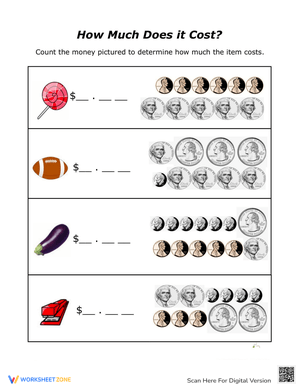
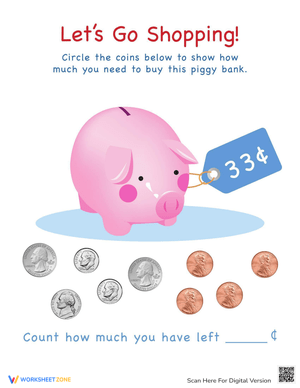
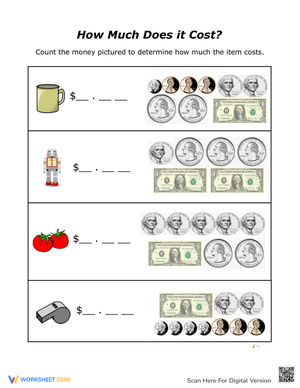
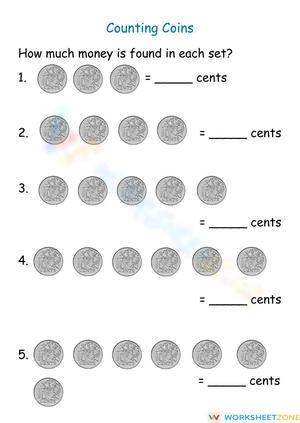
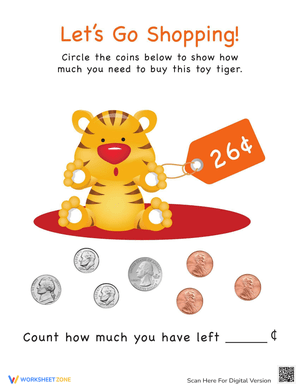
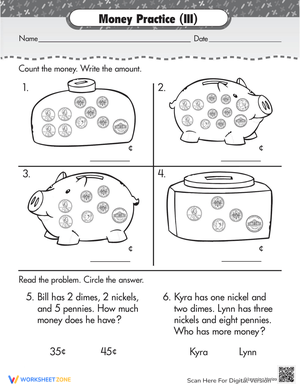
These 1st grade dimes worksheets give teachers printable, targeted practice for the most conceptually challenging coin in the primary curriculum — a coin that is physically the smallest U.S. coin yet holds more value than both the penny and nickel. Each worksheet isolates a specific dime skill: visual identification, value assignment, or skip counting collections. Together the set builds the foundation students need before coin combinations enter the picture.
The Student Error That Shows Up Every Year
The size-value confusion is universal in first grade. Students who correctly sort coins by color will still insist the nickel is worth more than the dime because it is physically larger. The error runs deeper than a memory gap — it is a logical inference from a pattern that holds in every other part of a six-year-old's experience: a bigger cup holds more juice, a bigger pile of blocks is more blocks. No amount of repetition fixes this without instruction that directly names the contradiction. Telling students clearly that the size of a coin has nothing to do with how much it is worth — and that coins are one of the only places this rule breaks down — disrupts the faulty pattern faster than hoping exposure will correct it over time.
A second error to watch for: students confuse the dime and the quarter because both are silver. Until a student has memorized the reeded edge, Roosevelt's portrait, and the size relationship between the two coins, they grab the wrong one during counting tasks. Watch for students who record a quarter as "ten cents" — they have associated silver with dime without anchoring to any specific physical feature.
Concepts Covered Across the Set
The worksheets move through a deliberate skill sequence. Assigning a student to a skip-counting task before they can reliably identify the coin produces errors that look like counting problems but are actually identification problems — which is why sequence matters here.
- Visual identification: Students circle or color only the dimes in a mixed coin array. No counting, no value — just recognition built through repeated exposure to the coin's specific features.
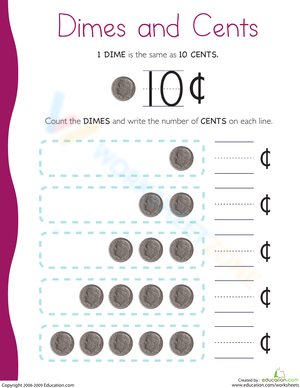
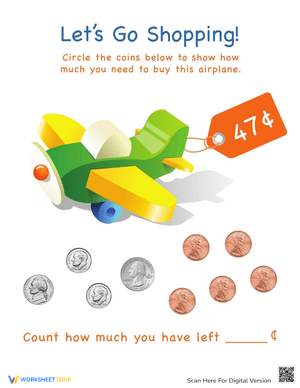
- Value reading: Students write "10¢" beneath each dime image and match individual coins to price tags, locking in the one-dime-equals-ten-cents relationship before groups appear.
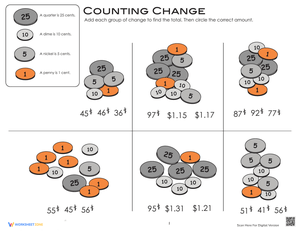
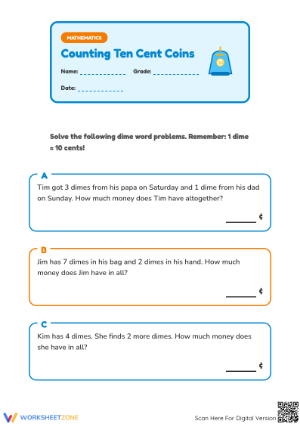
- Skip counting collections: Students count rows of two, three, four, five, and six dimes by tens and record the total. The tens structure of dimes makes these tasks direct practice in base-ten reasoning, not just money knowledge.
- Comparison tasks: Students circle the group worth more cents. These tasks are constructed so the larger group by coin count is sometimes the smaller amount, forcing students to apply value rather than quantity as the deciding factor.
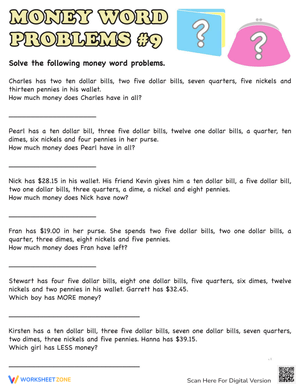
- Word problems: One-sentence problems combine a dime count with addition or subtraction — "Yara has four dimes. She gives one to her brother. How many cents does she have?" — extending the skill without changing the coin.
Building These Worksheets Into Your Money Unit
The worksheets land best after hands-on coin handling, not before. A reliable opener: spend five minutes at the start of the lesson having students sort real or plastic coins by feel with their eyes closed. The dime's reeded edge and its noticeably smaller size give students a tactile anchor before they look at a printed image. Students who had the actual coin in their hands two minutes earlier approach the identification worksheet with more confidence and make fewer reversals between the dime and the quarter.
Dime counting worksheets make strong Monday morning warm-ups once the coin unit is underway. The five-minute window between morning meeting and the first lesson is enough for a single skip-counting task — three or four dimes, write the total. That daily repetition across a week consolidates the tens pattern more reliably than a single longer session does.
Reserve the comparison worksheets for formative assessment moments. A student who correctly identifies which group holds more cents — when the answer requires knowing that two dimes beat five pennies — demonstrates that the size-value misconception has shifted. That is the conceptual move worth documenting. Because the 1st grade dimes worksheets set includes tasks at each of these stages, you can assign by skill level rather than working through the set in order, which matters when half the class still needs identification practice while three students are ready for word problems.
Standard Alignment
Money does not appear as a named standard in the Common Core until Grade 2, where CCSS 2.MD.C.8 explicitly addresses solving problems with quarters, dimes, nickels, and pennies. Grade 1 teachers introduce dimes earlier because dime work builds two Grade 1 standards simultaneously. Counting a collection of dimes is direct practice for CCSS 1.NBT.B.2 — understanding that two-digit numbers represent amounts of tens and ones — because three dimes worth 30 cents is a physical, countable model of three groups of ten. It also reinforces CCSS 1.OA.C.5, which asks students to relate counting to addition and subtraction.
The instructional placement is deliberate: dime work belongs after the class has engaged with tens and ones in a place-value context, not at the start of the year. When students already understand that 40 means four groups of ten, connecting that to four dimes worth 40 cents is an application rather than an introduction. Sequencing it this way turns a money lesson into a place-value reinforcement — the same thirty minutes serves both goals.
Adjusting the Worksheets for Mixed Readiness Levels
For students who struggle most with visual discrimination, restrict sorting tasks to dimes and pennies only. The copper-versus-silver color contrast provides an additional perceptual cue that the dime-nickel pairing does not offer. Once a student reliably pulls dimes from a dime-penny mix, introduce the nickel. Modified pages with enlarged coin images also reduce visual load for students still developing the fine motor control to work comfortably with small printed representations.
Students who can identify the dime but lose count midway through a collection benefit from a printed number line across the top of the worksheet showing multiples of ten. They touch each multiple as they move a finger from coin to coin — a two-channel process that offloads part of the tracking work and lets them focus on the counting itself rather than holding the entire sequence in working memory.
Advanced students who skip count through six dimes without hesitation need problems that require reversing the process: "The bookmark costs 50 cents. How many dimes is that?" Working backward from a total to a coin count is a meaningfully harder task than counting forward, and it connects to the division reasoning that arrives formally in later grades. A 1st grade dimes worksheets with extension pages keeps these students inside the same unit topic rather than pulling them off to unrelated enrichment material.
Frequently Asked Questions
Why do first graders have such a hard time accepting that a smaller coin is worth more?
The difficulty is developmental. Children at this stage categorize objects using perceptual cues — size, weight, color — and every prior experience has confirmed that larger means more. The dime violates that pattern, and the violation requires explicit, direct instruction to override. Stating outright that "the size of a coin has nothing to do with its value" — writing it on the board, repeating it across the unit — works better than assuming repeated exposure will quietly correct the inference on its own.
How many dimes should counting tasks include for first graders?
Start with two or three dimes and increase gradually to a maximum of six in a single task. Beyond six, most first graders make tracking errors — they lose their place mid-count and arrive at a wrong total, not because they don't know to count by tens, but because visually tracking a longer row exceeds their current stamina. Keeping tasks to six coins or fewer surfaces actual understanding rather than tracking failures masquerading as conceptual gaps.
Where do dimes fit in the sequence of coin instruction?
Pennies and nickels should come first. The penny-to-nickel relationship introduces the idea that coins carry assigned values without triggering the size-value conflict — a nickel is larger and worth more, which matches student expectations. Introducing the dime after that foundation creates a productive conflict: students must confront the rule they just formed and revise it. Mid-unit placement, between nickels and quarters, consistently produces the most durable understanding. This 1st grade dimes worksheets set follows that progression — identification before counting, dimes after nickels — so the worksheet sequence supports the instructional logic rather than working against it.













 Interactive Worksheet Maker
 Quiz Maker
 Word Search Maker
 Crossword Puzzle Maker
 Word Scramble Generator
 Sentence Scramble Generator
 Handwriting Worksheet Generator
 Name Tracing Generator
 Fill In The Blank Generator