


























Views
Downloads

Printable Counting Ten Cent Coins Worksheet | Grade 1 Math
Paste this activity's link or code into your existing LMS (Google Classroom, Canvas, Teams, Schoology, Moodle, etc.).
Students can open and work on the activity right away, with no student login required.
You'll still be able to track student progress and results from your teacher account.
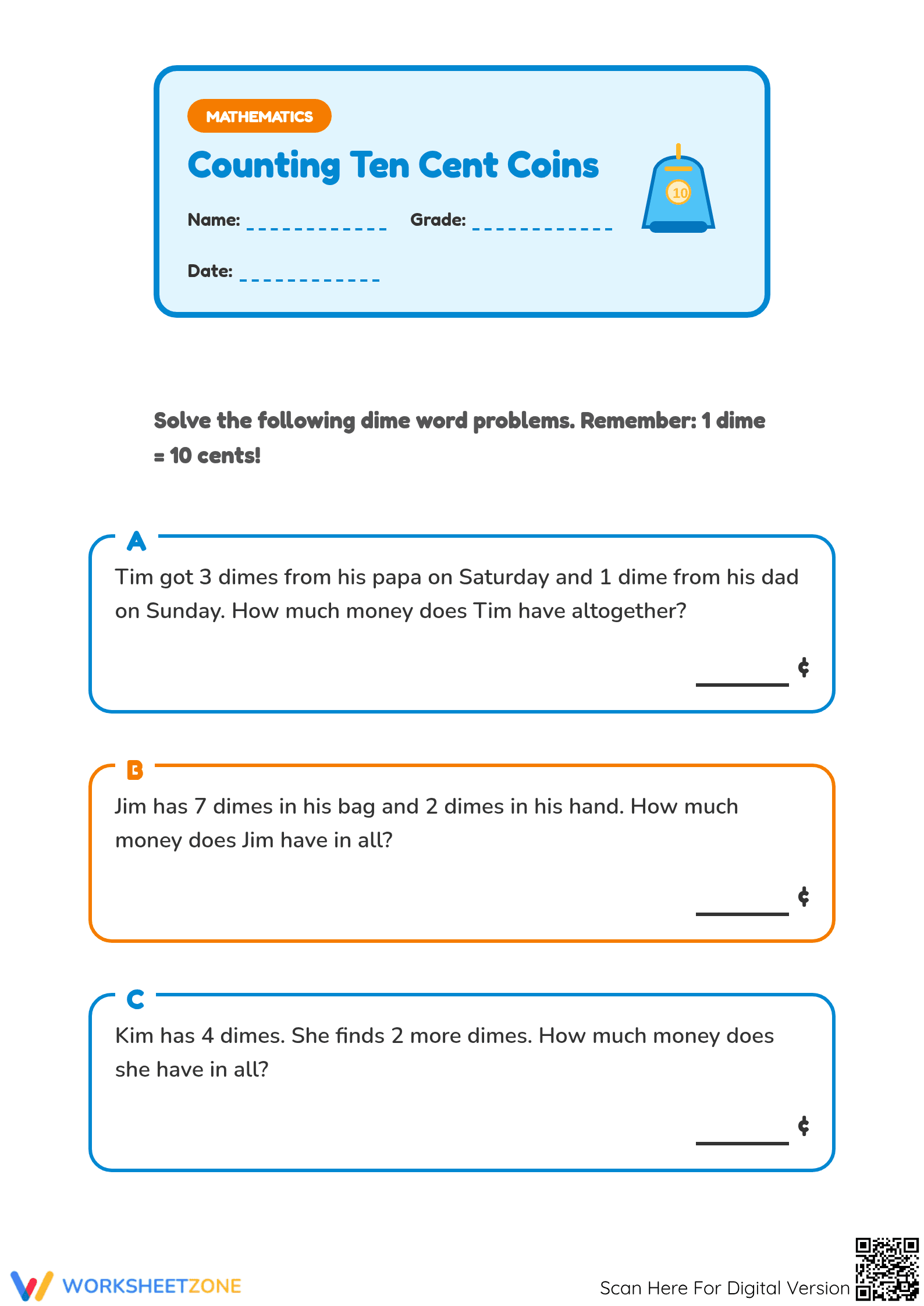
This comprehensive Grade 1 money worksheet helps students master the value of ten-cent coins through 21 engaging word problems. By focusing specifically on dimes, learners build a strong foundation in skip-counting by tens and applying addition and subtraction to real-world financial scenarios. Students will calculate totals, determine change, and compare values to achieve fluency in basic currency management.
At a Glance
- Grade: 1 · Subject: Math
- Standard:
2.MD.C.8— Solve word problems involving dollar bills, quarters, dimes, nickels, and pennies- Skill Focus: Counting dimes and money word problems
- Format: 5 pages · 21 problems · Answer key included · PDF
- Best For: Guided math centers and independent practice
- Time: 25–35 minutes
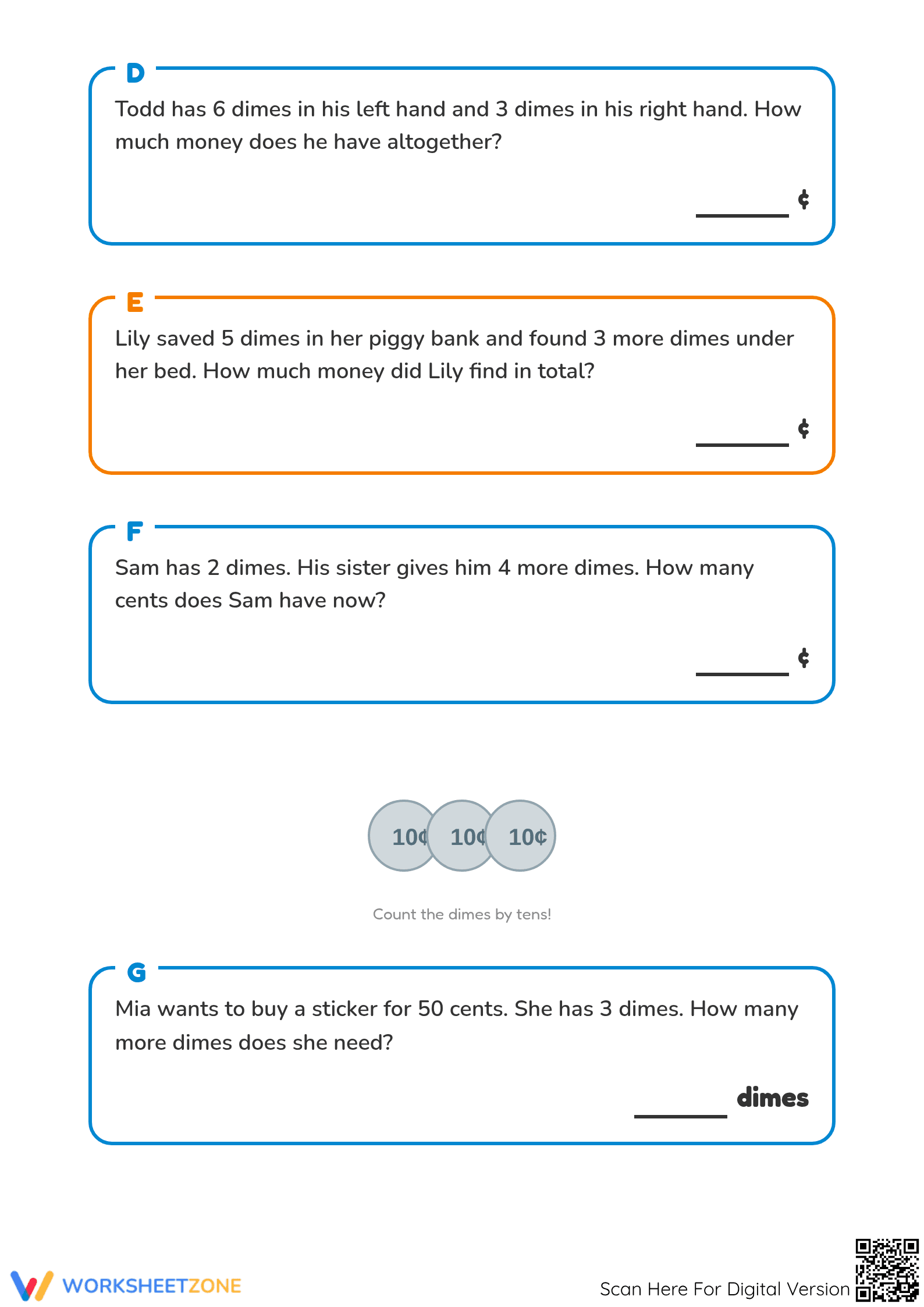
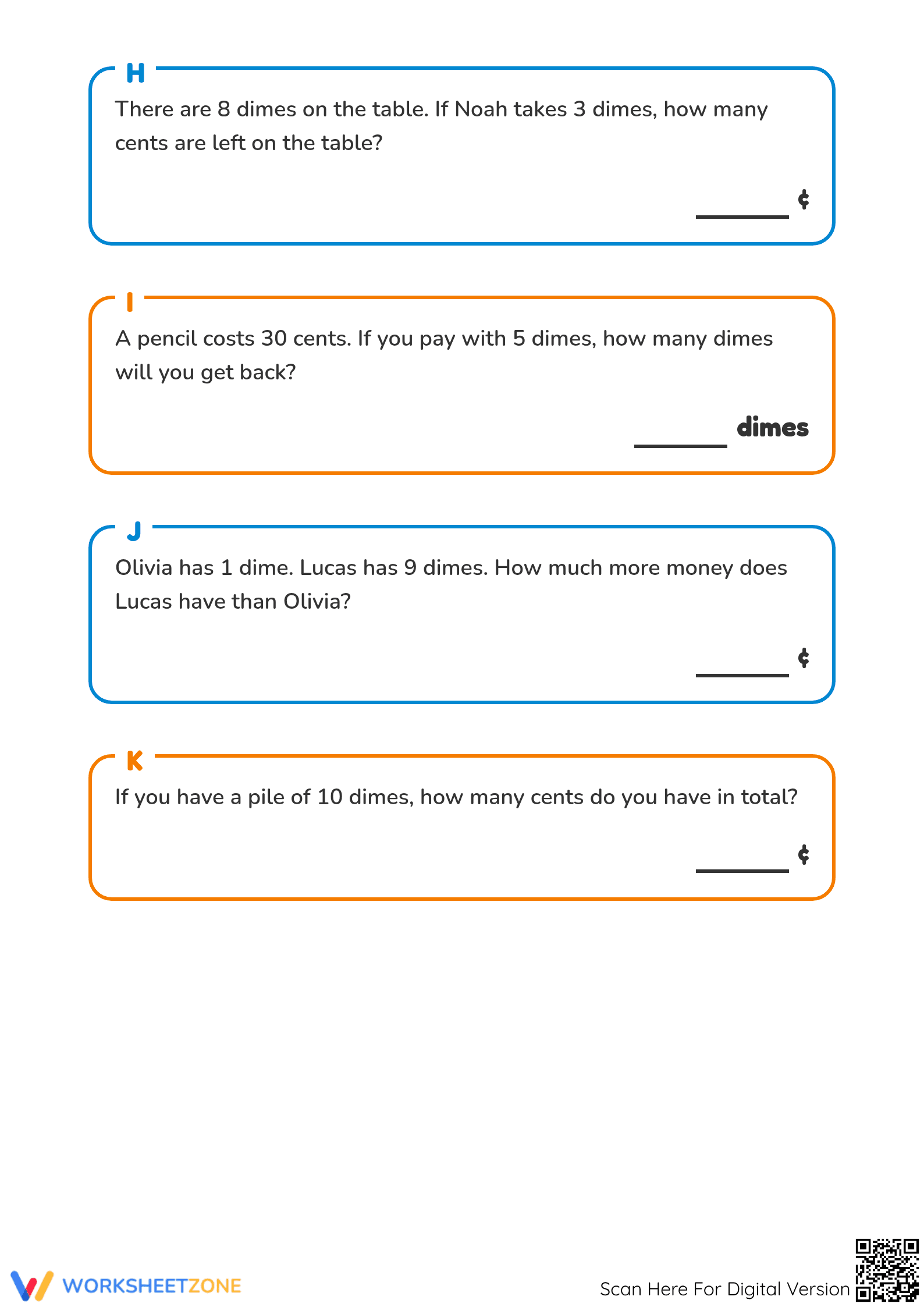
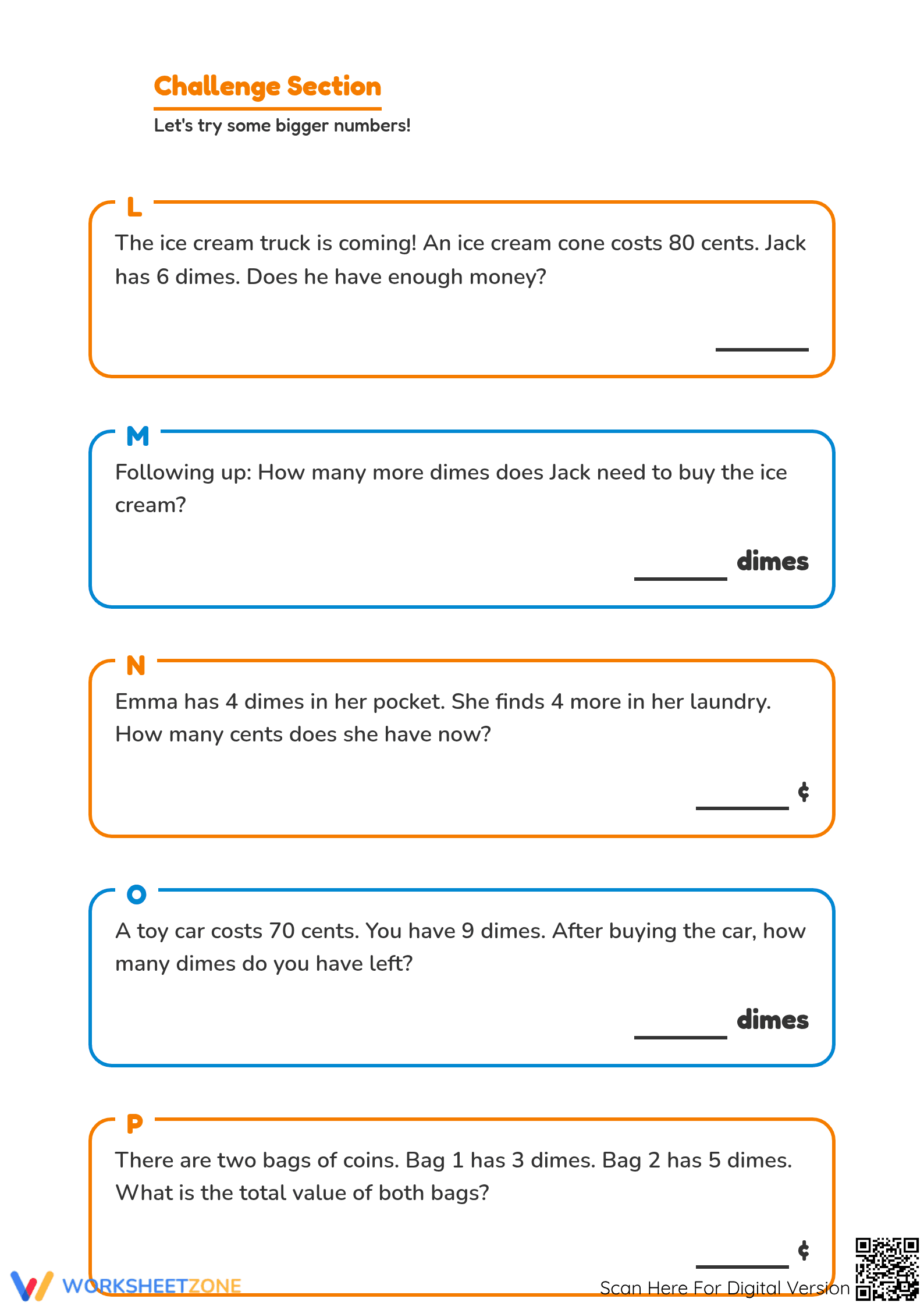
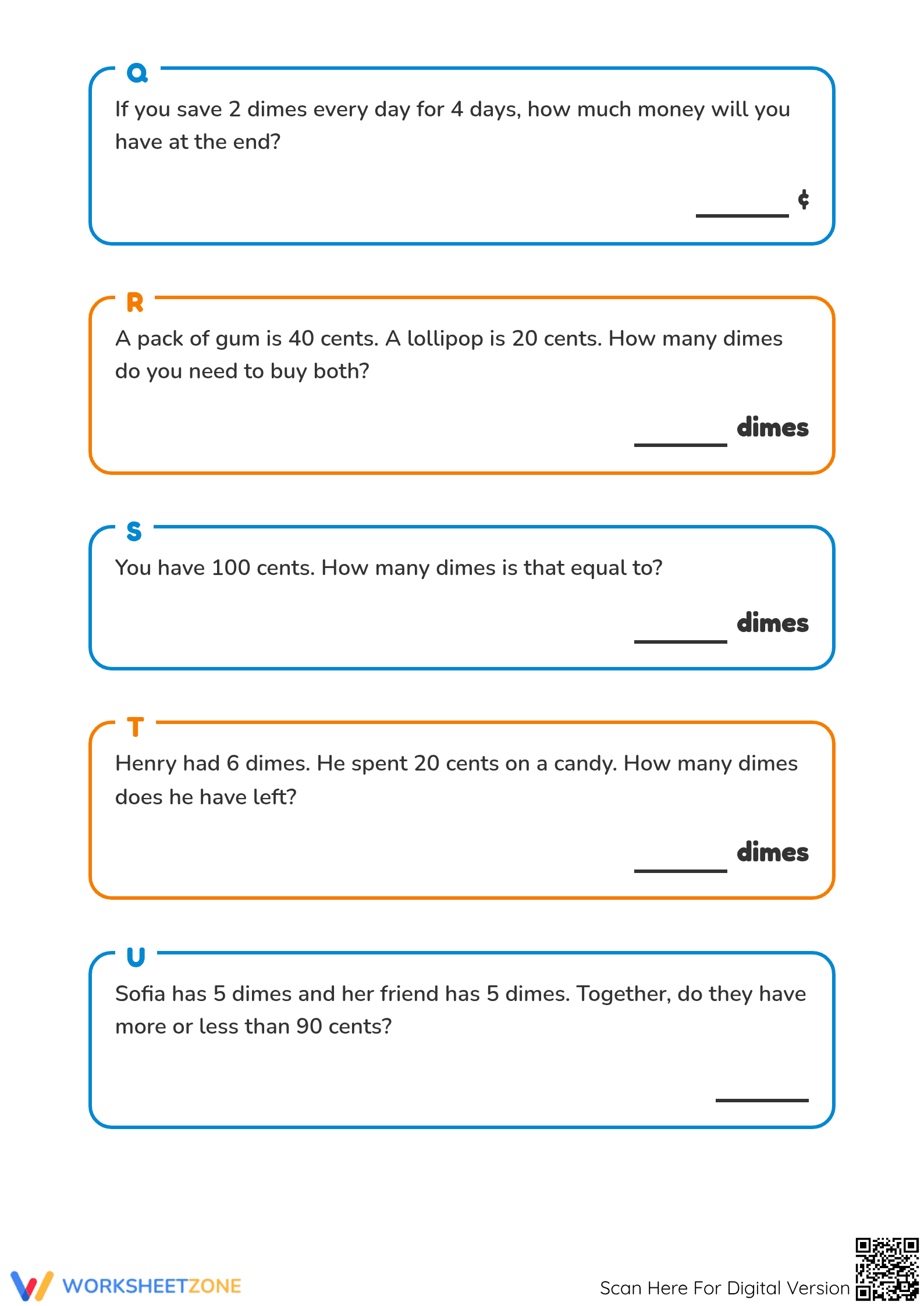
What's Inside: This five-page PDF resource contains 21 unique word problems labeled A through U. The first three pages focus on foundational addition and subtraction with dimes, while the final two pages provide a "Challenge Section" with multi-step logic and larger values. Each problem includes a dedicated answer line with either a cent symbol or the word "dimes" to ensure unit clarity. A complete five-page answer key is provided for immediate feedback.
Skill Progression
- Guided Practice: The first 6 problems (A-F) utilize simple scenarios like "getting dimes from papa" to establish the 1 dime = 10 cents relationship with direct addition.
- Supported Practice: Problems G-K introduce subtraction and comparison, asking students to determine "how many more" or find totals from a pile of 10 coins.
- Independent Practice: The Challenge Section (L-U) requires students to evaluate if they have "enough money" for an ice cream cone and solve multi-day saving scenarios.
This structure follows a gradual-release model, moving from basic computation to higher-order financial reasoning.
Standards Alignment
Primary Standard: `CCSS.MATH.CONTENT.2.MD.C.8` — Solve word problems involving dollar bills, quarters, dimes, nickels, and pennies, using $ and ¢ symbols appropriately. While this is a Grade 2 standard, it is commonly introduced in Grade 1 to build skip-counting proficiency. Both standard codes can be copied directly into lesson plans, IEP goals, or district curriculum mapping tools.
How to Use It
This worksheet is ideal for use during the "You Do" phase of a lesson on money or as a formative assessment after teaching skip-counting by tens. Teachers can observe students during the challenge section to identify who can transition from counting physical coins to abstract mental math. Expected completion time is 25 to 35 minutes depending on student reading level.
Who It's For
Designed for first-grade students or second-grade learners needing intervention, this resource supports diverse needs through clear, readable text and structured response boxes. It pairs naturally with plastic coin manipulatives or a classroom anchor chart displaying the heads and tails of a dime.
According to the RAND AIRS 2024 report, early exposure to structured word problems involving currency significantly improves a student's ability to apply algebraic thinking to everyday situations. This worksheet addresses that need by isolating the dime (10 cents), allowing students to master one coin's value before introducing the complexity of mixed-coin sets. By solving 21 distinct tasks, learners move beyond rote memorization of the standard CCSS.MATH.CONTENT.2.MD.C.8 and into functional application. The inclusion of a challenge section ensures that advanced learners are pushed toward evaluative thinking, such as determining sufficiency of funds. This resource provides the rigorous practice required for mastery in early elementary mathematics curriculum and serves as a reliable tool for tracking individual progress in IEP goal attainment.


