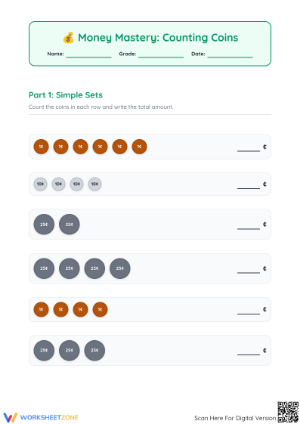
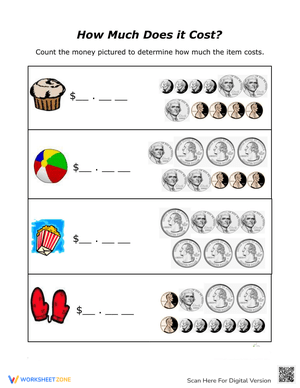
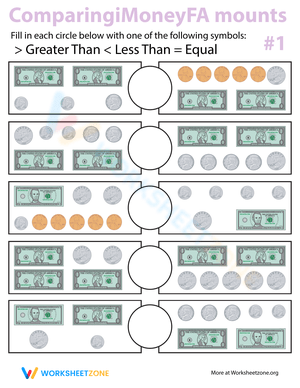
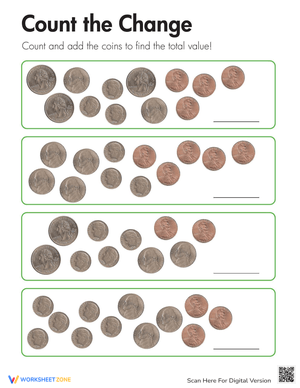
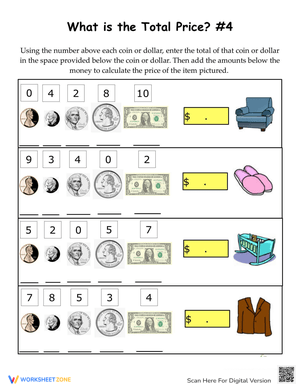
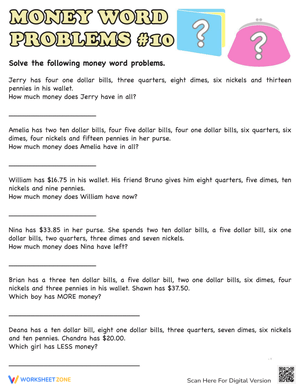
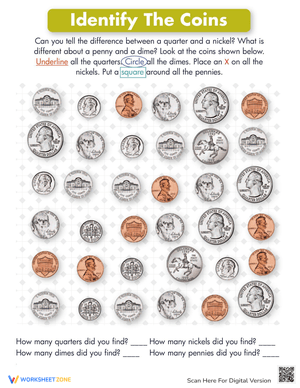
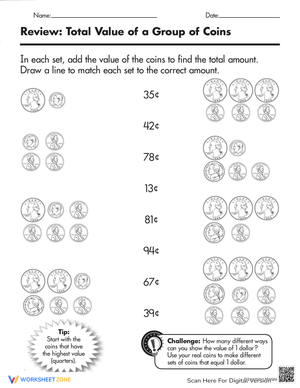
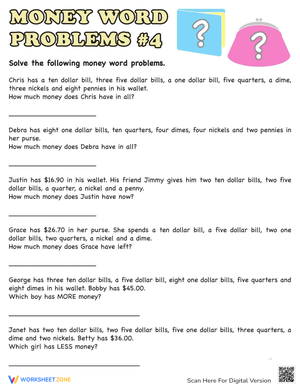
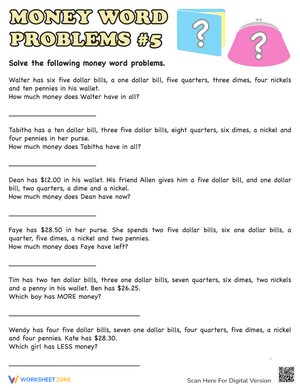
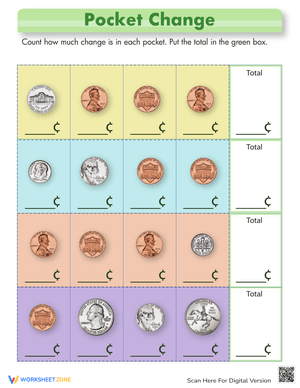
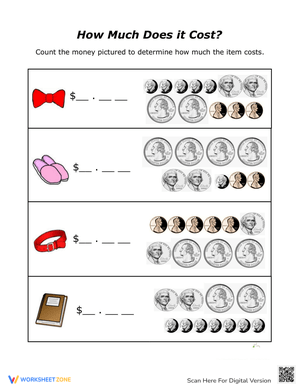
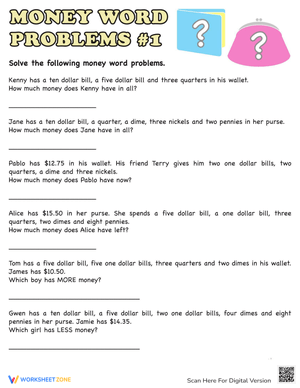
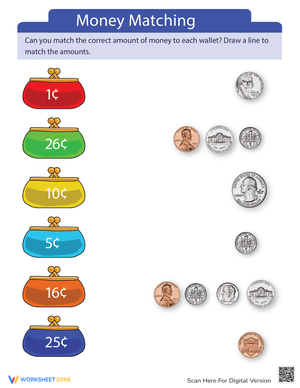
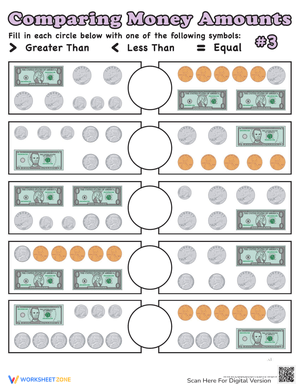
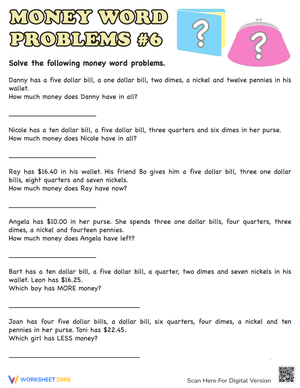
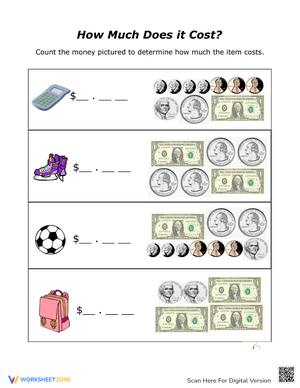
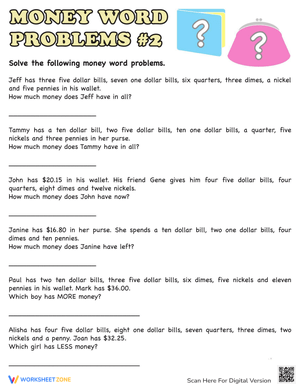
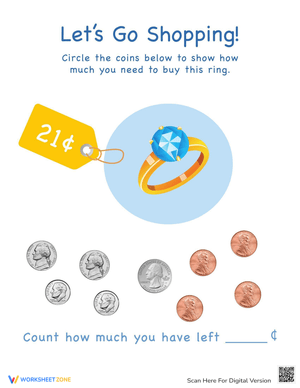
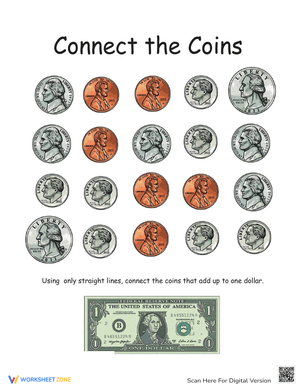
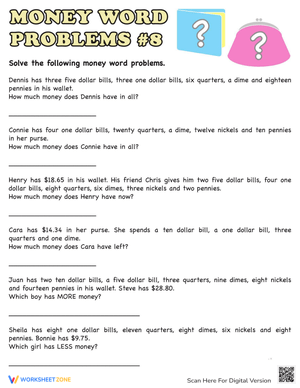
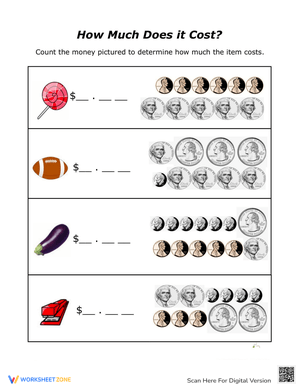
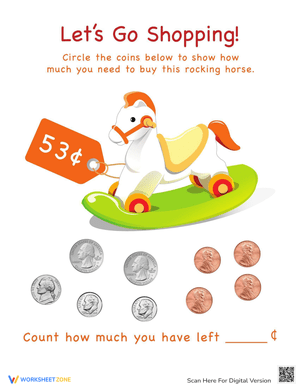
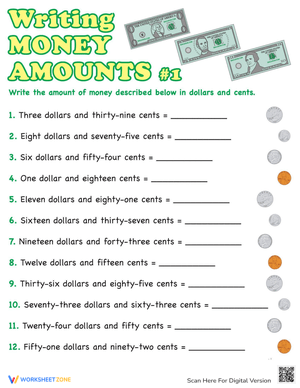
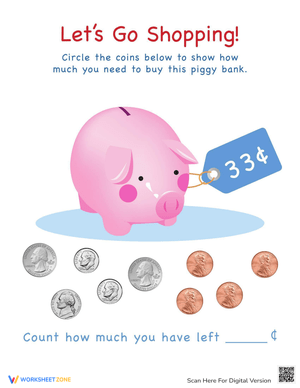
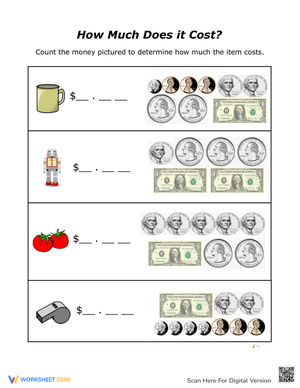
These quarters worksheets for 1st grade give teachers printable, focused activities built around one of the more deceptively demanding coins in early money math — a coin most first graders can pick out of a jar by instinct but still misvalue or swap with a nickel when working under time pressure. The set addresses visual identification, value recognition, side-by-side coin comparison, and introductory skip counting by twenty-fives, moving students from recognition toward confident application.
What Students Work Through Across the Set
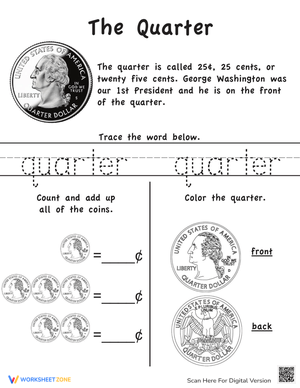
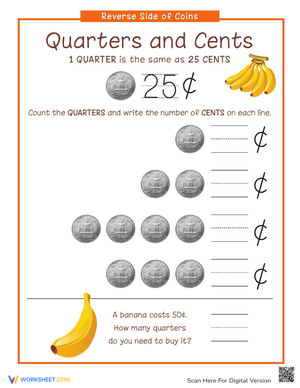
The activities stay tightly targeted on the skills that actually trip students up at this grade level. Students examine both sides of the quarter — noting Washington's profile on the obverse and observing that the reverse design varies widely, from the traditional eagle to state and national park commemorative images. They write and match the value 25¢, connect that numeral to the phrase twenty-five cents, and sort quarters out of mixed coin lineups featuring pennies, nickels, and dimes. Several worksheets address skip counting through the four-step sequence 25 — 50 — 75 — 100, using images of one through four quarters placed side by side so students can see the accumulation before they attempt the pattern on their own. One worksheet introduces the equivalency that four quarters equal one dollar, establishing a concept students will revisit formally in second grade.
Frequent Mistakes to Watch For and Correct
The quarter-nickel confusion is the most stubborn error pattern in first grade money math, and it is almost always a size problem, not a face problem. Students who correctly name Washington on the quarter will still grab a nickel during a timed sort because both coins are silver and both register as "big" against a dime or penny. The distinguishing detail that works most reliably is the edge: a quarter's reeded ridges are unmistakable against a nickel's smooth rim. These worksheets include zoomed-in edge diagrams and sorting tasks designed to force that comparison, but the real teaching moment comes when physical coins land in a student's hand. The ones who rely on color and general size get stuck; the ones who run a thumb across the rim find the quarter immediately.
A second recurring error involves the value itself. Twenty-five is a two-digit number that sits outside the familiar counting patterns of tens and fives, and many students default to writing 5¢ — borrowing the nickel's value because the two coins look related — or even 10¢, reaching for the next round number they know. Tracing, matching, and fill-in-the-blank tasks across multiple worksheets create the repetition that closes that gap; a single explanation almost never does.
Building These Worksheets Into Your Week
The quarters worksheets for 1st grade set works best alongside physical coins, not instead of them. A classroom sequence that holds up in practice: introduce the quarter with a real coin or plastic play money during a ten-minute whole-group lesson, use the identification worksheet as guided practice the same day, then pull a sorting or skip-counting worksheet as a warm-up or center task later in the week. The format prints on standard letter paper, so the worksheets drop straight into a math center folder without any additional prep.
The mystery bag activity pairs particularly well with the sorting worksheets. Fill a small opaque pouch with a mix of quarters, nickels, dimes, and pennies. Students reach in without looking and try to pull out only quarters by feel — reeded edge, larger diameter. When they sit down immediately after to complete the sorting worksheet, their tactile memory is fresh and accuracy climbs noticeably. This works especially well as a Monday warm-up after a weekend gap, when students need a quick sensory re-engagement before returning to pencil-and-paper tasks. During review, ask students to explain how they identified the coin rather than simply checking answers — that explanation is where the understanding actually lives.
Why Twenty-Five Cents Is Harder Than It Looks
Most coin values a first grader encounters are multiples of ten: a dime is 10¢, a dollar is 100¢. Even the nickel's 5¢ fits a familiar skip-counting rhythm. The quarter's 25¢ falls outside those patterns, which is why students can memorize the value verbally but hesitate the moment they need to write it or apply it in context. The cognitive load is real: a first grader is simultaneously managing the coin's appearance, a two-digit value that is not a decade number, and the translation from physical object to written symbol. Worksheets that keep the coin image, the numeral 25, and the written phrase twenty-five cents in the same visual frame reduce that load — eliminating the need to hold one representation in memory while processing another. That design choice reflects how working memory actually functions in early elementary learners, and it matters more for this coin than for any other in the standard first grade sequence.
Standard Alignment
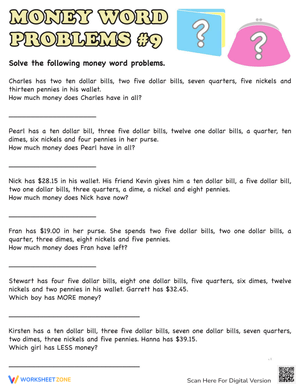
Coin recognition and value are not addressed in the Common Core State Standards until second grade, where 2.MD.C.8 asks students to solve word problems involving combinations of dollar bills, quarters, dimes, nickels, and pennies. Many state standards, however, introduce coin identification and basic value in first grade, and the quarters worksheets for 1st grade set fits that early-introduction window. Teachers in fully CCSS-aligned contexts will find these worksheets most useful as supplemental material and as a direct bridge into the second-grade standard — students who arrive at 2.MD.C.8 with solid quarter identification already in place can focus instructional time on the combination and word-problem work the standard actually requires, rather than backfilling basic coin knowledge.
Adjusting the Set for Different Student Levels
For students still sorting out the penny and nickel, the quarter needs context before isolation. Start those learners on the two-coin sorting worksheets — quarter against one other coin — before introducing the full four-coin lineup. Students who grasp identification quickly can move directly to the skip-counting and equivalency worksheets, or they can build the four-quarter-equals-one-dollar relationship with physical coins and record their reasoning in writing rather than circling answers. The quarters worksheets for 1st grade set spans enough difficulty — from single-coin identification to the 25-50-75-100 counting sequence — that teachers can assign different worksheets to different groups within the same class period without building a separate activity from scratch. For students who struggle with fine motor tasks, the coin-rubbing and tracing activities are lower-demand entry points that still reinforce the coin's shape and edge texture without requiring precise numeral formation.
Frequently Asked Questions
How do I help a student who keeps confusing the quarter and the nickel?
Start with the edge, not the face. Both coins are silver, and the nickel reads as "big" compared to a dime, so visual appearance alone does not resolve the confusion reliably. Have the student run a finger along the rim of each coin while naming it: reeded equals quarter, smooth equals nickel. That physical rule transfers to worksheet sorting tasks faster than visual comparison drills alone, and it holds up even when students encounter unfamiliar commemorative reverse designs they have not seen before.
Does the order in which coins are introduced matter?
Most first grade sequences move from pennies to nickels to dimes before the quarter, following either value order or frequency of classroom use. The quarter is actually easier to spot in a pile — its size and ridged edge make it distinctive — but its value is the hardest of the four to internalize because 25 sits outside the decade-number pattern. A reasonable approach: bring the quarter's appearance in early alongside other coins, but hold off on formal value work until students are writing and comparing two-digit numbers with some confidence.
Can these worksheets work for second graders who are behind on coin identification?
Yes. The identification and sorting activities are straightforward enough to serve as remediation for second graders who did not consolidate coin recognition the previous year. Those students will move through the simpler identification worksheets quickly and reach the skip-counting and equivalency content — which aligns directly with 2.MD.C.8 — without requiring modification of the materials.













 Interactive Worksheet Maker
 Quiz Maker
 Word Search Maker
 Crossword Puzzle Maker
 Word Scramble Generator
 Sentence Scramble Generator
 Handwriting Worksheet Generator
 Name Tracing Generator
 Fill In The Blank Generator