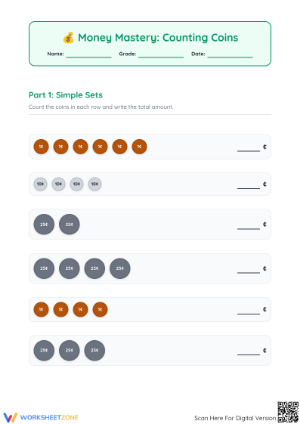
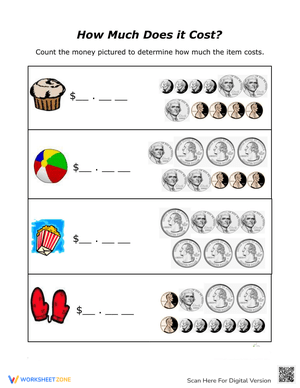
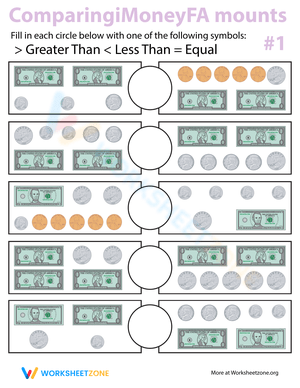
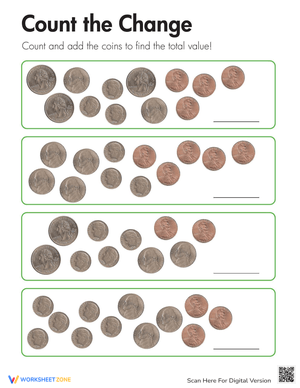
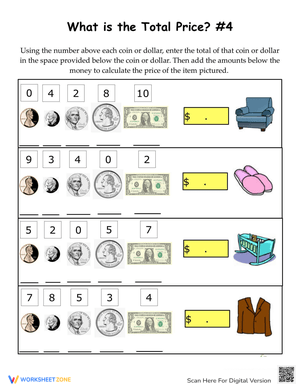
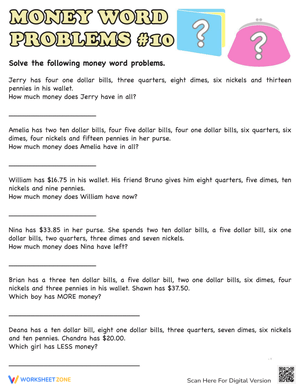
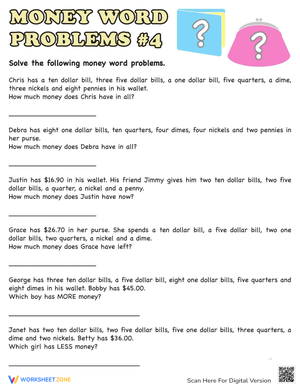
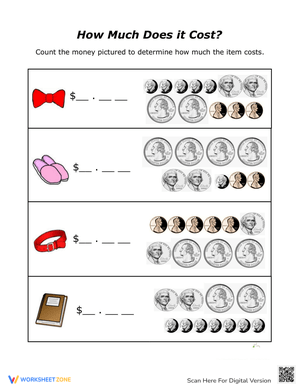
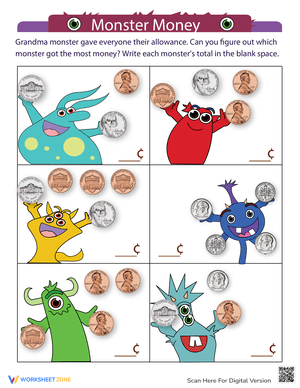
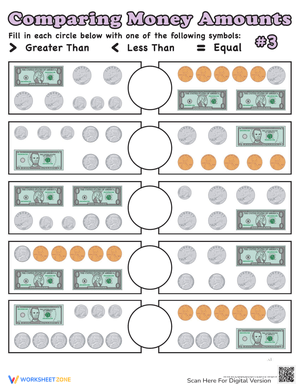
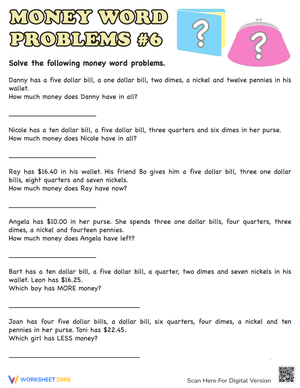
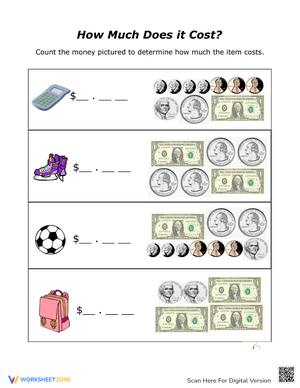
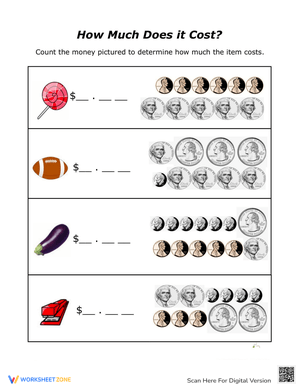
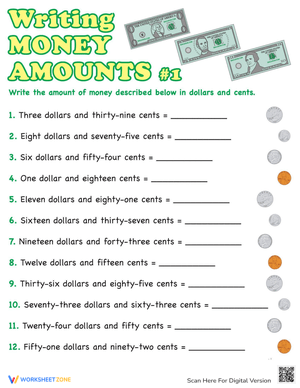
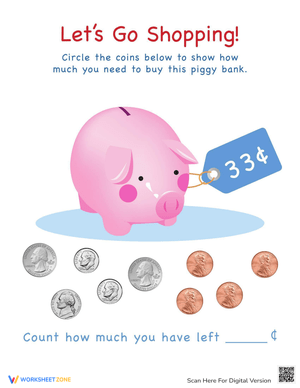
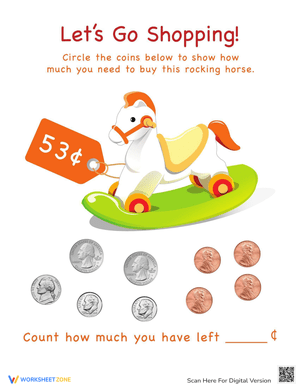
These 1st grade nickels printable worksheets resources give teachers a focused practice set for the moment when coin work moves beyond simple penny identification into the trickier territory of value equivalence and skip counting by fives. The set covers visual recognition, coin comparison, cent notation, and counting groups of nickels — each worksheet targeting a distinct layer of the concept so teachers can assign them in sequence or pull individual ones for targeted review.
What Each Worksheet Covers
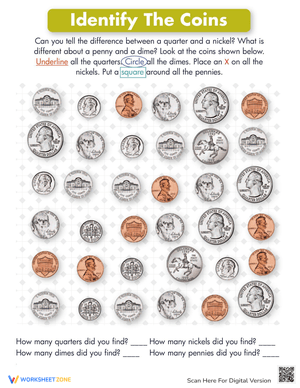
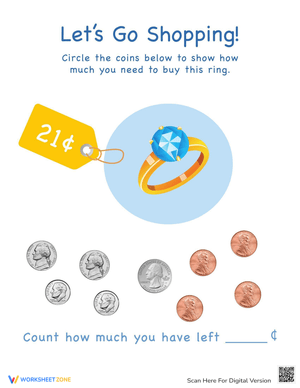
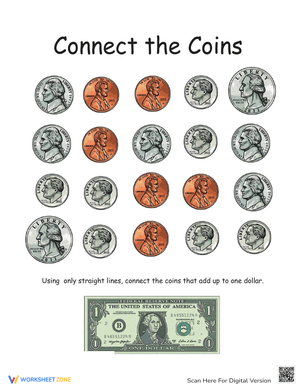
The worksheets address five distinct skill areas. Early worksheets ask students to identify and circle nickels among mixed-coin arrays, reinforcing the visual features that set the nickel apart: Jefferson's portrait on the obverse, Monticello on the reverse, and — critically — the coin's smooth, unridged edge. Later worksheets move into value work, asking students to draw the equivalent number of pennies for a given number of nickels, then write the total in cents using the ¢ symbol. The final worksheets in the progression have students count rows of nickels and record running totals, building the 5-10-15-20 rhythm that will reappear when they read a clock face later in the year.
- Identifying nickels in mixed-coin arrays by portrait, reverse design, and edge
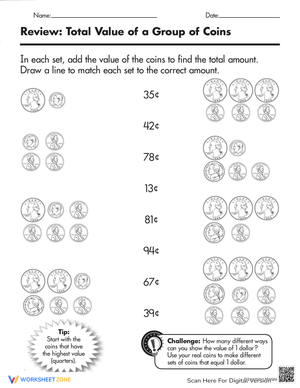
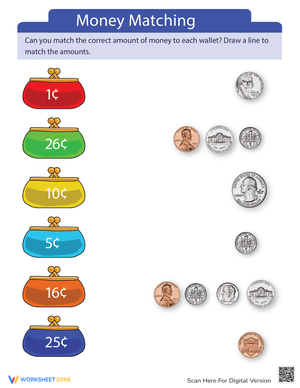
- Matching nickel images to cent values (5¢, 10¢, 15¢, 20¢)
- Drawing penny equivalents for a given set of nickels
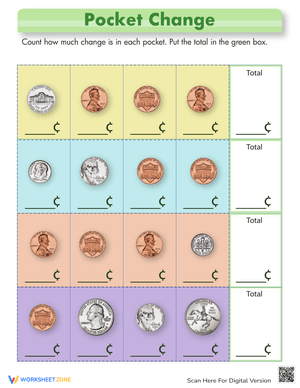
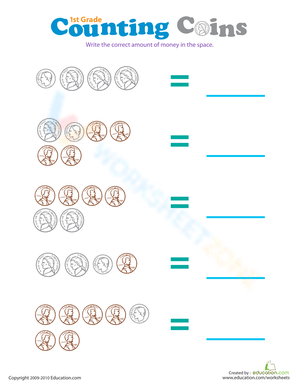
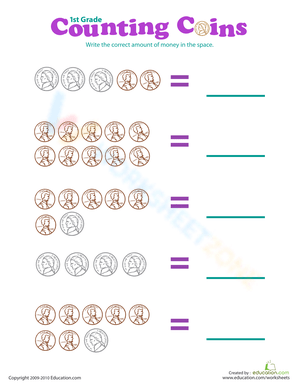
- Counting groups of nickels and writing the total in cents
- Side-by-side comparison of nickel and quarter features
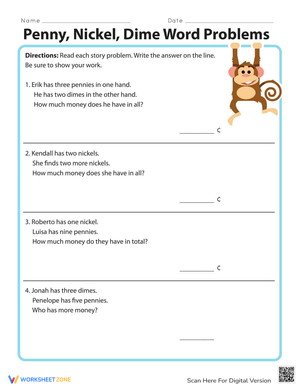
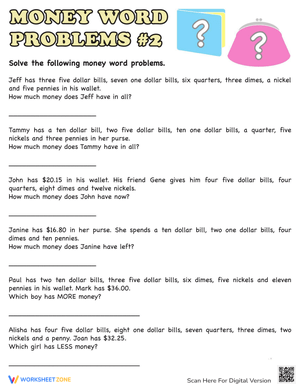
- Simple word problems with nickel totals under 25¢
Mistakes Students Make That These Worksheets Help You Catch
Two confusions come up constantly in 1st grade coin work. The first is nickel-quarter: both are silver, both carry a president's portrait, and on a printed worksheet both can look large relative to the dime. Students who conflate the two are usually relying on color alone, having learned that "the copper one is a penny" without internalizing any other distinguishing markers. The side-by-side comparison worksheet addresses this directly by pairing a nickel and a quarter at the same printed size and prompting students to annotate the edge difference — smooth versus ridged.
The second confusion catches more teachers off guard: students who correctly identify a nickel still write its value as "5" rather than "5¢." This looks like a notation slip, but it usually signals that the student hasn't fully grasped that cents are a unit distinct from counting numbers. The worksheets include a guided section where students practice writing both "5 cents" and "5¢" in response to the same coin image, and the word problem format forces them to specify units in their answers. There's also the dime problem — students who learned that the small silver coin is a dime sometimes generalize that all small silver coins are dimes and assign dime value to the nickel. Seeing both coins labeled explicitly on the comparison worksheet typically resolves this within a single session.
Working These Worksheets Into Your Weekly Lesson Plan
The identification and comparison worksheets work well at the start of a money unit, run as a five-minute warm-up after morning meeting. Students who already know their coins move through them quickly; students who are still uncertain get low-stakes repetition before the lesson proper begins. The skip-counting worksheets are better placed mid-unit, once students have the 5-times sequence in short-term memory from number-line work — pairing skip counting by fives with a concrete coin context deepens retention more than either activity does alone.
These 1st grade nickels printable worksheets pages also function well as exit tickets at the end of a whole-group coin lesson. A single counting worksheet — five nickels, write the total — takes about three minutes and gives the teacher a clear read on who is ready to move to mixed-coin work and who needs another day with nickels alone. For math centers, the matching and penny-equivalence worksheets run with minimal setup and no direct supervision, which matters when the teacher is occupied with a small group across the room.
Standard Alignment
CCSS.MATH.CONTENT.1.MD.B.3 requires first graders to tell and write time and to work with money — specifically, to count and compare coins including pennies, nickels, dimes, and quarters, representing each denomination in terms of cents. The nickel worksheets address this standard by building coin recognition before layering in cent values and then skip-counting application. In practical terms, most teachers hit this standard in two separate instructional windows: a brief coin-identification block in early fall and a deeper money unit in late winter, when students have enough skip-counting fluency to handle coin-counting demands without the procedure itself overloading working memory.
Adapting the Worksheets Across Ability Levels
For students still uncertain which coin is which, the identification worksheets can be paired with a real nickel taped to the corner of the desk — not as a shortcut but as a reference. Touching the smooth edge while looking at the printed image builds a sensory-visual connection that printed materials alone don't create. Students who have already mastered nickel identification and skip counting by fives get genuine extension from the word problem worksheets when asked to represent the same totals using different coin combinations, which requires actual problem-solving rather than repeating a mastered procedure.
Students who work above grade level sometimes hit an interesting ceiling here: they count nickels fluently but stumble when a word problem asks them to write the same amount two ways — once in cents and once in dollar-decimal format ($0.05 per nickel). That's above the 1st grade standard, but it surfaces naturally with students who are ready for it and gives teachers a meaningful extension without requiring entirely separate materials.
Frequently Asked Questions
Do students need to know the dime before working on nickels?
Not necessarily, but introducing the dime alongside the nickel — rather than after it — prevents a persistent confusion: students who learn the nickel in isolation sometimes construct a mental rule that "the big silver coin is worth five cents," which breaks down the moment the dime appears. These 1st grade nickels printable worksheets materials include the dime on comparison pages specifically so teachers can address the size-value inversion early. The dime is smaller than the nickel but worth twice as much — a counter-intuitive relationship that is far easier to address before it hardens into a fixed misconception.
How many nickels should a student count fluently before moving to mixed-coin sets?
A workable benchmark is confident counting of up to ten nickels — reaching 50¢ — before introducing mixed arrays. Students who can't yet hold the skip-count rhythm steady through ten coins will lose track quickly once pennies or dimes enter the picture. The skip-counting worksheets in this set top out at eight nickels, which is enough to confirm fluency without overloading working memory for students still consolidating the pattern.
Are these worksheets useful in kindergarten or 2nd grade?
The identification and matching worksheets work in kindergarten as an introduction, though the skip-counting and word problem worksheets assume a level of number fluency most kindergarteners haven't yet developed. In 2nd grade, these 1st grade nickels printable worksheets activities serve well as a diagnostic at the start of a money unit — a quick way to identify students who remain shaky on nickel recognition or cent notation before the class moves into mixed-coin counting and making change.













 Interactive Worksheet Maker
 Quiz Maker
 Word Search Maker
 Crossword Puzzle Maker
 Word Scramble Generator
 Sentence Scramble Generator
 Handwriting Worksheet Generator
 Name Tracing Generator
 Fill In The Blank Generator