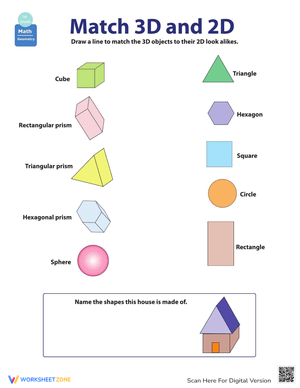
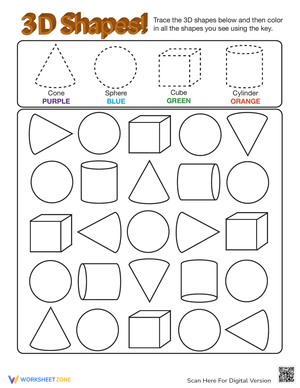
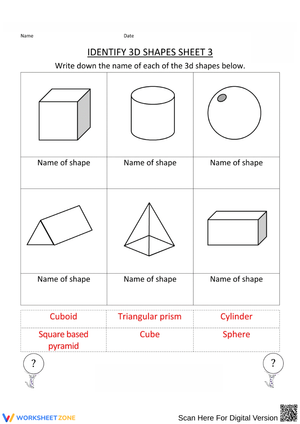
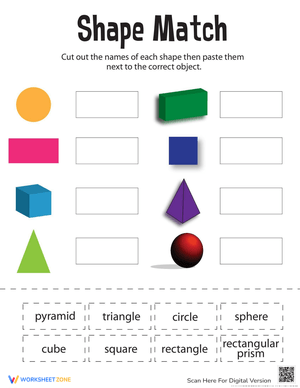
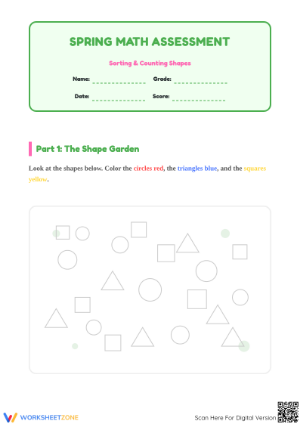
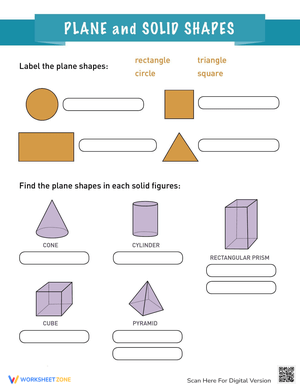
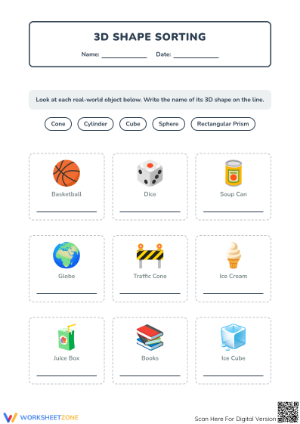
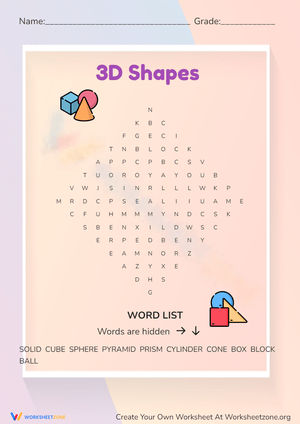
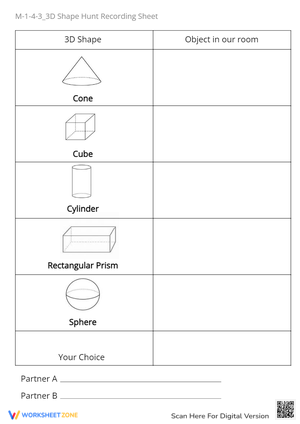
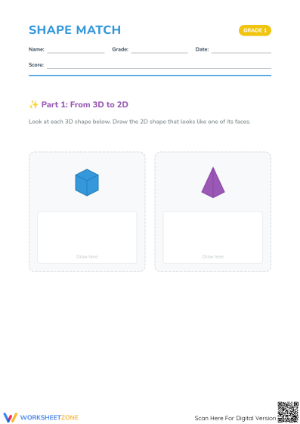
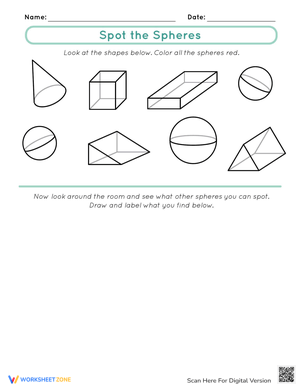
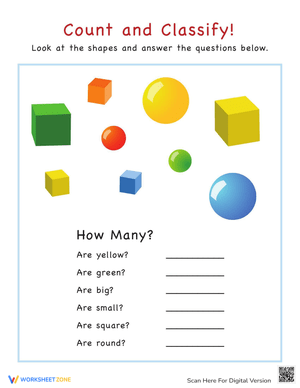
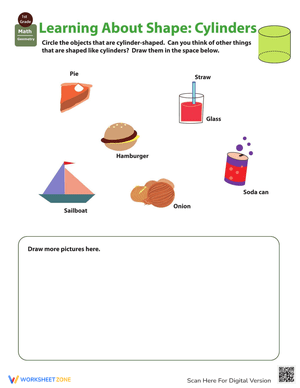
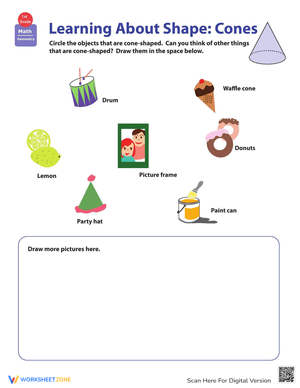
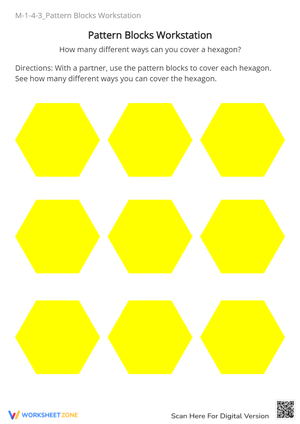
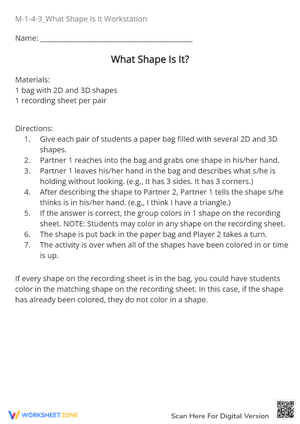
1st grade 3d shapes pdf worksheets give teachers a print-ready path from whole-group instruction to independent practice with cube, sphere, cone, and cylinder — the four solid shapes that anchor Grade 1 geometry. Each worksheet in this set targets a distinct skill: identifying shapes by name, matching solids to real-world objects, sorting by shape type, and marking attributes like "rolls" or "has flat sides." Teachers get visually focused practice pages that go directly into morning work folders, sub plans, or small-group intervention binders without any additional setup.
The Specific Skills Each Worksheet Builds
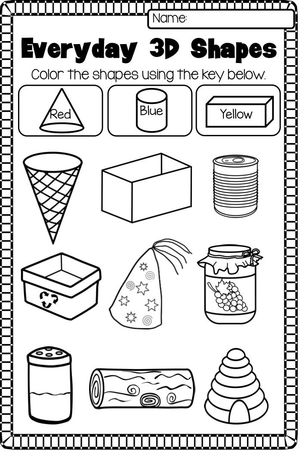
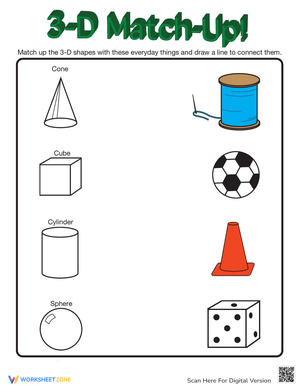
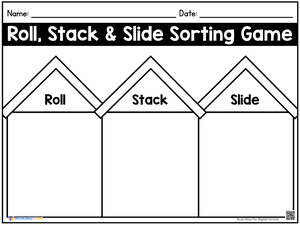
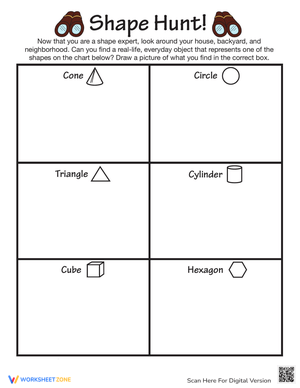
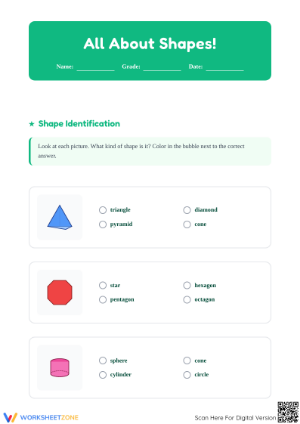
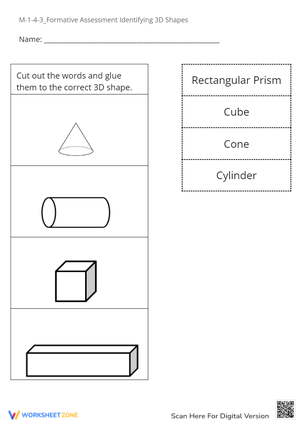
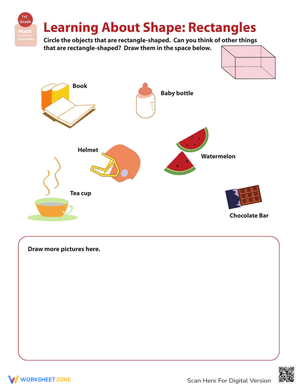
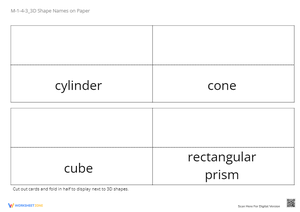
The tasks across this set move students through the full recognition sequence that Grade 1 geometry requires. Some worksheets ask students to circle the correct shape name beneath a picture. Others present a row of everyday objects — a tissue box, a tennis ball, a soup can, a party hat — and ask students to write or match the shape each one represents. Sorting worksheets have students cut and paste a mixed set of images into four labeled columns. A few shorter worksheets function as exit checks: four to six items that show whether students have locked in the shape names before moving forward.
- Shape identification: students look at a solid and select or write cube, sphere, cone, or cylinder
- Real-world matching: students draw a line from a common object to the 3D shape it represents
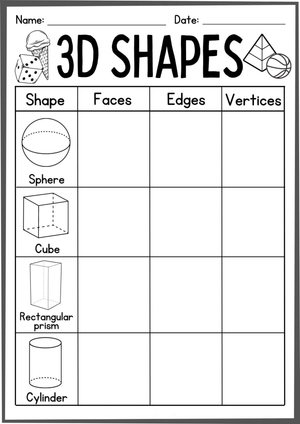
- Attribute sorting: students mark shapes that roll, shapes with flat faces, or shapes that stack
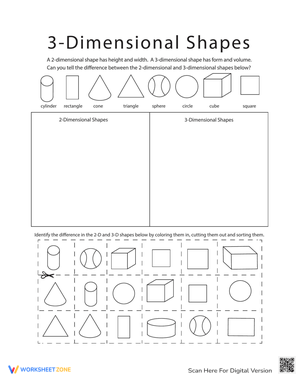
- Cut-and-paste categorizing: students physically place images into shape groups before gluing
- Exit checks: brief four- to six-item reviews used to identify who still confuses specific pairs
Why This Format Works for This Skill at This Age
Six-year-olds build geometric understanding through perceptual comparison — they need to see a sphere next to a cylinder and notice the difference before a label sticks. Worksheets do their best work here when they follow hands-on exploration rather than replace it. After students have passed around a foam cube and a plastic cylinder and described what they noticed, a matching worksheet gives them a way to organize that observation on paper. Drawing a line from "soup can" to "cylinder" reinforces the connection made during handling, which is a fundamentally different cognitive operation than memorizing a definition cold.
The visual format also reduces the language load that can derail early geometry lessons. Students who are still building math vocabulary do not have to produce a sentence; they underline, circle, or sort. That keeps the focus on shape recognition rather than language production, and it lets teachers read geometry understanding more cleanly in the finished work.
Mistakes Students Make That These Worksheets Help You Catch
The most persistent error at this level is 2D/3D confusion, and it follows a predictable pattern. A student who correctly identifies a flat circle on a sorting page will often label a sphere a "circle" on the next page — because the sphere looks circular when drawn in profile. The same transfer problem appears with cones labeled as "triangles" and cylinders labeled as "rectangles." This is not carelessness; students are applying the 2D category knowledge they already own to a context where it does not quite fit. Worksheets that pair a drawn solid with a photo of the real-world object are especially useful for catching this — if a student marks a tennis ball as a "circle," you know immediately where the instruction gap sits.
A secondary error worth watching: students frequently confuse cube and sphere when the task is attribute-based rather than name-based. Asked to mark "shapes that roll," some students select the cube because "it can fall over," reasoning from physical experience rather than geometric property. These are exactly the conversations worth surfacing during a quick small-group debrief after the worksheet is collected.
Smart Ways to Work These Worksheets Into Your Week
These worksheets fit into the transitions that already exist in a Grade 1 math block. A single identification page works well as the settling task at the start of math time — students know immediately what to do, which means the first five minutes of the block do not require teacher management. Exit checks take two to three minutes at the end of a lesson and produce cleaner data than a thumbs-up/thumbs-down check because you can see exactly which shapes a student is confusing.
For math centers, pair one sorting or matching worksheet with a small basket of classroom objects — a glue stick, an eraser block, a ball, a crayon. Students complete the worksheet, then physically verify their answers by picking up each object and checking whether it rolls or stacks. That verification step, which takes under two minutes, addresses the attribute confusion that paper tasks alone sometimes miss. The 1st grade 3d shapes pdf worksheets in this set print cleanly at standard letter size and fit in dry-erase sleeves for repeated center use across the geometry unit.
Adjusting the Set for a Range of Learners
Students who are still working on shape names benefit from keeping two shapes in focus at a time rather than all four. Start with sphere and cube — they are perceptually distinct and map clearly to familiar objects. Once those two are secure, introduce cylinder, then cone. Spending two worksheets per pair before moving forward is more effective than cycling through all four shapes on the first day and revisiting blurred names later.
For students who have the four names locked and need more challenge, the attribute-based worksheets are the right next step. Instead of identifying a cylinder by name, they mark whether it rolls, count its flat faces, and find two classroom objects that match. Some students at this level can also be asked to write one sentence explaining how they know a shape is a cube — that constraint surfaces the difference between visual recognition and actual attribute understanding. Students who need a different response mode entirely do better with cut-and-paste pages, which let them position images before committing to a final placement rather than circling or writing under pressure.
Standard Alignment
These 1st grade 3d shapes pdf worksheets align with CCSS 1.G.A.1, which asks Grade 1 students to distinguish between defining and non-defining attributes of shapes and to identify shapes by those attributes. In classroom terms, this is the standard where instruction shifts from "does this look like a box?" to "what makes a cube a cube?" — the move from purely visual recognition to attribute-based identification. The attribute-sorting and exit-check worksheets in this set directly address that progression. Note that some of the real-world matching tasks also reinforce K.G.A.3 for classes where students are consolidating kindergarten 3D shape knowledge at the start of first grade.
Frequently Asked Questions
Which 3D shapes are covered across the set?
Every worksheet focuses on cube, sphere, cone, and cylinder — the four shapes specified in Grade 1 geometry instruction. No additional solids are introduced, which keeps the cognitive demand appropriate for students working through this standard for the first time.
Can these pages be reused in centers with dry-erase sleeves?
Yes. The clean layouts print clearly at standard letter size and slide into dry-erase sleeves without trimming. Students mark answers with a dry-erase marker and wipe the page between rotations. This works especially well for identification and matching worksheets, where students circle or draw lines rather than cut and paste.
What if my students haven't handled real 3D objects yet before using these?
Run a five-minute exploration first — set out one example of each shape and let students handle and describe them before picking up a pencil. The 1st grade 3d shapes pdf worksheets are built to follow that kind of concrete introduction, not replace it. Students who go straight from a cold start to the paper task will complete it more slowly and with more guessing, and the data you collect will reflect confusion rather than actual understanding.
Are answer keys included?
Yes. Each worksheet has a corresponding answer key formatted for quick review during center rotations or after collection. This makes the set workable for sub plans without requiring a substitute to make judgment calls about student responses.













 Interactive Worksheet Maker
 Quiz Maker
 Word Search Maker
 Crossword Puzzle Maker
 Word Scramble Generator
 Sentence Scramble Generator
 Handwriting Worksheet Generator
 Name Tracing Generator
 Fill In The Blank Generator